PRESS-NEWS.org - Press Release Distribution
PRESS RELEASES DISTRIBUTION

Cosmic forecast: Dark clouds will give way to sunshine

Cosmic forecast: Dark clouds will give way to sunshine
2014-09-03
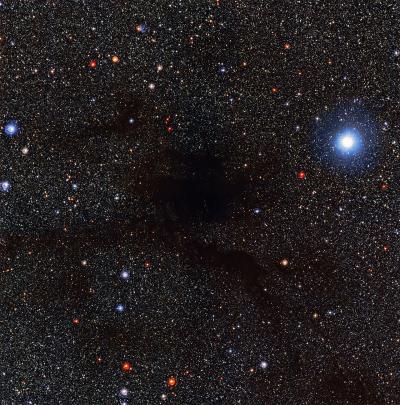
(Press-News.org) Lupus 4 is located about 400 light-years away from Earth, straddling the constellations of Lupus (The Wolf) and Norma (The Carpenter's Square). The cloud is one of several affiliated dark clouds found in a loose star cluster called the Scorpius–Centaurus OB association. An OB association is a relatively young, yet widely dispersed grouping of stars [1]. The stars likely had a common origin in a gigantic cloud of material.

Because the association, and its Lupus clouds, form the closest such grouping to the Sun, they are a prime target for studying how stars grow up together before going their separate ways. The Sun, along with most stars in our galaxy, is thought to have started out in a similar environment.

American astronomer Edward Emerson Barnard is credited with the earliest descriptions of the Lupus dark clouds in the astronomical literature, back in 1927. Lupus 3, neighbour to Lupus 4, is the best studied, thanks to the presence of at least 40 fledgling stars formed over the last three million years, and which are on the cusp of igniting their fusion furnaces (eso1303). The main energy source in these adolescent stars, known as T Tauri stars, is the heat generated by their gravitational contraction. That is in contrast to the fusion of hydrogen and other elements which powers mature stars such as the Sun.

Observations of the cold darkness of Lupus 4 have turned up only a few T Tauri stars. Yet promisingly for Lupus 4 in terms of future star formation is a dense, starless core of material in the cloud. Given a few million years, that core should develop into T Tauri stars. Comparing Lupus 3 and Lupus 4 in this way suggests that the former is older than the latter, because its contents have had more time to develop into stars.

How many stars might eventually start to shine within Lupus 4? It is hard to say, as mass estimates for Lupus 4 vary. Two studies agree on a figure of around 250 times the mass of the Sun, though another, using a different method, arrives at a figure of around 1600 solar masses. Either way, the cloud contains ample material to give rise to plenty of bright new stars. Rather as earthly clouds make way for sunshine, so, too, shall this cosmic dark cloud eventually dissipate and give way to brilliant starlight.

INFORMATION: Notes

[1] The "OB" refers to the hot, bright, short-lived stars of spectral types O and B that are still shining brilliantly within the widely dispersed cluster as it travels through the Milky Way galaxy.

Links

Photos of the MPG/ESO 2.2-metre telescope: http://www.eso.org/public/images/archive/search/?adv=&subject_name=mpg

Other photos taken with the MPG/ESO 2.2-metre telescope: http://www.eso.org/public/images/archive/search/?adv=&facility=15

Photos of La Silla: http://www.eso.org/public/images/archive/category/lasilla/

Contacts

Richard Hook
ESO education and Public Outreach Department
Garching bei München, Germany
Tel: +49 89 3200 6655
Cell: +49 151 1537 3591
Email: rhook@eso.org

[Attachments] See images for this press release:
Cosmic forecast: Dark clouds will give way to sunshine

ELSE PRESS RELEASES FROM THIS DATE:

Scientists discover how to 'switch off' autoimmune diseases

Scientists discover how to switch off autoimmune diseases
2014-09-03
Scientists have made an important breakthrough in the fight against debilitating autoimmune diseases such as multiple sclerosis by revealing how to stop cells attacking healthy body tissue. Rather than the body's immune system destroying its own tissue by mistake, researchers at the University of Bristol have discovered how cells convert from being aggressive to actually protecting against disease. The study, funded by the Wellcome Trust, is published today [03 September] in Nature Communications. It's hoped this latest insight will lead to the widespread use of antigen-specific ...

Unplanned births out-of-hospital increases risk of infant mortality

Unplanned births out-of-hospital increases risk of infant mortality
2014-09-03
New research reveals that unplanned births out-of-hospital in Norway are associated with higher infant mortality. The findings published in Acta Obstetricia et Gynecologica Scandinavica, a journal of the Nordic Federation of Societies of Obstetrics and Gynecology, indicate that young women who have given birth at least once before (multiparous) and those living in remote areas are more likely to have unplanned deliveries, which may increase the risk of death in newborns. In 2013, close to 60,000 babies were born in Norway according to the Statistics Norway. The country ...

Around 1 in 10 UK women has dry eye disease, requiring artificial tears

2014-09-03
The symptoms of dry eye disease include the sensation of grit in the eye, frequently accompanied by itching, burning and visual disturbance. The causes are poorly understood. The researchers base their findings on almost 4000 women aged 20 to 87 (average age 57) from the TwinsUK cohort, drawn from the registry held at St Thomas' Hospital in London. This cohort is widely regarded as representative of the UK general population, and has been used to look at a wide range of diseases and genetic traits over the years. The prevalence of dry eye disease, and the frequency and ...

Stillbirth gap closing between indigenous and non-indigenous women, shows Australian study

2014-09-03
The gap in stillbirth rates between indigenous and non-indigenous women in Queensland, Australia, is closing, however indigenous women are still at risk of stillbirth due to preventable causes, find researchers in a new study published today (3 September) in BJOG: An International Journal of Obstetrics and Gynaecology (BJOG). The Australian study used data from the Queensland Perinatal Data Collection and looked at 881,211 singleton births from 1995 to 2011. It aimed to assess the differences in stillbirth rates over time among indigenous (Australian Aboriginal and Torres ...

Estrogen increases cannabis sensitivity

Estrogen increases cannabis sensitivity
2014-09-03
PULLMAN, Wash. - Smoking today's concentrated pot might be risky business for women, according to new research from Washington State University. The study is the first to demonstrate sex differences in the development of tolerance to THC. Psychology professor Rebecca Craft showed that, thanks to their estrogen levels, female rats are at least 30 percent more sensitive than males to the pain-relieving qualities of THC—the key active ingredient in cannabis. Females also develop tolerance to THC more quickly. These sensitivities could increase vulnerability to negative ...

Discharged patients return to the ER because 'better safe than sorry'

2014-09-02
WASHINGTON – Patients who return to the emergency department within a few days of discharge do so principally because they are anxious about their symptoms and have lost trust in other parts of the health care system, according to the results of a study published online today in Annals of Emergency Medicine ("Return Visits to the Emergency Department: The Patient Perspective"). "When asked why they did not follow up as an outpatient, patients reported feeling that their symptoms were too severe to wait until their scheduled appointment or being instructed to return ...

NASA satellites calling here you come again, Tropical Storm Dolly

NASA satellites calling here you come again, Tropical Storm Dolly
2014-09-02
Tropical Storm Dolly visited Mexico six years ago, and NASA satellite data is calling "Here you come again," reminiscent of the famous country singer's hit song, as another storm named Dolly heads for a second landfall in Mexico. In July of 2008, Tropical Storm Dolly made landfall on Mexico's Yucatan Peninsula of Mexico before making a second and final landfall in south Texas. Now, six years later, Tropical Storm Dolly returns thanks to the six year list of revolving hurricane names, and once again Dolly is making landfall in eastern Mexico. NASA's Aqua satellite caught ...

Residency training predicts physicians' ability to practice conservatively

2014-09-02
LEBANON, NH – Doctors trained in locations with less intensive (and expensive) practice patterns appear to consistently be better at making clinical decisions that spare patients unnecessary and excessive medical care, according to a new study in JAMA Internal Medicine. "Growing concern about the costs and harms of medical care has spurred interest in assessing physicians' ability to avoid the provision of unnecessary care," said lead author Brenda Sirovich of the VA Outcomes Group and The Dartmouth Institute for Health Policy & Clinical Practice. Sirovich and colleagues ...

Experiences make you happier than possessions -- Before and after

2014-09-02
To get the most enjoyment out of our dollar, science tells us to focus our discretionary spending on experiences such as travel over material goods. A new Cornell University study shows that the enjoyment we derive from experiential purchases may begin even before we buy. This research offers important information for individual consumers who are trying to "decide on the right mix of material and experiential consumption for maximizing well-being," said psychology researcher and study author Thomas Gilovich of Cornell University. Previously, Gilovich and colleagues ...

Diabetes mellitus and mild cognitive impairment: Higher risk in middle age?

2014-09-02
Essen, Germany, September 2, 2014 – In a large population-based study of randomly selected participants in Germany, researchers found that mild cognitive impairment (MCI) occurred twice more often in individuals diagnosed with diabetes mellitus type 2. Interestingly, this strong association was only observed in middle-aged participants (50-65 years), whereas in older participants (66-80 years) the association vanished. This study is published in the Journal of Alzheimer's Disease. The concept of MCI describes an intermediate state between normal cognitive aging and dementia. ...

LAST 30 PRESS RELEASES:

How do health care professionals determine eligibility for MAiD?

Microplastics detected in rural woodland 

JULAC and Taylor & Francis sign open access agreement to boost the impact of Hong Kong research

Protecting older male athletes’ heart health 

KAIST proposes AI-driven strategy to solve long-standing mystery of gene function

Eye for trouble: Automated counting for chromosome issues under the microscope

The vast majority of US rivers lack any protections from human activities, new research finds

Ultrasound-responsive in situ antigen "nanocatchers" open a new paradigm for personalized tumor immunotherapy

Environmental “superbugs” in our rivers and soils: new one health review warns of growing antimicrobial resistance crisis

Triple threat in greenhouse farming: how heavy metals, microplastics, and antibiotic resistance genes unite to challenge sustainable food production

Earthworms turn manure into a powerful tool against antibiotic resistance

AI turns water into an early warning network for hidden biological pollutants

Hidden hotspots on “green” plastics: biodegradable and conventional plastics shape very different antibiotic resistance risks in river microbiomes

Engineered biochar enzyme system clears toxic phenolic acids and restores pepper seed germination in continuous cropping soils

Retail therapy fail? Online shopping linked to stress, says study

How well-meaning allies can increase stress for marginalized people

Commercially viable biomanufacturing: designer yeast turns sugar into lucrative chemical 3-HP

Control valve discovered in gut’s plumbing system

George Mason University leads phase 2 clinical trial for pill to help maintain weight loss after GLP-1s

Hop to it: research from Shedd Aquarium tracks conch movement to set new conservation guidance

Weight loss drugs and bariatric surgery improve the body’s fat ‘balance:’ study

The Age of Fishes began with mass death

TB harnesses part of immune defense system to cause infection

Important new source of oxidation in the atmosphere found

A tug-of-war explains a decades-old question about how bacteria swim

Strengthened immune defense against cancer

Engineering the development of the pancreas

The Journal of Nuclear Medicine ahead-of-print tip sheet: Jan. 9, 2026

Mount Sinai researchers help create largest immune cell atlas of bone marrow in multiple myeloma patients

Why it is so hard to get started on an unpleasant task: Scientists identify a “motivation brake”

[Press-News.org] Cosmic forecast: Dark clouds will give way to sunshine