PRESS-NEWS.org - Press Release Distribution
PRESS RELEASES DISTRIBUTION

NASA's HS3 mission covers transition of Hurricane Cristobal

NASA's HS3 mission covers transition of Hurricane Cristobal
2014-09-16
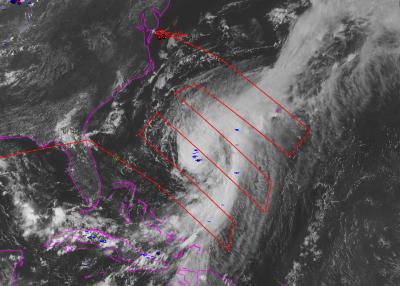
(Press-News.org) NASA's Global Hawk 872 aircraft flew over Hurricane Cristobal on August 28 and 29 and gathered data on the storm as it was becoming extra-tropical.

NASA's airborne Hurricane and Severe Storm Sentinel, or HS3, mission kicked off on August 26 when one of the remotely piloted Global Hawk aircraft flew a "lawnmower" or back and forth pattern over Hurricane Cristobal while gathering data using dropsondes and two other instruments. The Global Hawk dropped 81 dropsondes over Cristobal. A dropsonde is a device that measures winds, temperature, pressure and humidity as it falls from the aircraft to the surface.

The Global Hawk flew a second mission over Cristobal over August 28 and 29 and dropped sondes over the storm when it was becoming extra-tropical.

A conversion to an "extra tropical" storm means that the tropical low pressure system eventually loses its warm core and becomes a cold-core system. During the time it is becoming extra-tropical the cyclone's primary energy source changes from the release of latent heat from condensation (from thunderstorms near the storm's center) to baroclinic (temperature and air pressure) processes. When a cyclone becomes extra-tropical it will usually connect with nearby fronts and or troughs (extended areas of low pressure) consistent with a baroclinic (pressure) system. When that happens it appears the system grows larger while the core weakens.

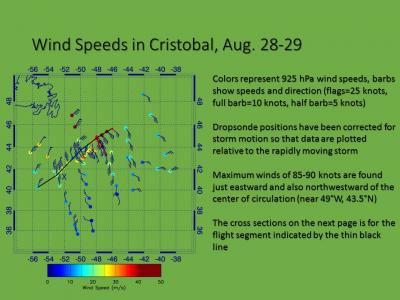
During the August 28-29 Global Hawk overflights, the dropsonde data showed maximum low-level winds of 85-90 knots (97.8 to 103.6 mph/157.4 to 166.7 kph) just east and northwest of the center of circulation (near 49 degrees west longitude and 43.5 north latitude). These strong winds were located 150-300 km from the storm center, suggesting a shift of the strongest winds outward from the center compared to earlier stages in Cristobal's lifecycle.

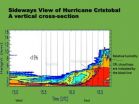
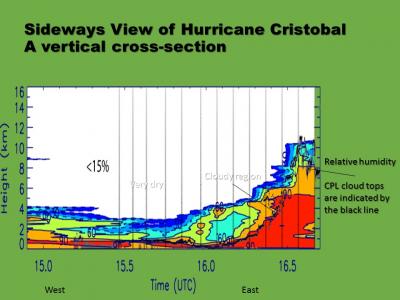
Dropsonde data also revealed that very dry air was rapidly moving eastward across the western and southern sides of the storm as it was making its transition.

The Cloud Physics Lidar, or CPL, instrument that also flew aboard the Global Hawk detected only shallow clouds across the western and southern portions of the storm, but saw clouds quickly build up to near 10 kilometers (6.2 miles) on the eastern side.

The HS3 mission is funded by NASA Headquarters and overseen by NASA's Earth System Science Pathfinder Program at NASA's Langley Research Center in Hampton, Virginia. It is one of five large airborne campaigns operating under the Earth Venture program.

The HS3 mission also involves collaborations with partners including the National Centers for Environmental Prediction, Naval Postgraduate School, Naval Research Laboratory, NOAA's Unmanned Aircraft System Program, Hurricane Research Division and Earth System Research Laboratory, Northrop Grumman Space Technology, National Center for Atmospheric Research, State University of New York at Albany, University of Maryland - Baltimore County, University of Wisconsin, and University of Utah. The HS3 mission is managed by the Earth Science Project Office at NASA Ames Research Center, Moffett Field, California.

INFORMATION: For more information about NASA's HS3 mission, visit:

http://www.nasa.gov/hs3

[Attachments] See images for this press release:
NASA's HS3 mission covers transition of Hurricane Cristobal NASA's HS3 mission covers transition of Hurricane Cristobal 2 NASA's HS3 mission covers transition of Hurricane Cristobal 3

ELSE PRESS RELEASES FROM THIS DATE:

Results of OCT STEMI trial reported at TCT 2014

2014-09-16
WASHINGTON, DC – September 16, 2014 – The first randomized trial to examine serial optical coherence tomography (OCT) in primary percutaneous coronary intervention (PCI) was reported at the 26th annual Transcatheter Cardiovascular Therapeutics (TCT) scientific symposium. Sponsored by the Cardiovascular Research Foundation (CRF), TCT is the world's premier educational meeting specializing in interventional cardiovascular medicine. OCT uses light emitted from an intravascular catheter to capture high-resolution cross sectional imaging from within coronary arteries. OCT ...

Results of IVUS-CTO trial reported at TCT 2014

2014-09-16
WASHINGTON, DC – September 14, 2014 – A new study found that intravascular ultrasound (IVUS) -guided intervention in patients with chronic total occlusion (CTO) could improve outcomes compared to a conventional angiography-guided approach during percutaneous coronary intervention (PCI). The IVUS-CTO study is the first randomized trial to examine the clinical impact of IVUS guidance for CTO intervention. Findings were reported today at the 26th annual Transcatheter Cardiovascular Therapeutics (TCT) scientific symposium. Sponsored by the Cardiovascular Research Foundation ...

Epigenetic drugs: A hope to treat cancer resistance and reduce cancer relapse?

2014-09-16
High school biology taught us that we inherit certain traits from our parents that are pre-determined. But what if you could change how these genes play out by taking certain drugs or better yet, just changing your diet? That's exactly what a team of researchers at the Boston University School of Medicine (BUSM) have proposed through their research of epigenetics research. Epigenetics regulates gene expression in a reversible manner by chemically modifying DNA and histone proteins, which prevent permanent mutations or alterations within the gene themselves. Throughout ...

Results of DKCRUSH-VI trial reported at TCT 2014

2014-09-16
WASHINGTON, DC – September 14, 2014 – A new study found that fractional flow reserve (FFR)-guided provisional side branch (SB) stenting of true coronary bifurcation lesions yields similar outcomes to the current standard of care. The DKCRUSH-VI clinical trial is the first study to compare FFR-guided and angiography-guided stenting. Findings were reported today at the 26th annual Transcatheter Cardiovascular Therapeutics (TCT) scientific symposium. Sponsored by the Cardiovascular Research Foundation (CRF), TCT is the world's premier educational meeting specializing in ...

Results of RIBS IV trial reported at TCT 2014

2014-09-16
WASHINGTON, DC – September 14, 2014 – A new clinical trial comparing the use of everolimus-eluting stents (EES) and drug-eluting balloons (DEB) in treating in-stent restenosis (ISR) from drug-eluting stents found that EES provided superior late angiographic results and better late clinical outcomes. Findings were reported today at the 26th annual Transcatheter Cardiovascular Therapeutics (TCT) scientific symposium. Sponsored by the Cardiovascular Research Foundation (CRF), TCT is the world's premier educational meeting specializing in interventional cardiovascular medicine. ...

UTMB professor implements lifesaving protocol for school children with severe allergies

2014-09-16
As the number of children with food allergies in the U.S. increases, so does the risk of children having a severe, potentially life-threatening allergic reaction called anaphylaxis on school campuses. School nurses often have treatment plans in place for students with diagnosed allergies, but many children have their first allergic reactions at school, where a specific medication, such as EpiPen epinephrine injectors, may not be available and a response protocol may not be in place. Students with identified food allergies are generally well known to school nurses. School ...

Healthy humans make nice homes for viruses

Healthy humans make nice homes for viruses
2014-09-16
The same viruses that make us sick can take up residence in and on the human body without provoking a sneeze, cough or other troublesome symptom, according to new research at Washington University School of Medicine in St. Louis. On average, healthy individuals carry about five types of viruses on their bodies, the researchers report online in BioMed Central Biology. The study is the first comprehensive analysis to describe the diversity of viruses in healthy people. The research was conducted as part of the Human Microbiome Project, a major initiative funded by the ...

Benefit of endocrine therapy in elderly women with low risk hormone receptor positive breast cancer?

2014-09-16
Treatment with endocrine therapy and radiation therapy as part of breast conservation is the current standard of care for women with hormone-receptor positive (HR+) invasive breast cancer. A new study by researchers at Fox Chase Cancer Center, however, shows that combination may not be necessary for all patient populations with the disease. The results, which Fox Chase researchers presented at the American Society for Radiation Oncology's 56th Annual Meeting on Sunday, September 14, suggest that low-risk patients over 65 years old with small tumors may achieve comparable ...

Study identifies when and how much various prostate cancer treatments will impact urinary and sexual functioning

2014-09-16
Men with prostate cancer may one day be able to predict when and how much various treatments will impact their urinary and sexual functioning, thanks in part to new findings that researchers at Fox Chase Cancer Center presented at the American Society for Radiation Oncology's 56th Annual Meeting on Tuesday, September 16. Looking over data gathered from more than 17,000 surveys completed by men diagnosed with prostate cancer, Fox Chase researchers tracked when patients' urinary and sexual symptoms changed following each type of treatment, and by how much. "The ultimate ...

World Health Organization policy improves use of medicines

2014-09-16
In this issue of PLOS Medicine, Kathleen Holloway from WHO and David Henry (University of Toronto, Canada) evaluated data on reported adherence to WHO essential medicines practices and measures of quality use of medicines from 56 low and middle income countries for 2002-2008. They compared the countries' government-reported implementation of 36 essential medicines policies with independent survey results for 10 validated indicators of quality use of medicines (QUM). They claim that the results provide the strongest evidence to date that WHO essential medicines policies ...

LAST 30 PRESS RELEASES:

Korea University, Stanford University, and IESGA launch Water Sustainability Index to combat ESG greenwashing

Molecular glue discovery: large scale instead of lucky strike

Insulin resistance predictor highlights cancer connection

Explaining next-generation solar cells

Slippery ions create a smoother path to blue energy

Magnetic resonance imaging opens the door to better treatments for underdiagnosed atypical Parkinsonisms

National poll finds gaps in community preparedness for teen cardiac emergencies

One strategy to block both drug-resistant bacteria and influenza: new broad-spectrum infection prevention approach validated

Survey: 3 in 4 skip physical therapy homework, stunting progress

College students who spend hours on social media are more likely to be lonely – national US study

Evidence behind intermittent fasting for weight loss fails to match hype

How AI tools like DeepSeek are transforming emotional and mental health care of Chinese youth

Study finds link between sugary drinks and anxiety in young people

Scientists show how to predict world’s deadly scorpion hotspots

ASU researchers to lead AAAS panel on water insecurity in the United States

ASU professor Anne Stone to present at AAAS Conference in Phoenix on ancient origins of modern disease

Proposals for exploring viruses and skin as the next experimental quantum frontiers share US$30,000 science award

ASU researchers showcase scalable tech solutions for older adults living alone with cognitive decline at AAAS 2026

Scientists identify smooth regional trends in fruit fly survival strategies

Antipathy toward snakes? Your parents likely talked you into that at an early age

Sylvester Cancer Tip Sheet for Feb. 2026

Online exposure to medical misinformation concentrated among older adults

Telehealth improves access to genetic services for adult survivors of childhood cancers

Outdated mortality benchmarks risk missing early signs of famine and delay recognizing mass starvation

Newly discovered bacterium converts carbon dioxide into chemicals using electricity

Flipping and reversing mini-proteins could improve disease treatment

Scientists reveal major hidden source of atmospheric nitrogen pollution in fragile lake basin

Biochar emerges as a powerful tool for soil carbon neutrality and climate mitigation

Tiny cell messengers show big promise for safer protein and gene delivery

AMS releases statement regarding the decision to rescind EPA’s 2009 Endangerment Finding

[Press-News.org] NASA's HS3 mission covers transition of Hurricane Cristobal