Venus holds warning for Earth
Published 2010-11-30 · Original archive entry · Explore research explainers
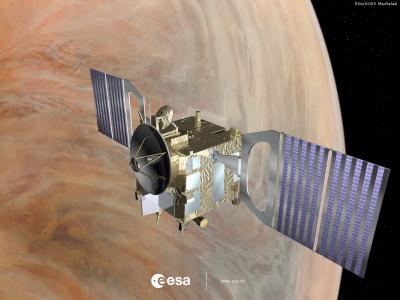
A mysterious high-altitude layer of sulphur dioxide discovered by ESA's Venus Express has been explained. As well as telling us more about Venus, it could be a warning against injecting our atmosphere with sulphur droplets to mitigate climate change.
Venus is blanketed in sulphuric acid clouds that block our view of the surface. The clouds form at altitudes of 50 km when sulphur dioxide from volcanoes combines with water vapour to make sulphuric acid droplets. Any remaining sulphur dioxide should be destroyed rapidly by the intense solar radiation above 70 km.
So the detection of a sulphur dioxide layer at 90� km by ESA's Venus Express orbiter in 2008 posed a complete mystery. Where did that sulphur dioxide come from?
Now, computer simulations by Xi Zhang, California Institute of Technology, USA, and colleagues from America, France and Taiwan show that some sulphuric acid droplets may evaporate at high altitude, freeing gaseous sulphuric acid that is then broken apart by sunlight, releasing sulphur dioxide gas.
"We had not expected the high-altitude sulphur layer, but now we can explain our measurements," says Håkan Svedhem, ESA's Venus Express Project Scientist.
"However, the new findings also mean that the atmospheric sulphur cycle is more complicated than we thought."
VIDEO: This animation shows Venus, a planet very similar to Earth in mass and size, but in reality an entirely different, exotic and inhospitable world. It is hidden below blankets of...
Click here for more information.
As well as adding to our knowledge of Venus, this new understanding may be warning us that proposed ways of mitigating climate change on Earth may not be as effective as originally thought.
Nobel prize winner Paul Crutzen has recently advocated injecting artificially large quantities of sulphur dioxide into Earth's atmosphere at around 20 km to counteract the global warming resulting from increased greenhouse gases.
The proposal stems from observations of powerful volcanic eruptions, in particular the 1991 eruption of Mount Pinatubo in the Philippines that shot sulphur dioxide up into Earth's atmosphere. Reaching 20 km in altitude, the gas formed small droplets of concentrated sulphuric acid, like those found in Venus' clouds, which then spread around Earth. The droplets created a haze layer that reflected some of the Sun's rays back into space, cooling the whole planet by about 0.5°C.
However, the new work on the evaporation of sulphuric acid on Venus suggests that such attempts at cooling our planet may not be as successful as first thought, because we do not know how quickly the initially protective haze will be converted back into gaseous sulphuric acid: this is transparent and so allows all the Sun's rays through.
"We must study in great detail the potential consequences of such an artificial sulphur layer in the atmosphere of Earth," says Jean-Loup Bertaux, Université de Versailles-Saint-Quentin, France, Principal Investigator of the SPICAV sensor on Venus Express. "Venus has an enormous layer of such droplets, so anything that we learn about those clouds is likely to be relevant to any geo-engineering of our own planet."
In effect, nature is doing the experiment for us and Venus Express allows us to learn the lessons before experimenting with our own world.
INFORMATION:
Notes for editors
Photolysis of sulphuric acid as the source of sulphur oxides in the mesosphere of Venus, by Xi Zhang, Mao-Chang Liang, Franck Montmessin, Jean-Loup Bertaux, Christopher Parkinson and Yuk L. Yung, is published in Nature Geoscience today.
Venus Express's instrument SPICAV stands for Spectroscopy for Investigation of Characteristics of the Atmosphere of Venus.
For more information:
Markus Bauer
ESA Science and Robotic Exploration Communication Officer
Tel: +31 71 565 6799, +31 61 594 3 954
Email: markus.bauer@esa.int
Håkan Svedhem
ESA Project Scientist Venus Express
Email: H.Svedhem@esa.int
Jean-Loup Bertaux, SPICAV Principal Investigator
LATMOS, Université de Versailles-Saint-Quentin, France,
Tel: +33 1 80 28 50 62, +33 6 80 73 08 70
Email: jean-loup.bertaux@latmos.ipsl.fr
Colin F. Wilson
Oxford University, UK
Tel: +44 1865 272 086
Email: wilson@atm.ox.ac.uk
Venus is blanketed in sulphuric acid clouds that block our view of the surface. The clouds form at altitudes of 50 km when sulphur dioxide from volcanoes combines with water vapour to make sulphuric acid droplets. Any remaining sulphur dioxide should be destroyed rapidly by the intense solar radiation above 70 km.
So the detection of a sulphur dioxide layer at 90� km by ESA's Venus Express orbiter in 2008 posed a complete mystery. Where did that sulphur dioxide come from?
Now, computer simulations by Xi Zhang, California Institute of Technology, USA, and colleagues from America, France and Taiwan show that some sulphuric acid droplets may evaporate at high altitude, freeing gaseous sulphuric acid that is then broken apart by sunlight, releasing sulphur dioxide gas.
"We had not expected the high-altitude sulphur layer, but now we can explain our measurements," says Håkan Svedhem, ESA's Venus Express Project Scientist.
"However, the new findings also mean that the atmospheric sulphur cycle is more complicated than we thought."
VIDEO: This animation shows Venus, a planet very similar to Earth in mass and size, but in reality an entirely different, exotic and inhospitable world. It is hidden below blankets of...
Click here for more information.
As well as adding to our knowledge of Venus, this new understanding may be warning us that proposed ways of mitigating climate change on Earth may not be as effective as originally thought.
Nobel prize winner Paul Crutzen has recently advocated injecting artificially large quantities of sulphur dioxide into Earth's atmosphere at around 20 km to counteract the global warming resulting from increased greenhouse gases.
The proposal stems from observations of powerful volcanic eruptions, in particular the 1991 eruption of Mount Pinatubo in the Philippines that shot sulphur dioxide up into Earth's atmosphere. Reaching 20 km in altitude, the gas formed small droplets of concentrated sulphuric acid, like those found in Venus' clouds, which then spread around Earth. The droplets created a haze layer that reflected some of the Sun's rays back into space, cooling the whole planet by about 0.5°C.
However, the new work on the evaporation of sulphuric acid on Venus suggests that such attempts at cooling our planet may not be as successful as first thought, because we do not know how quickly the initially protective haze will be converted back into gaseous sulphuric acid: this is transparent and so allows all the Sun's rays through.
"We must study in great detail the potential consequences of such an artificial sulphur layer in the atmosphere of Earth," says Jean-Loup Bertaux, Université de Versailles-Saint-Quentin, France, Principal Investigator of the SPICAV sensor on Venus Express. "Venus has an enormous layer of such droplets, so anything that we learn about those clouds is likely to be relevant to any geo-engineering of our own planet."
In effect, nature is doing the experiment for us and Venus Express allows us to learn the lessons before experimenting with our own world.
INFORMATION:
Notes for editors
Photolysis of sulphuric acid as the source of sulphur oxides in the mesosphere of Venus, by Xi Zhang, Mao-Chang Liang, Franck Montmessin, Jean-Loup Bertaux, Christopher Parkinson and Yuk L. Yung, is published in Nature Geoscience today.
Venus Express's instrument SPICAV stands for Spectroscopy for Investigation of Characteristics of the Atmosphere of Venus.
For more information:
Markus Bauer
ESA Science and Robotic Exploration Communication Officer
Tel: +31 71 565 6799, +31 61 594 3 954
Email: markus.bauer@esa.int
Håkan Svedhem
ESA Project Scientist Venus Express
Email: H.Svedhem@esa.int
Jean-Loup Bertaux, SPICAV Principal Investigator
LATMOS, Université de Versailles-Saint-Quentin, France,
Tel: +33 1 80 28 50 62, +33 6 80 73 08 70
Email: jean-loup.bertaux@latmos.ipsl.fr
Colin F. Wilson
Oxford University, UK
Tel: +44 1865 272 086
Email: wilson@atm.ox.ac.uk