Machine harvesting may increase apple supply for hard cider market
Study compares machine, hand harvest for specialty cider apples
Published 2014-12-08 · Original archive entry · Explore research explainers
MOUNT VERNON, WA - Cider - or "hard cider" as it is typically known in the United States - is experiencing a real revival. The fermented apple juice with 0.5% to 7% alcohol-by-volume is the fastest growing alcohol market segment in the US, boasting a 54% increase in production annually from 2007 to 2012. Naturally, increasing consumer demand for cider translates to a need for more apples to make quality cider products.
Carol A. Miles and Jaqueline King from Washington State University's Department of Horticulture published a study in HortTechnology that can provide apple growers with valuable information about harvesting techniques to help them meet market demand for specialty cider apples. "Growers in the United States require cost-effective orchard practices to be cost competitive with other agricultural production systems," explained Miles and King. "In the United Kingdom, which has a long history of cider production and is the world's largest producer of cider, apples are almost exclusively harvested by machine. These methods were developed for traditional orchards with large, widely spaced trees." In contrast, the authors said, new cider apple acreage in the US is planted with higher-density orchards on semidwarfing rootstocks, and apples are harvested by hand. Because most cider apples are smaller than standard dessert apple varieties, it can take up to four times longer to pick one bin of cider apples than one bin of dessert apples. According to the study, hand harvest can account for 46% of a grower's total annual variable costs when the orchard is in full production.
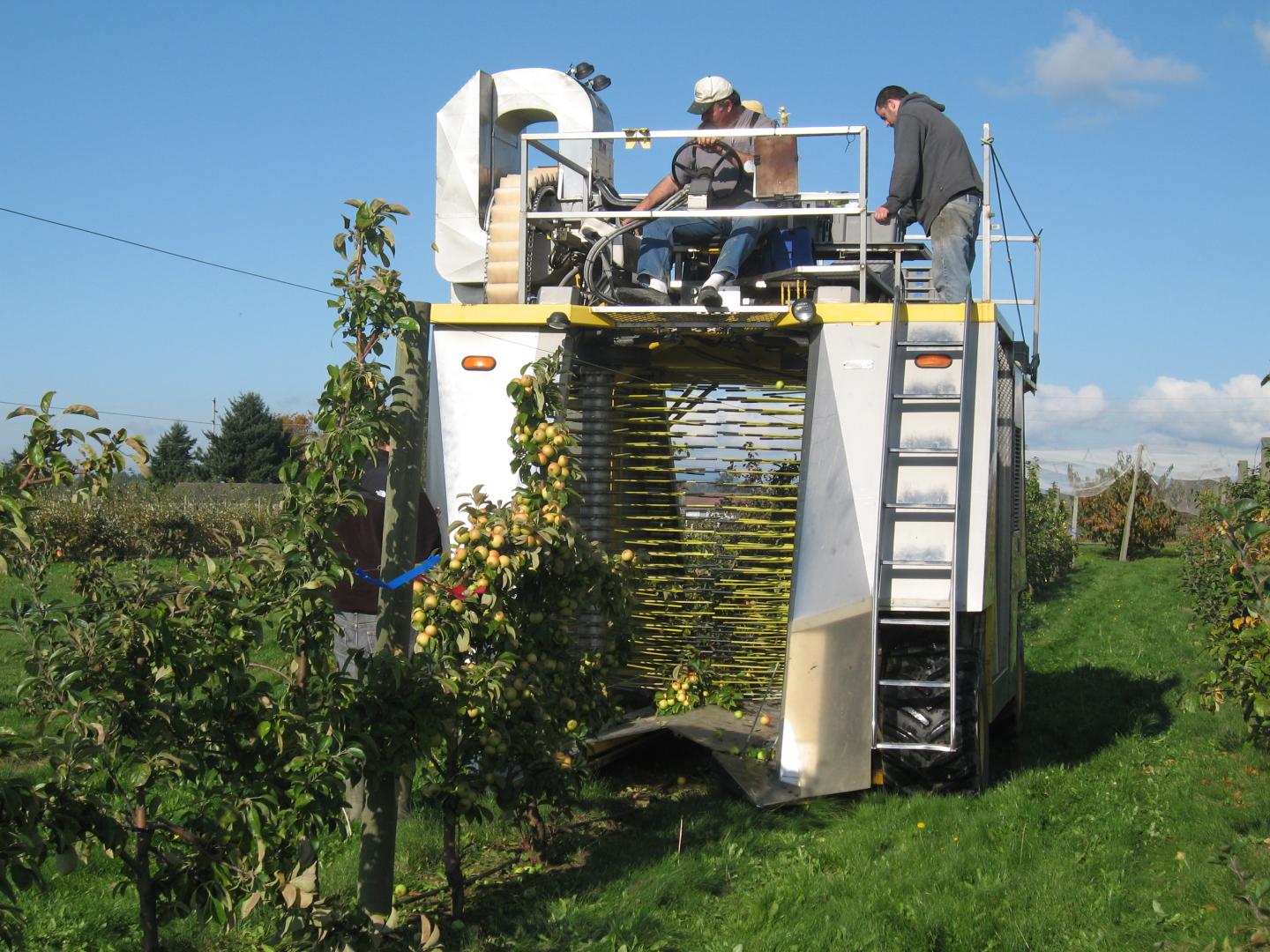
Miles and King performed a 2-year study of 'Brown Snout' bittersweet specialty cider apple (grafted onto M.27 and East Malling/Long Ashton 9 rootstocks) to compare the total weight of harvested fruit, labor hours for harvest, tree and fruit damage, and fruit and juice quality for traditional hand harvest and mechanical harvest using an over-the-row small fruit harvester. During both years, hand harvest was done by four unskilled agricultural workers who were not experienced in apple picking. Machine harvest was done with an over-the-row small fruit harvester operated by an experienced harvester driver assisted by two workers who moved fruit from the machine harvest belt into totes on top of the harvester.
Analyses showed that the number of labor-hours per acre for hand harvest was eight times greater than for machine harvest in 2011, and was two times greater in 2012. "Hand-harvest labor-hours were three times greater in 2011 than in 2012 due to heavier fruit set and higher yields in 2011," the researchers explained. "The number of hours for machine harvest was similar for both years as the same number of people (three) was required to operate the harvester regardless of crop load, and machine speed through the orchard did not vary greatly year to year." On average for the 2 years of the study, hand harvest required 23 labor-hours per acre, while machine harvest required 5 labor-hours per acre. Generally, the 2-year average cost for harvest labor was four times greater for hand harvest ($417/acre) than for machine harvest ($93/acre).
The authors said the results showed that overall, harvesting apples with an over-the-row small fruit machine harvester used four times less labor than hand harvest. Additionally, apple yield with the machine harvester was 87% that of hand harvest, and apple juice quality characteristics were not negatively affected.
Miles and King noted that more information about harvester costs would better help growers weigh their options; over-the-row small fruit harvesters can range from $70,000 for used, refurbished models in good working order to $225,000 for a new custom-built model. "Our results suggest that machine harvest may be suitable for cider apples if equipment is available and affordable," Miles and King said.
Carol A. Miles and Jaqueline King from Washington State University's Department of Horticulture published a study in HortTechnology that can provide apple growers with valuable information about harvesting techniques to help them meet market demand for specialty cider apples. "Growers in the United States require cost-effective orchard practices to be cost competitive with other agricultural production systems," explained Miles and King. "In the United Kingdom, which has a long history of cider production and is the world's largest producer of cider, apples are almost exclusively harvested by machine. These methods were developed for traditional orchards with large, widely spaced trees." In contrast, the authors said, new cider apple acreage in the US is planted with higher-density orchards on semidwarfing rootstocks, and apples are harvested by hand. Because most cider apples are smaller than standard dessert apple varieties, it can take up to four times longer to pick one bin of cider apples than one bin of dessert apples. According to the study, hand harvest can account for 46% of a grower's total annual variable costs when the orchard is in full production.
Miles and King performed a 2-year study of 'Brown Snout' bittersweet specialty cider apple (grafted onto M.27 and East Malling/Long Ashton 9 rootstocks) to compare the total weight of harvested fruit, labor hours for harvest, tree and fruit damage, and fruit and juice quality for traditional hand harvest and mechanical harvest using an over-the-row small fruit harvester. During both years, hand harvest was done by four unskilled agricultural workers who were not experienced in apple picking. Machine harvest was done with an over-the-row small fruit harvester operated by an experienced harvester driver assisted by two workers who moved fruit from the machine harvest belt into totes on top of the harvester.
Analyses showed that the number of labor-hours per acre for hand harvest was eight times greater than for machine harvest in 2011, and was two times greater in 2012. "Hand-harvest labor-hours were three times greater in 2011 than in 2012 due to heavier fruit set and higher yields in 2011," the researchers explained. "The number of hours for machine harvest was similar for both years as the same number of people (three) was required to operate the harvester regardless of crop load, and machine speed through the orchard did not vary greatly year to year." On average for the 2 years of the study, hand harvest required 23 labor-hours per acre, while machine harvest required 5 labor-hours per acre. Generally, the 2-year average cost for harvest labor was four times greater for hand harvest ($417/acre) than for machine harvest ($93/acre).
The authors said the results showed that overall, harvesting apples with an over-the-row small fruit machine harvester used four times less labor than hand harvest. Additionally, apple yield with the machine harvester was 87% that of hand harvest, and apple juice quality characteristics were not negatively affected.
Miles and King noted that more information about harvester costs would better help growers weigh their options; over-the-row small fruit harvesters can range from $70,000 for used, refurbished models in good working order to $225,000 for a new custom-built model. "Our results suggest that machine harvest may be suitable for cider apples if equipment is available and affordable," Miles and King said.
INFORMATION:
The complete study and abstract are available on the ASHS HortTechnology electronic journal web site:
http://horttech.ashspublications.org/content/24/5/519.abstract
Founded in 1903, the American Society for Horticultural Science (ASHS) is the largest organization dedicated to advancing all facets of horticultural research, education, and application. More information at ashs.org