PRESS-NEWS.org - Press Release Distribution
PRESS RELEASES DISTRIBUTION

High photosensitivity 2-D-few-layered molybdenum diselenide phototransistors
High photosensitivity 2-D-few-layered molybdenum diselenide phototransistors
2014-12-08
(Press-News.org) Two-dimensional (2D) layered materials are now attracting a lot of interest due to their unique optoelectronic properties at atomic thicknesses. Among them, graphene has been mostly investigated, but the zero-gap nature of graphene limits its practical applications. Therefore, 2D layered materials with intrinsic band gaps such as MoS2, MoSe2, and MoTe2 are of interest as promising candidates for ultrathin and high-performance optoelectronic devices.

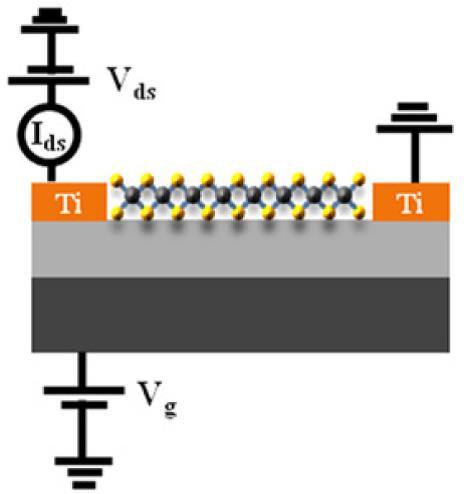
Here, Pil Ju Ko and colleagues at Toyohashi University of Technology, Japan have fabricated back-gated field-effect phototransistors made of MoSe2 crystals having a thickness of only twenty nanometers. The devices were fabricated by mechanical cleavage of MoSe2 crystals into few-layered flakes, followed by transfer onto a silicon wafer with pre-deposited titanium electrodes.

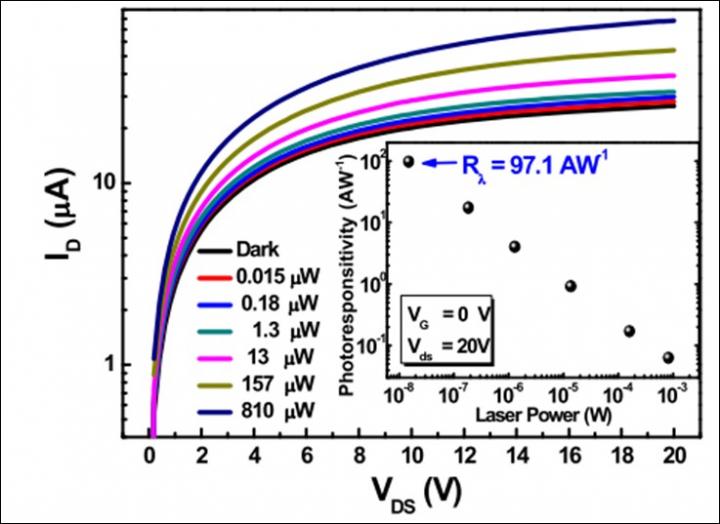
Despite their ultra-thin physical size, the devices showed excellent field-effect phototransistor characteristics. The measured photoresponsivity of 97.1 AW-1 at zero back gate voltage was higher than previous reports of photodetectors fabricated using GaS, GaSe, MoS2, and InSe. The photoresponse of the MoSe2 was much faster (less than 15 msec) than ultrasensitive photodetectors based on monolayer MoS2. Furthermore, the theoretical external quantum efficiency was 280-fold higher than of commercial Si and InGaAs photodiodes.

The research shows that MoSe2 is a promising material for photodetector applications. The group is optimization the device performance by studying thickness-dependent of the photosensitivity.

INFORMATION:

Reference: Authors: Abdelkader Abderrahmane, Pil Ju Ko, Tran Viet Thu, Shunji Ishizawa, Tsukasa Takamura and Adarsh Sandhu. Title of original paper: High photosensitivity few-layered MoSe2 back-gated field-effect phototransistors. Journal, volume, pages and year: Nanotechnology 25 365202 (1-5) (2014). Digital Object Identifier (DOI): 10.1088/0957-4484/25/36/365202. Affiliations: Electronics-Inspired Interdisciplinary Research Institute (EIIRIS) and Department of Electrical and Electronic Information Engineering, Toyohashi University of Technology, 1-1 Hibarigaoka, Tempaku, Toyohashi, Aichi 441-8580, Japan Department website: http://www.sandhu.jp/

This article is featured in the December 2014 issue of the Toyohashi Tech e-Newsletter: http://www.tut.ac.jp/english/newsletter/research_highlights/research05.html

Further information Toyohashi University of Technology
1-1 Hibarigaoka, Tempaku
Toyohashi, Aichi Prefecture, 441-8580, JAPAN
Inquiries: Committee for Public Relations
E-mail: press@office.tut.ac.jp

About Toyohashi University of Technology: Founded in 1976 as a National University of Japan, Toyohashi University of Technology is a vibrant modern institute with research activities reflecting the modern era of advanced electronics, engineering, and life sciences. Website: http://www.tut.ac.jp/english/

[Attachments] See images for this press release:
High photosensitivity 2-D-few-layered molybdenum diselenide phototransistors High photosensitivity 2-D-few-layered molybdenum diselenide phototransistors 2

ELSE PRESS RELEASES FROM THIS DATE:

Hummingbird's hover surprisingly easy to hack

Hummingbirds hover surprisingly easy to hack
2014-12-08
Hummingbirds' remarkable ability to hover in place is highly contingent on the tiny bird having a completely stationary visual field, according to University of British Columbia research published in the Proceedings of the National Academy of Sciences. UBC zoologists Benjamin Goller and Douglas Altshuler projected moving spiral and striped patterns in front of free-flying hummingbirds attempting to feed from a stationary feeder. Even minimal background pattern motion caused the hummingbirds to lose positional stability and drift. Giving the birds time to get used ...

Study offers future hope for tackling signs of aging

Study offers future hope for tackling signs of aging
2014-12-08
A new advance in biomedical research at the University of Leicester could have potential in the future to assist with tackling diseases and conditions associated with ageing - as well as in treating cancer. The research, which has shown promise in clinical samples, has been published in the prestigious scientific journal, Cell Death and Disease. The group of scientists coordinated by Dr Salvador Macip from the Mechanisms of Cancer and Ageing Lab and the Department of Biochemistry of the University of Leicester carried out the study to find new ways of identifying old ...

Office jerks beware -- your good ideas may not always be welcomed by colleagues

2014-12-08
You don't have to be a jerk to come up with fresh and original ideas, but sometimes being disagreeable is just what's needed to sell your brainchild successfully to others. However, difficult or irritating people should be aware of the social context in which they are presenting their ideas. A pushy strategy will not always be equally successful, warn Samuel Hunter of Pennsylvania State University and Lily Cushenbery of Stony Brook University in the US, in an article in Springer's Journal of Business and Psychology. People are often labelled as jerks if they are disagreeable ...

Detecting gases wirelessly and cheaply

2014-12-08
CAMBRIDGE, MA -- MIT chemists have devised a new way to wirelessly detect hazardous gases and environmental pollutants, using a simple sensor that can be read by a smartphone. These inexpensive sensors could be widely deployed, making it easier to monitor public spaces or detect food spoilage in warehouses. Using this system, the researchers have demonstrated that they can detect gaseous ammonia, hydrogen peroxide, and cyclohexanone, among other gases. "The beauty of these sensors is that they are really cheap. You put them up, they sit there, and then you come around ...

Many memories, many rooms

Many memories, many rooms
2014-12-08
Researchers have long wondered if there is an upper limit to our capacity to store memories and how we manage to remember so many events without mixing up events that are very similar. To explore this issue, researchers at the Norwegian University of Science and Technology's (NTNU) Kavli Institute for Systems Neuroscience and Centre for Neural Computation and colleagues from the Czech Republic and Italy tested the ability of rats to remember a number of distinct but similar locations. Their findings are published in the 8 December edition of the Proceedings of the National ...

UT Arlington team proposes new model for snake venom evolution

UT Arlington team proposes new model for snake venom evolution
2014-12-08
Technology that can map out the genes at work in a snake or lizard's mouth has, in many cases, changed the way scientists define an animal as venomous. If oral glands show expression of some of the 20 gene families associated with "venom toxins," that species gets the venomous label. But, a new study from The University of Texas at Arlington challenges that practice, while also developing a new model for how snake venoms came to be. The work, which is being published in the journal Molecular Biology and Evolution, is based on a painstaking analysis comparing groups of ...

Injectable 3-D vaccines could fight cancer and infectious diseases

2014-12-08
(BOSTON and CAMBRIDGE, Massachusetts) - One of the reasons cancer is so deadly is that it can evade attack from the body's immune system, which allows tumors to flourish and spread. Scientists can try to induce the immune system, known as immunotherapy, to go into attack mode to fight cancer and to build long lasting immune resistance to cancer cells. Now, researchers at the Wyss Institute for Biologically Inspired Engineering and Harvard's School of Engineering and Applied Sciences (SEAS) show a non-surgical injection of programmable biomaterial that spontaneously assembles ...

Does smoking hamper treatment for alcohol abuse?

2014-12-08
BUFFALO, N.Y. - A new study has shown that smoking can inhibit the success of treatment for alcohol abuse, putting people who are addicted to both tobacco and alcohol in a double bind. According to findings by the University at Buffalo Research Institute on Addictions (RIA), clients who smoke have shorter stays in alcohol treatment programs than non-smokers and may have poorer treatment outcomes than non-smokers. Kimberly Walitzer, PhD, deputy director and senior research scientist at RIA, led the study, which analyzed more than 21,000 adult treatment seekers from ...

Testing for drug-resistant bacteria before prostate biopsy can reduce infections

2014-12-08
PROVIDENCE, R.I. - Some infections after prostate biopsy due to drug-resistant Escherichia coli can be thwarted by simple rectal swab cultures prior to the procedure. The cultures test for antibiotic-resistant E. coli, and the findings are used to direct the selection of antimicrobial prophylaxis used for the procedure, according to Rhode Island Hospital researchers. The study was recently published in Urology. For patients undergoing transrectal ultrasound (TRUS)-guided biopsies, Ciprofloxacin may not be the best prophylactic option to use for patients colonized with ...

NASA catches 3 days of Typhoon Hagupit's motion over Philippines

NASA catches 3 days of Typhoon Hagupits motion over Philippines
2014-12-08
NASA's Terra and Aqua satellites flew over Typhoon Hagupit from Dec. 6 through Dec. 8 and the MODIS instrument that flies aboard both satellites provided images of the storm as it moved through the country. The Moderate Resolution Imaging Spectroradiometer or MODIS instrument aboard NASA's Aqua satellite caught a picture of Hagupit on Dec. 6 before it made landfall. On Dec. 7, the MODIS instrument aboard NASA's Terra satellite took an image of the storm as it was making landfall in the eastern Philippines. On Dec. 8 at 04:50 UTC (Dec. 7 at 11:50 p.m. EST) when NASA's ...

LAST 30 PRESS RELEASES:

Evidence behind intermittent fasting for weight loss fails to match hype

How AI tools like DeepSeek are transforming emotional and mental health care of Chinese youth

Study finds link between sugary drinks and anxiety in young people

Scientists show how to predict world’s deadly scorpion hotspots

ASU researchers to lead AAAS panel on water insecurity in the United States

ASU professor Anne Stone to present at AAAS Conference in Phoenix on ancient origins of modern disease

Proposals for exploring viruses and skin as the next experimental quantum frontiers share US$30,000 science award

ASU researchers showcase scalable tech solutions for older adults living alone with cognitive decline at AAAS 2026

Scientists identify smooth regional trends in fruit fly survival strategies

Antipathy toward snakes? Your parents likely talked you into that at an early age

Sylvester Cancer Tip Sheet for Feb. 2026

Online exposure to medical misinformation concentrated among older adults

Telehealth improves access to genetic services for adult survivors of childhood cancers

Outdated mortality benchmarks risk missing early signs of famine and delay recognizing mass starvation

Newly discovered bacterium converts carbon dioxide into chemicals using electricity

Flipping and reversing mini-proteins could improve disease treatment

Scientists reveal major hidden source of atmospheric nitrogen pollution in fragile lake basin

Biochar emerges as a powerful tool for soil carbon neutrality and climate mitigation

Tiny cell messengers show big promise for safer protein and gene delivery

AMS releases statement regarding the decision to rescind EPA’s 2009 Endangerment Finding

Parents’ alcohol and drug use influences their children’s consumption, research shows

Modular assembly of chiral nitrogen-bridged rings achieved by palladium-catalyzed diastereoselective and enantioselective cascade cyclization reactions

Promoting civic engagement

AMS Science Preview: Hurricane slowdown, school snow days

Deforestation in the Amazon raises the surface temperature by 3 °C during the dry season

Model more accurately maps the impact of frost on corn crops

How did humans develop sharp vision? Lab-grown retinas show likely answer

Sour grapes? Taste, experience of sour foods depends on individual consumer

At AAAS, professor Krystal Tsosie argues the future of science must be Indigenous-led

From the lab to the living room: Decoding Parkinson’s patients movements in the real world

[Press-News.org] High photosensitivity 2-D-few-layered molybdenum diselenide phototransistors