PRESS-NEWS.org - Press Release Distribution
PRESS RELEASES DISTRIBUTION

Virginia Tech, Ecuadoran scientists study rare 'Pinocchio Lizard' in effort to save it

Virginia Tech, Ecuadoran scientists study rare 'Pinocchio Lizard' in effort to save it
2015-04-02
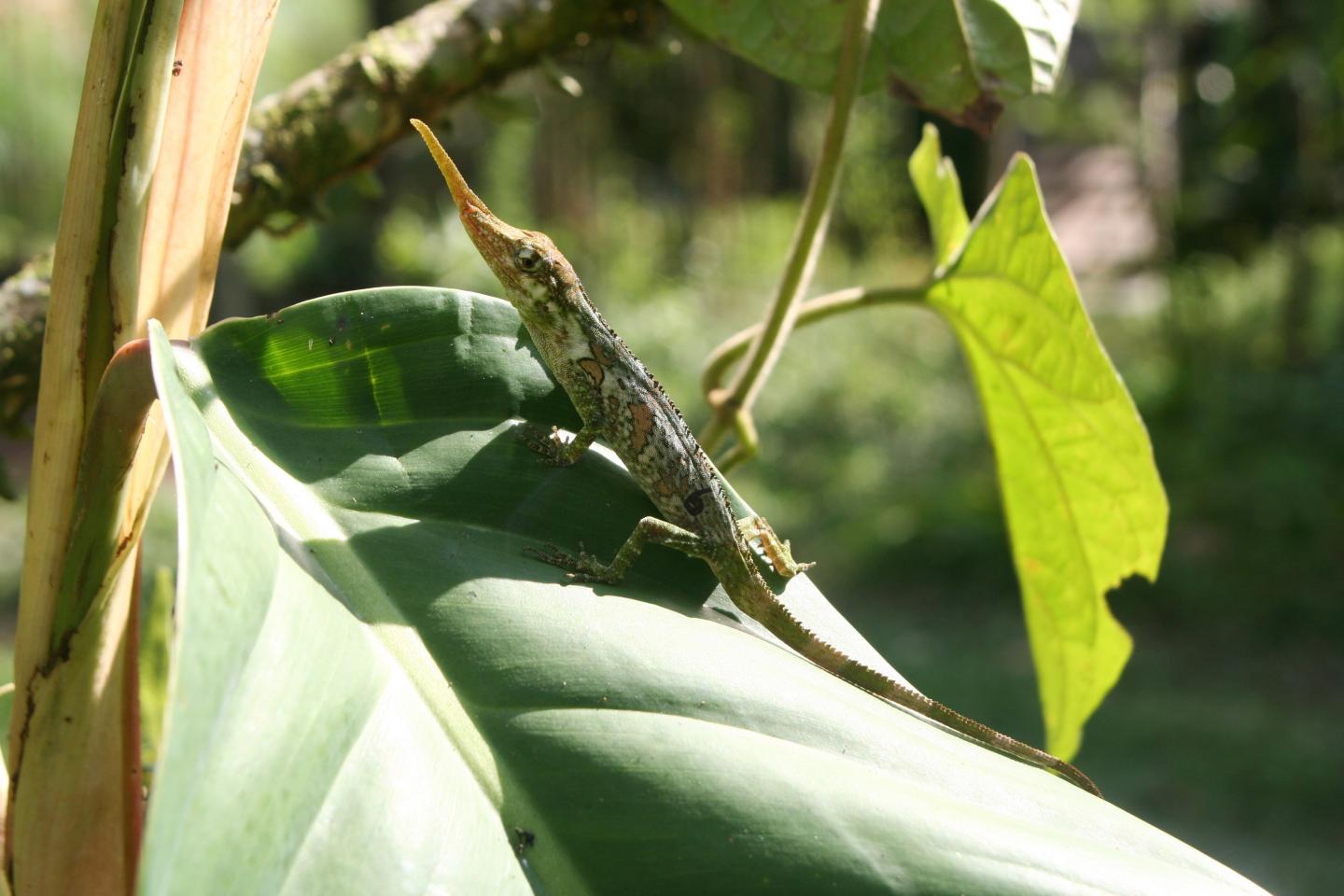
(Press-News.org) For more than 50 years, scientists thought that the horned anole lizard -- sometimes called the "Pinocchio Lizard" for its long, protruding nose -- was extinct. But it turns out this is a tall tale.

Scientists re-discovered the lizard in 2005, living elusively at the tops of tall trees in the cloud forests of Ecuador -- the only place in the world that it is known to exist.

A team led by a Virginia Tech scientist recently uncovered new information about the role that the lizard's long nose plays. Only the males have long noses, and they appear to be used in social interactions, both among males and between males and females.

Previous investigators had wondered if the nasal appendage served as a weapon of some sort in male-male interactions.

"It's important that we learn as much as we can about the natural history, social behavior, and ecology of this lizard, in order to save it from true extinction," said Ignacio Moore, an associate professor of biological sciences in the College of Science, a Fralin Life Science Institute affiliate, and a faculty member with the new Global Change Center at Virginia Tech.

Moore and his colleagues presented their findings at the 2015 Annual Meeting of the Society for Integrative and Comparative Biology in West Palm Beach, Florida. Quirola is now preparing an article about the findings.

While in Ecuador on research sabbatical, Moore partnered with Omar Torres-Carvajal, a faculty member at the Pontificia Universidad Católica del Ecuador in Quito, and Torres-Carvajal's undergraduate student Diego Quirola.

Late at night, wearing head lamps and shimmying up trees, the team was able to catch a few dozen lizards. They held them in an outdoor facility built to mimic the lizards' natural habitat and observed them for a couple days, after which the lizards were returned to the exact branch where they were found.

"We were able to observe and videotape 11 copulations and two male-male combat scenarios," said Quirola. "The nasal appendage was not used as a weapon in these interactions but was used as part of the social displays. The appendage is lifted during the social interactions although what role this specific movement plays is unclear."

What is becoming clear is that the appendage is an important part of their social interactions and a unique aspect of the natural history of this remarkable lizard.

"Ultimately we are interested in knowing about the evolution of this appendage, which is only found in two other species of anole lizards from Peru and Brazil. Do males with larger appendages dominate those with smaller ones? Do females prefer males with larger appendages? Did the appendix evolve under sexual selection? We hope to get some answers," said Torres-Carvajal.

Since it's rediscovery in 2005, the Pinocchio lizard is quickly becoming a commodity for its strange beauty and rareness, with pet smugglers offering large sums of money for its capture.

"It's important for scientists to educate the public about the biological importance of this lizard. It is not a pet but a truly remarkable product of nature," said Moore.

INFORMATION:


[Attachments] See images for this press release:
Virginia Tech, Ecuadoran scientists study rare 'Pinocchio Lizard' in effort to save it

ELSE PRESS RELEASES FROM THIS DATE:

Placenta reflects arsenic exposure in pregnant women and fetuses, Dartmouth study shows

2015-04-02
HANOVER, N.H. - The placenta can be used to reliably measure arsenic exposure in pregnant women and how much of the toxic metal is transferred to their fetuses, a Dartmouth College study shows. The study, the largest ever analysis of household drinking water arsenic and the mother-to-fetus connection, appears in the Journal of Exposure Science and Environmental Epidemiology. A PDF is available on request. Recent studies have used the placenta to identify early effects of exposure to lead, mercury, cadmium and other metals. Previous studies also have shown that arsenic ...

NYU researchers dramatically improve ART adherence for minority PHLA

2015-04-02
Up to 60% of persons living with HIV (PLHA) in the U.S. are neither taking antiretroviral therapy (ART) nor well engaged in HIV primary care, with racial/ethnic minorities more likely to experience barriers to engagement along this HIV continuum of care than their White counterparts. In fact, only 30% of persons living with HIV/AIDS (PLHA) in the United States have achieved "viral suppression," the ultimate goal of HIV treatment. Indeed, PLHA poorly engaged in HIV primary care and/or who are not on ART are at elevated risk for a host of poor outcomes, including more frequent ...

Raising retirement age would widen benefit disparities for disadvantaged

2015-04-02
The age to receive full Social Security benefits should be closer to 70, according to a report published in the journal Daedalus. "We're living longer and healthier than ever before, but the statutory age of retirement for receiving Social Security benefits doesn't reflect that," says lead author S. Jay Olshansky, professor of epidemiology in the University of Illinois at Chicago School of Public Health. When Social Security was enacted in 1935, the age of full retirement was set at 65. Back then, a 25-year-old had a 62.4 percent chance of living to retirement age, and ...

Older people at higher risk of emergency cancer diagnosis

2015-04-02
People over 60 are at higher risk of being diagnosed with lung or bowel cancer as an emergency in hospital than younger people, according to a Cancer Research UK-supported report *, published today by BMJ Open (Thursday). The researchers also found that women and less affluent people are at higher risk of an emergency lung cancer diagnosis. While being unmarried, divorced or widowed was associated with having bowel cancer diagnosed as an emergency. The Cancer Research UK review looked at over 20 studies featuring more than 687,000 lung or bowel cancer cases, of which ...

MA health reform did not lower preventable hospitalizations or reduce racial disparities

2015-04-02
CAMBRIDGE, Mass. - In the first three years after Massachusetts implemented its 2006 health care reform, which reduced the number of uninsured people in the state by roughly half, the rate of preventable hospitalizations did not decline compared with states with similar populations that did not expand health insurance coverage. Nor did the reform reduce racial and ethnic disparities in the rate of such hospitalizations. Those are some of the chief findings of a new study by researchers at Harvard Medical School and the Boston University School of Medicine, published today ...

Low T not just in males: Testosterone, atherosclerosis and obesity may be linked in females

2015-04-02
While testosterone replacement therapies may be controversial in males, new research in The FASEB Journal may extend this controversy to females too. That's because research involving mice, appearing in the April 2015 issue, suggests that there is an association between low levels of androgens (which includes testosterone), and atherosclerosis and obesity in females. "We hope that our study will contribute to intensified research efforts on the definition of androgen deficiency in women (e.g. which levels of androgens in the blood should be considered too low?), the ...

Pathway known to suppress tumors may also reduce burden of neurodegenerative diseases

2015-04-02
A molecular pathway known to suppress tumors appears to also be a major player in clearing cells of damaged proteins implicated in neurodegenerative diseases such as ALS and certain types of dementia, new research in roundworms and human cells suggests. Johns Hopkins Bloomberg School of Public Health researchers, publishing April 2 in the journal PLOS Biology, say their findings shed new light on how a cell's protein quality control mechanism works - and how this system could be harnessed one day to combat diseases caused by a buildup of proteins in cells. To function ...

Astronomers watch unfolding saga of massive star formation

2015-04-02
A pair of images of a young star, made 18 years apart, has revealed a dramatic difference that is providing astronomers with a unique, "real-time" look at how massive stars develop in the earliest stages of their formation. The astronomers used the National Science Foundation's Karl G. Jansky Very Large Array (VLA) to study a massive young star called W75N(B)-VLA 2, some 4200 light-years from Earth. They compared an image made in 2014 with an earlier VLA image from 1996. "The comparison is remarkable," said Carlos Carrasco-Gonzalez of the Center of Radioastronomy and ...

HIV spreads like internet malware and should be treated earlier

2015-04-02
A new model for HIV progression finds that it spreads in a similar way to some computer worms and predicts that early treatment is key to staving off AIDS. HIV specialists and network security experts at UCL noticed that the spread of HIV through the body using two methods - via the bloodstream and directly between cells - was similar to how some computer worms spread through both the internet and local networks respectively to infect as many computers as possible. They worked together to create a model for this 'hybrid spreading', which accurately predicted patients' ...

Age-discrimination during cell division maintains the 'stem' in stem cells

2015-04-02
CAMBRIDGE, Mass. (April 2, 2015) - A team of Whitehead Institute scientists has discovered that during division, stem cells distinguish between old and young mitochondria and allocate them disproportionately between daughter cells. As a result, the daughter cell destined to remain a stem cell receives predominantly young mitochondria, while the cell meant to differentiate into another cell type carries with it a higher compliment of the aged organelles. This asymmetric apportioning of cellular contents may represent a mechanism through which stem cells prevent the accumulation ...

LAST 30 PRESS RELEASES:

Making lighter work of calculating fluid and heat flow

Normalizing blood sugar can halve heart attack risk

Lowering blood sugar cuts heart attack risk in people with prediabetes

Study links genetic variants to risk of blinding eye disease in premature infants

Non-opioid ‘pain sponge’ therapy halts cartilage degeneration and relieves chronic pain

AI can pick up cultural values by mimicking how kids learn

China’s ecological redlines offer fast track to 30 x 30 global conservation goal

Invisible indoor threats: emerging household contaminants and their growing risks to human health

Adding antibody treatment to chemo boosts outcomes for children with rare cancer

Germline pathogenic variants among women without a history of breast cancer

Tanning beds triple melanoma risk, potentially causing broad DNA damage

Unique bond identified as key to viral infection speed

Indoor tanning makes youthful skin much older on a genetic level

Mouse model sheds new light on the causes and potential solutions to human GI problems linked to muscular dystrophy

The Journal of Nuclear Medicine ahead-of-print tip sheet: December 12, 2025

Smarter tools for peering into the microscopic world

Applications open for funding to conduct research in the Kinsey Institute archives

Global measure underestimates the severity of food insecurity

Child survivors of critical illness are missing out on timely follow up care

Risk-based vs annual breast cancer screening / the WISDOM randomized clinical trial

University of Toronto launches Electric Vehicle Innovation Ontario to accelerate advanced EV technologies and build Canada’s innovation advantage

Early relapse predicts poor outcomes in aggressive blood cancer

American College of Lifestyle Medicine applauds two CMS models aligned with lifestyle medicine practice and reimbursement

Clinical trial finds cannabis use not a barrier to quitting nicotine vaping

Supplemental nutrition assistance program policies and food insecurity

Switching immune cells to “night mode” could limit damage after a heart attack, study suggests

URI-based Global RIghts Project report spotlights continued troubling trends in worldwide inhumane treatment

Neutrophils are less aggressive at night, explaining why nighttime heart attacks cause less damage than daytime events

Menopausal hormone therapy may not pose breast cancer risk for women with BRCA mutations

Mobile health tool may improve quality of life for adolescent and young adult breast cancer survivors

[Press-News.org] Virginia Tech, Ecuadoran scientists study rare 'Pinocchio Lizard' in effort to save it