PRESS-NEWS.org - Press Release Distribution
PRESS RELEASES DISTRIBUTION

Scientists print low cost radio frequency antenna with graphene ink
The 'wonder material' takes an important step toward commercial applications like wearable wireless devices and sensors connected to the 'Internet of Things'

Scientists print low cost radio frequency antenna with graphene ink
2015-05-19
(Press-News.org) Scientists have moved graphene -- the incredibly strong and conductive single-atom-thick sheet of carbon -- a significant step along the path from lab bench novelty to commercially viable material for new electronic applications.

Researchers from the University of Manchester, together with BGT Materials Limited, a graphene manufacturer in the United Kingdom, have printed a radio frequency antenna using compressed graphene ink. The antenna performed well enough to make it practical for use in radio-frequency identification (RFID) tags and wireless sensors, the researchers said. Even better, the antenna is flexible, environmentally friendly and could be cheaply mass-produced. The researchers present their results in the journal Applied Physics Letters, from AIP Publishing.

The study demonstrates that printable graphene is now ready for commercial use in low-cost radio frequency applications, said Zhirun Hu, a researcher in the School of Electrical and Electronic Engineering at the University of Manchester.

"The point is that graphene is no longer just a scientific wonder. It will bring many new applications to our daily life very soon," added Kostya S. Novoselov, from the School of Physics and Astronomy at the University of Manchester, who coordinated the project.

Graphene Gets Inked

Since graphene was first isolated and tested in 2004, researchers have striven to make practical use of its amazing electrical and mechanical properties. One of the first commercial products manufactured from graphene was conductive ink, which can be used to print circuits and other electronic components.

Graphene ink is generally low cost and mechanically flexible, advantages it has over other types of conductive ink, such as solutions made from metal nanoparticles.

To make the ink, graphene flakes are mixed with a solvent, and sometimes a binder like ethyl cellulose is added to help the ink stick. Graphene ink with binders usually conducts electricity better than binder-free ink, but only after the binder material, which is an insulator, is broken down in a high-heat process called annealing. Annealing, however, limits the surfaces onto which graphene ink can be printed because the high temperatures destroy materials like paper or plastic.

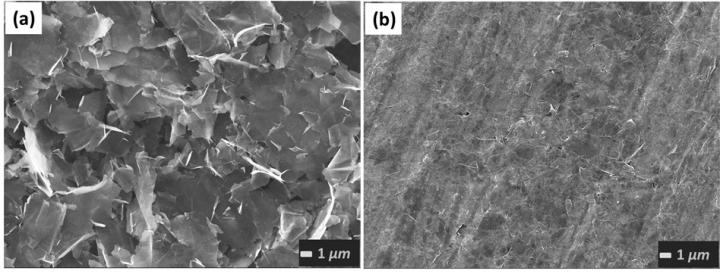
The University of Manchester research team, together with BGT Materials Limited, found a way to increase the conductivity of graphene ink without resorting to a binder. They accomplished this by first printing and drying the ink, and then compressing it with a roller, similar to the way new pavement is compressed with a road roller.

Compressing the ink increased its conductivity by more than 50 times, and the resulting "graphene laminate" was also almost two times more conductive than previous graphene ink made with a binder.

The high conductivity of the compressed ink, which enabled efficient radio frequency radiation, was one of the most exciting aspects of the experiment, Hu said.

Paving the Way to Antennas, Wireless Sensors, and More

The researchers tested their compressed graphene laminate by printing a graphene antenna onto a piece of paper. The antenna measured approximately 14 centimeters long, and 3.5 millimeter across and radiated radio frequency power effectively, said Xianjun Huang, who is the first author of the paper and a PhD candidate in the Microwave and Communcations Group in the School of Electrical and Electronic Engineering.

Printing electronics onto cheap, flexible materials like paper and plastic could mean that wireless technology, like RFID tags that currently transmit identifying info on everything from cattle to car parts, could become even more ubiquitous.

Most commercial RFID tags are made from metals like aluminium and copper, Huang said, expensive materials with complicated fabrication processes that increase the cost.

"Graphene based RFID tags can significantly reduce the cost thanks to a much simpler process and lower material cost," Huang said. The University of Manchester and BGT Materials Limited team has plans to further develop graphene enabled RFID tags, as well as sensors and wearable electronics.

INFORMATION:

The article, "Binder-free Highly Conductive Graphene Laminate for Low Cost Printed Radio Frequency Applications," is authored by Xianjun Huang, Ting Leng, Xiao Zhang, Jia Cing Chen, Kuo Hsin Chang, Andre K. Geim, Kostya S. Novoselov, and Zhirun Hu. It will be published in the journal Applied Physics Letters on May 19, 2015 (DOI: 10.1063/1.4919935). After that date, it can be accessed at: http://scitation.aip.org/content/aip/journal/apl/106/20/10.1063/1.4919935

ABOUT THE JOURNAL Applied Physics Letters features concise, rapid reports on significant new findings in applied physics. The journal covers new experimental and theoretical research on applications of physics phenomena related to all branches of science, engineering, and modern technology. See: http://apl.aip.org


[Attachments] See images for this press release:
Scientists print low cost radio frequency antenna with graphene ink

ELSE PRESS RELEASES FROM THIS DATE:

Antidepressants beneficial for women with postnatal depression

2015-05-19
Antidepressants are associated with better rates of treatment response and remission for women with postnatal depression, when compared to a placebo, according to a new systematic review by the Institute of Psychiatry, Psychology & Neuroscience (IoPPN) at King's College London. Reports often focus on the risks of using antidepressants during pregnancy and the postnatal period but this paper, published today in the Journal of the American Medical Association (JAMA), highlights the benefits that antidepressants can have for women with postnatal depression. Postnatal depression ...

Most European men descend from a handful of Bronze Age forefathers

2015-05-19
Researchers determined DNA sequences from the Y chromosomes of 334 men belonging to 17 populations from Europe and the Middle East Study shows that almost two out of three (64%) modern European men belong to just three young paternal lineage Male-specific population expansion was widespread, and surprisingly recent, focusing interest on the Bronze Age Geneticists from the University of Leicester have discovered that most European men descend from just a handful of Bronze Age forefathers, due to a 'population explosion' several thousand years ago. The project, which ...

Age-reversal effects of 'young blood' molecule GDF-11 called into question

Age-reversal effects of young blood molecule GDF-11 called into question
2015-05-19
The leading theory for why the blood of younger mice rejuvenates the muscles of older mice is now in contest. The vampiric exchange of young blood and old blood has long been reported to have anti-aging effects, but it was in 2013 when Harvard University researchers first linked GDF-11, a molecule that circulates in the blood, to this effect. Now, an analysis that set out to see how GDF-11 works in the muscles published May 19 in Cell Metabolism found just the opposite. The investigators showed first that GDF-11 was not specifically measured; the methods that were previously ...

Researchers determine best anesthesia option for infants

2015-05-19
Chicago -- May 14, 2015 -- Infants undergoing some types of surgery could have better recovery if they receive regional anesthesia rather than general anesthesia, according to two studies published in the Online First edition of Anesthesiology, the official medical journal of the American Society of Anesthesiologists® (ASA®). Researchers explored the differences between the two types of anesthesia by measuring the presence of apnea, a breathing complication, following hernia surgery. Experts have long examined the effects of anesthesia on infants and toddlers, ...

'Redesigned' antibodies may control HIV: Vanderbilt study

2015-05-19
With the help of a computer program called "Rosetta," researchers at Vanderbilt University have "redesigned" an antibody that has increased potency and can neutralize more strains of the AIDS-causing human immunodeficiency virus (HIV) than can any known natural antibody. Their findings, published online today in The Journal of Clinical Investigation, suggest that computer-redesigned antibodies may speed the search for an effective therapy or vaccine for a virus that so far has eluded all attempts to eradicate it. "There's a consensus (in the HIV field) that the vaccine ...

Hemodialysis is recommended for acute salicylate poisoning

2015-05-19
WASHINGTON --The best remedy for severe salicylate poisoning is hemodialysis, according to a comprehensive systematic review of the medical literature published on Friday in Annals of Emergency Medicine ("Extracorporeal Treatment for Salicylate Poisoning: Systematic Review and Recommendations from the EXTIRP Workgroup"). Salicylate is an active ingredient in aspirin as well as hundreds of over-the-counter medications, and contributes to approximately 20,000 accidental or intentional poisonings and nearly 30 deaths reported to US Poison Control Centers every year. "Our ...

Nature inspires first artificial molecular pump

2015-05-19
Using nature for inspiration, a team of Northwestern University scientists is the first to develop an entirely artificial molecular pump, in which molecules pump other molecules. This tiny machine is no small feat. The pump one day might be used to power other molecular machines, such as artificial muscles. The new machine mimics the pumping mechanism of life-sustaining proteins that move small molecules around living cells to metabolize and store energy from food. For its food, the artificial pump draws power from chemical reactions, driving molecules step-by-step from ...

Livers donated after cardiac death are safe to use in liver cancer patients

2015-05-19
JACKSONVILLE, Fla. -- Patients with liver cancer can be cured with a liver transplant. But because of the shortage of donated organs, these patients often die waiting for a liver. That's because most transplant centers predominantly use livers from donors who die from brain death. But in the largest study of its kind, transplant physicians at Mayo Clinic in Florida have found that liver cancer patients have the same beneficial outcomes using organs donated by patients who died of cardiac death. The study was recently published online in the American Journal of Transplantation. MULTIMEDIA ...

Large urban hospitals disadvantaged by medicare/medicaid patient satisfaction rating system

2015-05-19
(New York, May 19, 2015) -- The largest urban health systems, which serve as safety nets for large patient populations with lower socioeconomic status and greater likelihood to speak English as a second language, do worse on government patient satisfaction scores than smaller, non-urban hospitals likely to serve white customers with higher education levels, according to a new study by Mount Sinai researchers published this month in the Journal of Hospital Medicine. Patient satisfaction scores, in part due to the Affordable Care Act of 2010, are a key part of the formula ...

Cancer drugs may hold key to treating Down syndrome and other brain disorders

2015-05-19
ANN ARBOR--A class of FDA-approved cancer drugs may be able to prevent problems with brain cell development associated with disorders including Down syndrome and Fragile X syndrome, researchers at the University of Michigan Life Sciences Institute have found. The researchers' proof-of-concept study using fruit fly models of brain dysfunction was published today in the journal eLife. They show that giving the leukemia drugs nilotinib or bafetinib to fly larvae with the equivalent of Fragile X prevented the wild overgrowth of neuron endings associated with the disorder. ...

LAST 30 PRESS RELEASES:

USF Health launches nation’s first fully integrated institute for voice, hearing and swallowing care and research

Why rethinking wellness could help students and teachers thrive

Seabirds ingest large quantities of pollutants, some of which have been banned for decades

When Earth’s magnetic field took its time flipping

Americans prefer to screen for cervical cancer in-clinic vs. at home

Rice lab to help develop bioprinted kidneys as part of ARPA-H PRINT program award

Researchers discover ABCA1 protein’s role in releasing molecular brakes on solid tumor immunotherapy

Scientists debunk claim that trees in the Dolomites anticipated a solar eclipse

Impact of the 2010 World Health Organization Code on global physician migration

Measuring time at the quantum level

Researchers find a way to 3D print one of industry’s hardest engineering materials

Coupling dynamic effect based on the molecular sieve regulation of Fe nanoparticles

Engineering the “golden bridge”: Efficient tunnel junction design for next-generation all-perovskite tandem solar cells

Understanding how cancer cells use water pressure to move through the body

Killing cancer cells with RNA therapeutics

Mechanism-guided prediction of CMAS corrosion resistance and service life for high-entropy rare-earth disilicates

Seeing the unseen: Scientists demonstrate dual-mode color generation from invisible light

Revealing deformation mechanisms of the mineral antigorite in subduction zones

I’m walking here! A new model maps foot traffic in New York City

AI model can read and diagnose a brain MRI in seconds

Researchers boost perovskite solar cell performance via interface engineering

‘Sticky coat’ boosts triple negative breast cancer’s ability to metastasize

James Webb Space Telescope reveals an exceptional richness of organic molecules in one of the most infrared luminous galaxies in the local Universe

The internet names a new deep-sea species, Senckenberg researchers select a scientific name from over 8,000 suggestions.

UT San Antonio-led research team discovers compound in 500-million-year-old fossils, shedding new light on Earth’s carbon cycle

Maternal perinatal depression may increase the risk of autistic-related traits in girls

Study: Blocking a key protein may create novel form of stress in cancer cells and re-sensitize chemo-resistant tumors

HRT via skin is best treatment for low bone density in women whose periods have stopped due to anorexia or exercise, says study

Insilico Medicine showcases at WHX 2026: Connecting the Middle East with global partners to accelerate translational research

From rice fields to fresh air: Transforming agricultural waste into a shield against indoor pollution

[Press-News.org] Scientists print low cost radio frequency antenna with graphene ink
The 'wonder material' takes an important step toward commercial applications like wearable wireless devices and sensors connected to the 'Internet of Things'