PRESS-NEWS.org - Press Release Distribution
PRESS RELEASES DISTRIBUTION

Robot eyes will benefit from insect vision

Robot eyes will benefit from insect vision
2015-06-10
(Press-News.org) The way insects see and track their prey is being applied to a new robot under development at the University of Adelaide, in the hopes of improving robot visual systems.

The project - which crosses the boundaries of neuroscience, mechanical engineering and computer science - builds on years of research into insect vision at the University.

In a new paper published today in the Journal of The Royal Society Interface, researchers describe how the learnings from both insects and humans can be applied in a model virtual reality simulation, enabling an artificial intelligence system to 'pursue' an object.

"Detecting and tracking small objects against complex backgrounds is a highly challenging task," says the lead author of the paper, Mechanical Engineering PhD student Zahra Bagheri.

"Consider a cricket or baseball player trying to take a match-winning catch in the outfield. They have seconds or less to spot the ball, track it and predict its path as it comes down against the brightly coloured backdrop of excited fans in the crowd - all while running or even diving towards the point where they predict it will fall!

"Robotics engineers still dream of providing robots with the combination of sharp eyes, quick reflexes and flexible muscles that allow a budding champion to master this skill," she says.

Research conducted in the lab of University of Adelaide neuroscientist Dr Steven Wiederman (School of Medical Sciences) has shown that flying insects, such as dragonflies, show remarkable visually guided behaviour. This includes chasing mates or prey, even in the presence of distractions, like swarms of insects.

"They perform this task despite their low visual acuity and a tiny brain, around the size of a grain of rice. The dragonfly chases prey at speeds up to 60 km/h, capturing them with a success rate over 97%," Ms Bagheri says.

The team of engineers and neuroscientists has developed an unusual algorithm to help emulate this visual tracking. "Instead of just trying to keep the target perfectly centred on its field of view, our system locks on to the background and lets the target move against it," Ms Bagheri says. "This reduces distractions from the background and gives time for underlying brain-like motion processing to work. It then makes small movements of its gaze and rotates towards the target to keep the target roughly frontal."

This bio-inspired "active vision" system has been tested in virtual reality worlds composed of various natural scenes. The Adelaide team has found that it performs just as robustly as the state-of-the-art engineering target tracking algorithms, while running up to 20 times faster.

"This type of performance can allow for real-time applications using quite simple processors," says Dr Wiederman, who is leading the project, and who developed the original motion sensing mechanism after recording the responses of neurons in the dragonfly brain.

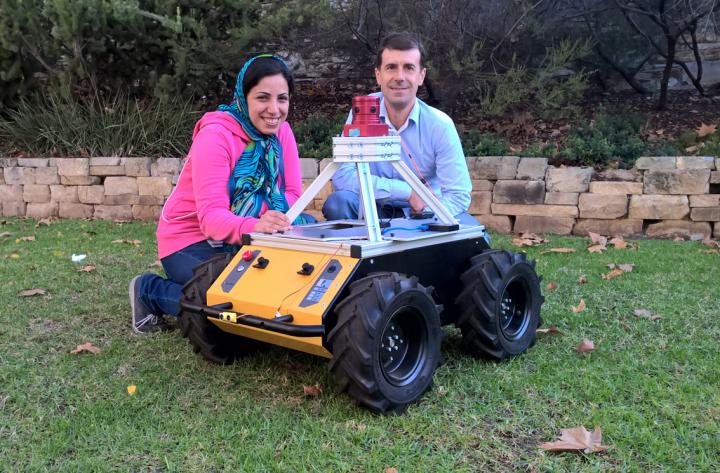
"We are currently transferring the algorithm to a hardware platform, a bio-inspired, autonomous robot."

INFORMATION:

Media Contacts:

Zahra Bagheri
PhD student
School of Mechanical Engineering
The University of Adelaide
zahra.bagheri@adelaide.edu.au

Dr Steven Wiederman
ARC Discovery Early Career Researcher
School of Medical Sciences
The University of Adelaide
Phone: +61 8 8313 8067
steven.wiederman@adelaide.edu.au


[Attachments] See images for this press release:
Robot eyes will benefit from insect vision

ELSE PRESS RELEASES FROM THIS DATE:

Statewide quality improvement program helps lower rates of trauma complications

2015-06-10
CHICAGO (June 10, 2015): As health insurers place more emphasis on paying for quality outcomes rather than for specific services provided by doctors and hospitals, several quality improvement programs have been developed as a way to help health care providers identify problem areas and share best practices. While some studies have evaluated how well these quality improvement programs achieve their goals, not many have focused on the area of trauma care. But now a team of trauma surgeons at the University of Michigan in Ann Arbor have reported how data from a statewide ...

Binghamton engineer creates origami battery

Binghamton engineer creates origami battery
2015-06-10
Origami, the Japanese art of paper folding, can be used to create beautiful birds, frogs and other small sculptures. Now a Binghamton University engineer says the technique can be applied to building batteries, too. Seokheun "Sean" Choi developed an inexpensive, bacteria-powered battery made from paper, he writes in the July edition of the journal Nano Energy. The battery generates power from microbial respiration, delivering enough energy to run a paper-based biosensor with nothing more than a drop of bacteria-containing liquid. "Dirty water has a lot of organic matter," ...

Partial sleep deprivation linked to biological aging in older adults

2015-06-10
DARIEN, IL - A new study suggests that one night of partial sleep deprivation promotes biological aging in older adults. Results show that one night of partial sleep deprivation activates gene expression patterns in peripheral blood mononuclear cells (PBMCs) consistent with increasing accumulation of damage that initiates cell cycle arrest and increases susceptibility to senescence. These findings causally link sleep deprivation to the etiology of biological aging, and further supports the hypothesis that sleep deprivation may be associated with elevated disease risk ...

Public debate could be key to strong economy

2015-06-10
As it turns out, people who speak their minds loudly and often could be responsible for economic prosperity. That's according to a new study by Michigan State University economist Siddharth Chandra, director of MSU's Asian Studies Center, and Nita Rudra, associate professor in the Department of Government at Georgetown University. "Our study demonstrates that freedom to express our opinions is not just something we should enjoy," said Chandra, who's also a professor in MSU's James Madison College. "It could have very important consequences - sometimes preventing the ...

Sleep duration and quality may impact cancer survival rate

2015-06-10
DARIEN, IL - A new study suggests that pre-diagnostic short sleep duration and frequent snoring were associated with significantly poorer cancer-specific survival, particularly among women with breast cancer. Results show that stratified by cancer site, short sleep duration and frequent snoring were associated with significantly poorer breast cancer-specific survival. "Our results suggest that sleep duration is important for breast cancer survival, particularly in women who snore," said lead author Amanda Phipps, assistant professor of epidemiology at the University ...

This week from AGU: Space weather warnings, real-time water management

2015-06-10
From AGU's blogs: New Tool Could Track Space Weather 24 Hours Before Reaching Earth A new model, described in a June 9 paper in the journal Space Weather, might finally give scientists a tool to predict a coronal mass ejection's magnetic configuration from afar, which means forecasters could give utility grid and satellite operators a full 24-hour advance warning to protect their systems. From AGU's journals: Satellite Measurements May Help Real-Time Water Management With the demand for water stored in reservoirs rising in many areas, it is becoming increasingly ...

A stiff upper lip makes sense to baby

2015-06-10
This news release is available in French. Montreal, June 10, 2015 -- When you're one and a half years old, having your favourite ball taken away is likely to result in a temper tantrum. But while babies wear their feelings on the sleeves of their onesies, adults often mask their emotions, responding to life's disappointments with stoic reserve. While you might think that witnessing such reactions would confuse toddlers and lead them to believe emotionally reserved adults aren't being honest -- so by extension are untrustworthy to begin with -- new research shows ...

Teenagers should exercise like kids to achieve best health outcomes

2015-06-10
As little as two minutes of high-intensity exercise four times a day improves health outcomes in adolescents, but the same amount of moderate-intensity exercise does not reap the same rewards, according to a new study from the University of Exeter. Researchers found that when exercise is broken up into short bursts over the course of a day - replicating the way young children go about being active - only high-intensity exercise is effective in improving blood sugar levels, fat metabolism and blood pressure in adolescents after the consumption of a fatty meal. The ...

Pedophiles more likely to have physical irregularities

2015-06-10
New research suggests pedophiles are more likely to have superficial facial flaws, known as Minor Physical Anomalies (MPAs). They are also more likely to be left-handed, says Fiona Dyshniku of the University of Windsor in Canada. She led an investigation into the prevalence and distribution of physical anomalies among men who are sent for sexological assessment. The study in Springer's journal Archives of Sexual Behavior adds to a growing body of evidence that suggests pedophilia develops prenatally, around the same time that such physical flaws develop. "Evidence is ...

The price of a happy ending can be bad decision-making, say researchers

2015-06-10
New research using high-speed gambling experiments shows that, for most of us, the last experience we've had can be the defining one when it comes to taking a decision, coming at the expense of other experiences we've accumulated further back in time. The study, published today in the journal Proceedings of the Royal Society B, supports the idea that the 'banker's fallacy' - focusing on immediate growth at the expense of longer-term stability that would produce better results - is intuitive in the way many of us make quick decisions. People's natural inclination towards ...

LAST 30 PRESS RELEASES:

Azacitidine–venetoclax combination outperforms standard care in acute myeloid leukemia patients eligible for intensive chemotherapy

Adding epcoritamab to standard second-line therapy improves follicular lymphoma outcomes

New findings support a chemo-free approach for treating Ph+ ALL

Non-covalent btki pirtobrutinib shows promise as frontline therapy for CLL/SLL

University of Cincinnati experts present research at annual hematology event

ASH 2025: Antibody therapy eradicates traces of multiple myeloma in preliminary trial

ASH 2025: AI uncovers how DNA architecture failures trigger blood cancer

ASH 2025: New study shows that patients can safely receive stem cell transplants from mismatched, unrelated donors

Protective regimen allows successful stem cell transplant even without close genetic match between donor and recipient

Continuous and fixed-duration treatments result in similar outcomes for CLL

Measurable residual disease shows strong potential as an early indicator of survival in patients with acute myeloid leukemia

Chemotherapy and radiation are comparable as pre-transplant conditioning for patients with b-acute lymphoblastic leukemia who have no measurable residual disease

Roughly one-third of families with children being treated for leukemia struggle to pay living expenses

Quality improvement project results in increased screening and treatment for iron deficiency in pregnancy

IV iron improves survival, increases hemoglobin in hospitalized patients with iron-deficiency anemia and an acute infection

Black patients with acute myeloid leukemia are younger at diagnosis and experience poorer survival outcomes than White patients

Emergency departments fall short on delivering timely treatment for sickle cell pain

Study shows no clear evidence of harm from hydroxyurea use during pregnancy

Long-term outlook is positive for most after hematopoietic cell transplant for sickle cell disease

Study offers real-world data on commercial implementation of gene therapies for sickle cell disease and beta thalassemia

Early results suggest exa-cel gene therapy works well in children

NTIDE: Disability employment holds steady after data hiatus

Social lives of viruses affect antiviral resistance

Dose of psilocybin, dash of rabies point to treatment for depression

Helping health care providers navigate social, political, and legal barriers to patient care

Barrow Neurological Institute, University of Calgary study urges “major change” to migraine treatment in Emergency Departments

Using smartphones to improve disaster search and rescue

Robust new photocatalyst paves the way for cleaner hydrogen peroxide production and greener chemical manufacturing

Ultrafast material captures toxic PFAS at record speed and capacity

Plant phenolic acids supercharge old antibiotics against multidrug resistant E. coli

[Press-News.org] Robot eyes will benefit from insect vision