PRESS-NEWS.org - Press Release Distribution
PRESS RELEASES DISTRIBUTION

Early breeding reduced harmful mutations in sorghum

Early breeding reduced harmful mutations in sorghum
2021-01-21
(Press-News.org) ITHACA, N.Y. - When humans first domesticated maize some 9,000 years ago, those early breeding efforts led to an increase in harmful mutations to the crop's genome compared to their wild relatives, which more recent modern breeding has helped to correct.

A new comparative study investigates whether the same patterns found in maize occurred in sorghum, a gluten-free grain grown for both livestock and human consumption. The researchers were surprised to find the opposite is true: Harmful mutations in sorghum landraces (early domesticated crops) actually decreased compared to their wild relatives.

The study, "Comparative Evolutionary Genetics of Deleterious Load in Sorghum and Maize," published Jan. 15 in Nature Plants. The senior author is Michael Gore, professor of molecular breeding and genetics in the College of Agriculture and Life Sciences (CALS).

The research may inform future breeding efforts in both sorghum and maize.

"We assumed that maize and sorghum would have complementary patterns of deleterious mutations, because all the work that has been done in crops up to this point has shown an increase in deleterious burden in domesticates compared to wild relatives from which crops originate," Gore said. "But sorghum does not follow this pattern and it's very surprising."

These "deleterious mutations," which potentially have a negative effect on the fitness of an organism, result from random genetic errors that occur every generation, and from ancient mutations that may be linked to beneficial genetic variants selected during crop domestication and improvement.

In the study, the researchers ran population genetics simulations to help explain why sorghum failed to follow the same pattern found in maize.

One major difference between maize and sorghum is that maize (wild and domesticated) is an "outcrosser," meaning its female flowers (ear shoots) are predominantly pollinated by other maize plants; domesticated sorghum is a "selfer," meaning the flowers of its panicles (heads) are mostly fertilized by each plant's own pollen.

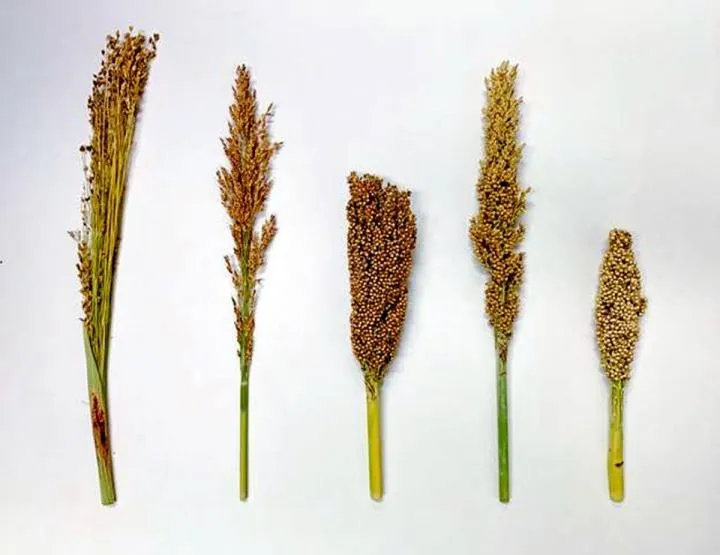
It turns out that sorghum's wild relatives have more open seed heads that facilitate outcrossing. But in the process of sorghum domestication, the panicles that hold these clusters of flowers became more compact, which increased "selfing" rates.

"We posit that the alteration of panicle morphology impacted deleterious mutation patterns in sorghum," Gore said. "The resultant increase in selfing likely contributed to the purging of deleterious mutations after domestication."

By understanding the historical patterns of harmful mutations, breeders may use that knowledge to better purge deleterious mutations from sorghum crops. "What we're learning in sorghum could also be applied to maize and vice versa," Gore said.

INFORMATION:

Roberto Lozano, a postdoctoral researcher in Gore's lab, is the paper's first author. Co-authors include Ed Buckler, a research geneticist at the U.S. Department of Agriculture-Agricultural Research Service and adjunct professor of plant breeding and genetics with Cornell's Institute of Biotechnology, whose prior research has identified patterns of harmful mutations related to maize domestication and breeding; and Jeffrey Ross-Ibarra, professor of evolution and ecology at University of California-Davis.

The study was funded by the U.S. Department of Energy.


[Attachments] See images for this press release:
Early breeding reduced harmful mutations in sorghum

ELSE PRESS RELEASES FROM THIS DATE:

California harbor porpoises rebound after coastal gillnetting stopped

California harbor porpoises rebound after coastal gillnetting stopped
2021-01-21
Harbor porpoises have rebounded in a big way off California. Their populations have recovered dramatically since the end of state set-gillnet fisheries that years ago entangled and killed them in the nearshore waters they frequent. These coastal set-gillnet fisheries are distinct from federally-managed offshore drift-gillnet fisheries. They have been prohibited in inshore state waters for more than a decade. The new research indicates that the coastal set gillnets had taken a greater toll on harbor porpoise than previously realized. The return of harbor porpoises reflects the first documented example of the species rebounding. It's a bright spot for marine wildlife, the scientists write in a new assessment published in Marine Mammal Science. "This is ...

See how they run: 'Exercise protein' doubles running capacity, restores function and extends healthy lifespans in older mice

2021-01-21
A new study shows that humans express a powerful hormone during exercise and that treating mice with the hormone improves physical performance, capacity and fitness. Researchers say the findings present new possibilities for addressing age-related physical decline. The research, published on Wednesday in Nature Communications, reveals a detailed look at how the mitochondrial genome encodes instructions for regulating physical capacity, performance and metabolism during aging and may be able to increase healthy lifespan. "Mitochondria are known as the cell's energy source, but they are also hubs that coordinate and fine-tune metabolism by actively communicating to the rest of the body," said Changhan David Lee, assistant professor at the USC Leonard Davis School of Gerontology ...

Medical terms for opioid addiction don't always reduce stigma, study finds

2021-01-21
BOSTON - Opioid addiction is persistently stigmatized, delaying and preventing treatment for many - an urgent problem with overdose deaths continuing to rise. To help alleviate this, various medical ways of describing opioid-related impairment, such as "a chronically relapsing brain disease," "illness," or "disorder," have been promoted in diagnostic systems and among national health agencies. "While intensely debated, there were no rigorous scientific studies out there to inform practice and policy about which terms may be most helpful in reducing stigma," says John F. Kelly, PhD, lead investigator ...

Crystal close up

2021-01-21
Two novel techniques, atomic-resolution real-time video and conical carbon nanotube confinement, allow researchers to view never-before-seen details about crystal formation. The observations confirm theoretical predictions about how salt crystals form and could inform general theories about the way in which crystal formation produces different ordered structures from an otherwise disordered chemical mixture. Crystals include many familiar things, such as snowflakes, salt grains and even diamonds. They are regular and repeating arrangements of constituent molecules that grow from a chaotic sea of those molecules. ...

Whole body imaging detects myeloma in more patients, treatment initiated earlier

2021-01-21
Researchers from King's College London have shown that whole body magnetic resonance imaging (WBMRI) not only detects more myeloma-defining disease than positron emission tomography/computed tomography (PET/CT) with 18F-fluorodeoxyglucose (FDG) but that it also allows critical treatment to be initiated earlier. In a study published today in the European Journal of Nuclear Medicine and Molecular Imaging, researchers looked at 46 patients with suspected myeloma, a debilitating bone marrow cancer which sees 140,000 new cases each year globally. Less than 50 percent of patients survive after five years and at present it is not clear which is the best imaging ...

Teamwork in a molecule

Teamwork in a molecule
2021-01-21
"Such reactions are usually carried out using transition metals, such as nickel or iridium," explains Prof. Robert Kretschmer, Junior Professor of Inorganic Chemistry at the University of Jena, whose work has been published in the prestigious Journal of the American Chemical Society. "However, transition metals are expensive and harmful to the environment, both when they are mined and when they are used. Therefore, we are trying to find better alternatives." That two metals can do more than one is already known in the case of transition metals. "However, there has been hardly ...

Fighting respiratory virus outbreaks through 'nano-popcorn' sensor-based rapid detection

Fighting respiratory virus outbreaks through nano-popcorn sensor-based rapid detection
2021-01-21
Viral respiratory diseases are easily transmissible and can spread rapidly across the globe, causing significant damage. The ongoing covid-19 pandemic is a testament to this. In the past too, other viruses have caused massive respiratory disease outbreaks: for example, a subtype of the influenza virus, the type A H1N1 virus, was responsible for the Spanish flu and the Swine flu outbreaks. Thus, to prevent such health crises in the future, timely and accurate diagnosis of these viruses is crucial. This is exactly what researchers from Korea have attempted to work toward, in their brand-new study. Read on to understand how! For several decades now, polymerase chain reaction (PCR)-based assays have been the gold standard for detecting influenza viruses. And while these ...

Having plants at home improved psychological well-being during lockdown

Having plants at home improved psychological well-being during lockdown
2021-01-21
An international study coordinated by the Research Group for Urban Nature and Biosystems Engineering (NATURIB) from the University of Seville's School of Agricultural Engineering emphasises that having plants at home had a positive influence on the psychological well-being of the dwelling's inhabitants during COVID-19 lockdown. Researchers from the Hellenic Mediterranean University (Greece), the Federal Rural University of Pernambuco (Brazil) and the University of Genoa (Italy) participated in the study along with representatives from the University ...

Mechanism that produces rapid acceleration in clicking beetles identified

Mechanism that produces rapid acceleration in clicking beetles identified
2021-01-21
Did you know that fleas, ants, and click beetles are capable of blazingly fast accelerations, with some up to 10^6 meters per square-second? Their quick movements make fast animals like the cheetah look like slowpokes. A new study by a team that included Jake Socha, professor in biomedical engineering and mechanics in Virginia Tech's College of Engineering, published in the journal Proceedings of the National Academies of Sciences shows that a snap-through unbending movement of the body is the main reason for the clicking beetle's fast acceleration. Most animals use muscle to move. For example, when we want to bend our elbow, our biceps ...

Natural hazard events and national risk reduction measures unconnected

Natural hazard events and national risk reduction measures unconnected
2021-01-21
Countries where massive natural hazard events occur frequently are not more likely than others to make changes to reduce risks from future disasters. This is shown in an interdisciplinary Uppsala University study now published in Nature Communications. Natural hazard events, such as storms, floods, and wildfires, entail huge and growing costs all over the world, but they can also be occasions for countries to implement risk-reducing changes. There is no research consensus on whether natural hazard events lead to policy modifications or, instead, contribute to stability and preservation of existing solutions. Knowledge in this area to date has been ...

LAST 30 PRESS RELEASES:

Making lighter work of calculating fluid and heat flow

Normalizing blood sugar can halve heart attack risk

Lowering blood sugar cuts heart attack risk in people with prediabetes

Study links genetic variants to risk of blinding eye disease in premature infants

Non-opioid ‘pain sponge’ therapy halts cartilage degeneration and relieves chronic pain

AI can pick up cultural values by mimicking how kids learn

China’s ecological redlines offer fast track to 30 x 30 global conservation goal

Invisible indoor threats: emerging household contaminants and their growing risks to human health

Adding antibody treatment to chemo boosts outcomes for children with rare cancer

Germline pathogenic variants among women without a history of breast cancer

Tanning beds triple melanoma risk, potentially causing broad DNA damage

Unique bond identified as key to viral infection speed

Indoor tanning makes youthful skin much older on a genetic level

Mouse model sheds new light on the causes and potential solutions to human GI problems linked to muscular dystrophy

The Journal of Nuclear Medicine ahead-of-print tip sheet: December 12, 2025

Smarter tools for peering into the microscopic world

Applications open for funding to conduct research in the Kinsey Institute archives

Global measure underestimates the severity of food insecurity

Child survivors of critical illness are missing out on timely follow up care

Risk-based vs annual breast cancer screening / the WISDOM randomized clinical trial

University of Toronto launches Electric Vehicle Innovation Ontario to accelerate advanced EV technologies and build Canada’s innovation advantage

Early relapse predicts poor outcomes in aggressive blood cancer

American College of Lifestyle Medicine applauds two CMS models aligned with lifestyle medicine practice and reimbursement

Clinical trial finds cannabis use not a barrier to quitting nicotine vaping

Supplemental nutrition assistance program policies and food insecurity

Switching immune cells to “night mode” could limit damage after a heart attack, study suggests

URI-based Global RIghts Project report spotlights continued troubling trends in worldwide inhumane treatment

Neutrophils are less aggressive at night, explaining why nighttime heart attacks cause less damage than daytime events

Menopausal hormone therapy may not pose breast cancer risk for women with BRCA mutations

Mobile health tool may improve quality of life for adolescent and young adult breast cancer survivors

[Press-News.org] Early breeding reduced harmful mutations in sorghum