Bacteria and viruses: a network of intestinal relationships
Published 2021-03-10 · Original archive entry · Explore research explainers
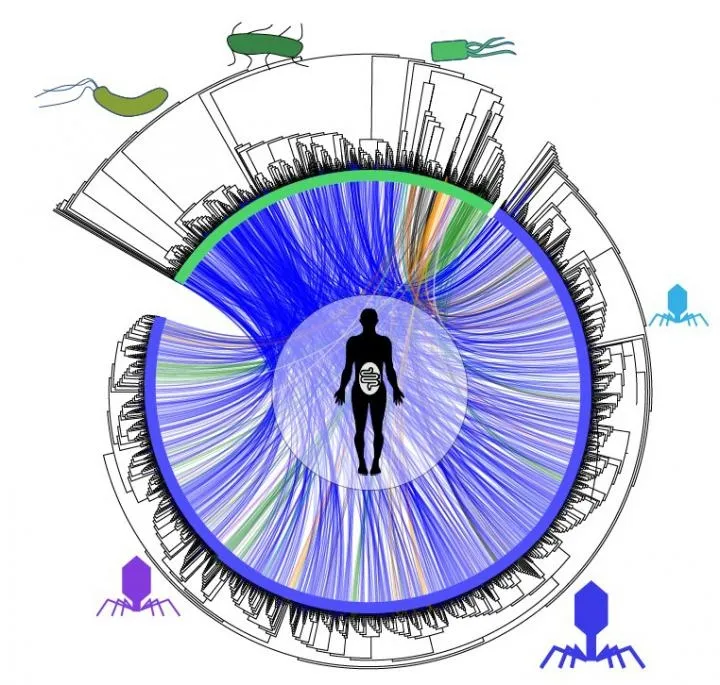
The balance of human intestinal microbiota, consisting of hundreds of bacterial species and phages (bacteria viruses), is crucial to good health. A research team, including scientists from the CNRS* and the Institut Pasteur, has characterised the phage-bacterial interaction networks of the microbiota in ten healthy individuals, with unprecedented precision. Scientists detected several hundred bacterial and phage genomes and identified the thousands of interactions that bind them by quantifying the contacts between the DNA molecules of viruses and their hosts. This method has the advantage of providing exhaustive data from limited biological samples. The results were then analysed using algorithms similar to those applied to the study of social media communities. This panorama of relationships between bacteria and phages could be applied to therapies involving intestinal microbiota, such as faecal transplantation and phagotherapy. The approach used in the study, recently published in eLife, could also lead to more precise analyses of terrestrial and marine ecosystems.
* Researchers from the Génétique des génomes unit (CNRS/Institut Pasteur) and the Bioinformatics and Biostatistics Hub (CNRS/Institut Pasteur)
* Researchers from the Génétique des génomes unit (CNRS/Institut Pasteur) and the Bioinformatics and Biostatistics Hub (CNRS/Institut Pasteur)
INFORMATION: