PRESS-NEWS.org - Press Release Distribution
PRESS RELEASES DISTRIBUTION

A new window to see hidden side of magnetized universe

A new window to see hidden side of magnetized universe
2021-05-05
(Press-News.org) New observations and simulations show that jets of high-energy particles emitted from the central massive black hole in the brightest galaxy in galaxy clusters can be used to map the structure of invisible inter-cluster magnetic fields. These findings provide astronomers with a new tool for investigating previously unexplored aspects of clusters of galaxies.

As clusters of galaxies grow through collisions with surrounding matter, they create bow shocks and wakes in their dilute plasma. The plasma motion induced by these activities can drape intra-cluster magnetic layers, forming virtual walls of magnetic force. These magnetic layers, however, can only be observed indirectly when something interacts with them. Because it is simply difficult to identify such interactions, the nature of intra-cluster magnetic fields remains poorly understood. A new approach to map/characterize magnetic layers is highly desired.

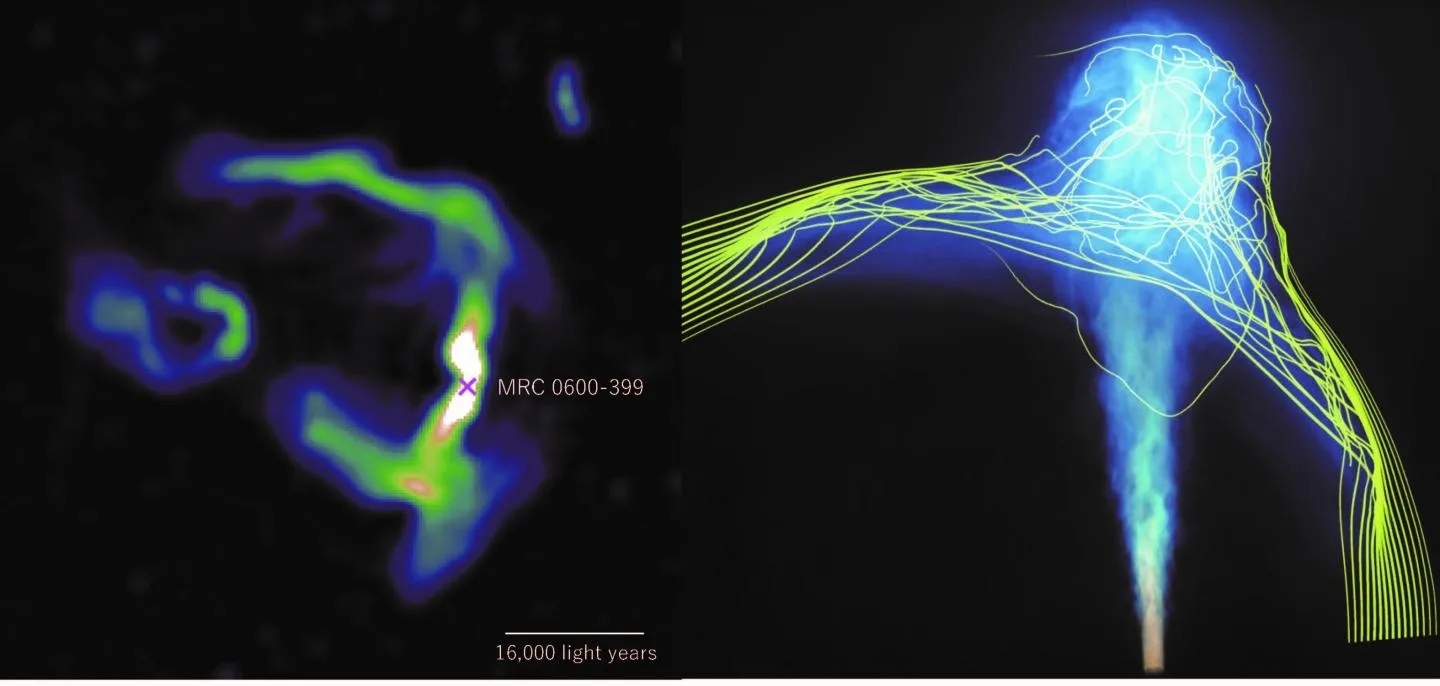
An international team of astronomers including Haruka Sakemi, a graduate student at Kyushu University (now a research fellow at the National Astronomical Observatory of Japan - NAOJ), used the MeerKAT radio telescope located in the Northern Karoo desert of South Africa to observe a bright galaxy in the merging galaxy cluster Abell 3376 known as MRC 0600-399. Located more than 600 million light-years away in the direction of the constellation Columba, MRC 0600-399 is known to have unusual jet structures bent to 90-degree angles. Previous X-ray observations revealed that MRC 0600-399 is the core of a sub-cluster penetrating the main cluster of galaxies, indicating the presence of strong magnetic layers at the boundary between the main and sub-clusters. These features make MRC 0600-399 an ideal laboratory to investigate interactions between jets and strong magnetic layers.

The MeerKAT observations revealed unprecedented details of the jets, most strikingly, faint "double-scythe" structure extending in the opposite direction from the bend points and creating a "T" shape. These new details show that, like a stream of water hitting a pane of glass, this is a very chaotic collision. Dedicated computer simulations are required to explain the observed jet morphology and possible magnetic field configurations.

Takumi Ohmura, a graduate student at Kyushu University (now a research fellow at the University of Tokyo's Institute for Cosmic-Ray Research - ICRR), from the team performed simulations on NAOJ's supercomputer ATERUI II, the most powerful computer in the world dedicated to astronomical calculations. The simulations assumed an arch-like strong magnetic field, neglecting messy details like turbulence and the motion of the galaxy. This simple model provides a good match to the observations, indicating that the magnetic pattern used in the simulation reflects the actual magnetic field intensity and structure around MRC 0600-399. More importantly, it demonstrates that the simulations can successfully represent the underlying physics so that they can be used on other objects to characterize more complex magnetic field structures in clusters of galaxies. This provides astronomers with a new way to understand the magnetized Universe and a tool to analyze the higher-quality data from future radio observatories like the SKA (the Square Kilometre Array).

INFORMATION:

These results appeared as Chibueze, Sakemi, Ohmura, et. al. "Jets from MRC 0600-399 bent by magnetic fields in the cluster Abell 3376" in Nature on May 6, 2021.


[Attachments] See images for this press release:
A new window to see hidden side of magnetized universe

ELSE PRESS RELEASES FROM THIS DATE:

Fast changing smells can teach mice about space

2021-05-05
Researchers at the Francis Crick Institute and UCL (University College London) have found that mice can sense extremely fast and subtle changes in the structure of odours and use this to guide their behaviour. The findings, published in Nature today (Wednesday), alter the current view on how odours are detected and processed in the mammalian brain. Odour plumes, like the steam off a hot cup of coffee, are complex and often turbulent structures, and can convey meaningful information about an animal's surroundings, like the movements of a predator or the location of food sources. But it has previously been assumed that mammalian brains can't fully process these temporal ...

New bonobo genome fine tunes great ape evolution studies

New bonobo genome fine tunes great ape evolution studies
2021-05-05
Chimpanzees and bonobos diverged comparatively recently in great ape evolutionary history. They split into different species about 1.7 million years ago. Some of the distinctions between chimpanzee (Pan troglodytes) and bonobo (Pan paniscus) lineages have been made clearer by a recent achievement in hominid genomics. A new bonobo genome assembly has been constructed with a multiplatform approach and without relying on reference genomes. According to the researchers on this project, more than 98% of the genes are now completely annotated and 99% of the gaps are closed. The ...

Like a Trojan horse, graphene oxide can act as a carrier of organic pollutants to fish

Like a Trojan horse, graphene oxide can act as a carrier of organic pollutants to fish
2021-05-05
Graphene is a two-dimensional nanomaterial composed of carbon and formed by a single layer of densely packed carbon atoms. The high mechanical strength and significant electrical and thermal properties of graphene mean that it is highly suited to many new applications in the fields of electronics, biological, chemical and magnetic sensors, photodetectors and energy storage and generation. Due to its potential applications, graphene production is expected to increase significantly in the coming years, but given its low market uptake and the limitations in analysing its effects, little information on the concentrations of graphene nanomaterials in ecosystems ...

Many patients with cancer are experiencing loneliness and related symptoms during the COVID-19 pandemic

2021-05-05
Loneliness and social isolation, which can have negative effects on health and longevity, are being exacerbated by the COVID-19 pandemic. More than half of surveyed adults with cancer have been experiencing loneliness in recent months, according to a study published early online in CANCER, a peer-reviewed journal of the American Cancer Society. Studies conducted before the pandemic reported that 32 percent to 47 percent of patients with cancer are lonely. In this latest survey, which was administered in late May 2020, 53 percent of 606 patients with a cancer diagnosis were categorized as experiencing loneliness. Patients in the lonely group reported higher levels of social isolation, as well as more severe symptoms of anxiety, depression, ...

3D bioprinting technique controls cell orientation

3D bioprinting technique controls cell orientation
2021-05-05
WASHINGTON, May 5, 2021 - 3D bioprinting can create engineered scaffolds that mimic natural tissue. Controlling the cellular organization within those engineered scaffolds for regenerative applications is a complex and challenging process. Cell tissues tend to be highly ordered in terms of spatial distribution and alignment, so bioengineered cellular scaffolds for tissue engineering applications must closely resemble this orientation to be able to perform like natural tissue. In Applied Physics Reviews, from AIP Publishing, an international research team describes its approach for directing cell orientation within ...

Meet the freaky fanged frog from the Philippines

Meet the freaky fanged frog from the Philippines
2021-05-05
LAWRENCE -- Researchers at the University of Kansas have described a new species of fanged frog discovered in the Philippines that's nearly indistinguishable from a species on a neighboring island except for its unique mating call and key differences in its genome. The KU-led team has just published its findings in the peer-reviewed journal Ichthyology & Herpetology. "This is what we call a cryptic species because it was hiding in plain sight in front of biologists, for many, many years," said lead author Mark Herr, a doctoral student at the KU Biodiversity Institute and Natural History Museum ...

Methane nibbling bacteria are more active during summer

Methane nibbling bacteria are more active during summer
2021-05-05
"The findings of our study tell us where and when greenhouse gas is being most absorbed in Arctic waters." Says Friederike Gründger, who conducted the study as part of her post-doctoral research at CAGE. The study, which was conducted on the shallow shelf west of Svalbard, took a closer look at communities of bacteria that use methane as an energy source and carbon substrate for growth. The results from the study show that these methane-oxidizing bacteria are highly affected by the specific underwater landscape and seasonal conditions in the study area. "Several large depressions, up to 40m deep, are observed along the shallow shelf off Western Svalbard, ...

What is driving reductions in residential greenhouse gas emissions in the US?

2021-05-05
In 2005, greenhouse gas (GHG) emissions from residential energy use hit an all-time high in the United States. Each year since, emissions have dropped at an average annual rate of 2 percent. In a study published in Environmental Research Letters, "Drivers of change in US residential energy consumption and greenhouse gas emissions, 1990-2015," a team of researchers from the Yale School of the Environment (YSE) outlined several factors that have contributed to this decrease, highlighting efficiencies in new home construction, energy consumption and household appliances, ...

Temple scientists: Drug derived from cannabis shows promising pain-halting effects in mice

Temple scientists: Drug derived from cannabis shows promising pain-halting effects in mice
2021-05-05
(Philadelphia, PA) - For patients with chronic pain, ineffective treatments, lowered work productivity, and other factors often coalesce, fueling feelings of hopelessness and anxiety and setting the stage for even bigger problems, including substance use disorders. In 2017 alone, some 18 million Americans misused prescription pain relievers over the course of the previous year. In many of these instances, patients suffering from chronic pain became addicted to prescription opioids. In addition to being highly addictive, many studies suggest that prescription opioids do not effectively control pain over the long term, and hence researchers ...

Personalized sweat sensor reliably monitors blood glucose without finger pricks

Personalized sweat sensor reliably monitors blood glucose without finger pricks
2021-05-05
Many people with diabetes endure multiple, painful finger pricks each day to measure their blood glucose. Now, researchers reporting in ACS Sensors have developed a device that can measure glucose in sweat with the touch of a fingertip, and then a personalized algorithm provides an accurate estimate of blood glucose levels. According to the American Diabetes Association, more than 34 million children and adults in the U.S. have diabetes. Although self-monitoring of blood glucose is a critical part of diabetes management, the pain and inconvenience caused ...

LAST 30 PRESS RELEASES:

Under the Lens: Microbiologists Nicola Holden and Gil Domingue weigh in on the raw milk debate

Science reveals why you can’t resist a snack – even when you’re full

Kidney cancer study finds belzutifan plus pembrolizumab post-surgery helps patients at high risk for relapse stay cancer-free longer

Alkali cation effects in electrochemical carbon dioxide reduction

Test platforms for charging wireless cars now fit on a bench

$3 million NIH grant funds national study of Medicare Advantage’s benefit expansion into social supports

Amplified Sciences achieves CAP accreditation for cutting-edge diagnostic lab

Fred Hutch announces 12 recipients of the annual Harold M. Weintraub Graduate Student Award

Native forest litter helps rebuild soil life in post-mining landscapes

Mountain soils in arid regions may emit more greenhouse gas as climate shifts, new study finds

Pairing biochar with other soil amendments could unlock stronger gains in soil health

Why do we get a skip in our step when we’re happy? Thank dopamine

UC Irvine scientists uncover cellular mechanism behind muscle repair

Platform to map living brain noninvasively takes next big step

Stress-testing the Cascadia Subduction Zone reveals variability that could impact how earthquakes spread

We may be underestimating the true carbon cost of northern wildfires

Blood test predicts which bladder cancer patients may safely skip surgery

Kennesaw State's Vijay Anand honored as National Academy of Inventors Senior Member

Recovery from whaling reveals the role of age in Humpback reproduction 

Can the canny tick help prevent disease like MS and cancer?

Newcomer children show lower rates of emergency department use for non‑urgent conditions, study finds

Cognitive and neuropsychiatric function in former American football players

From trash to climate tech: rubber gloves find new life as carbon capturers materials

A step towards needed treatments for hantaviruses in new molecular map

Boys are more motivated, while girls are more compassionate?

Study identifies opposing roles for IL6 and IL6R in long-term mortality

AI accurately spots medical disorder from privacy-conscious hand images

Transient Pauli blocking for broadband ultrafast optical switching

Political polarization can spur CO2 emissions, stymie climate action

Researchers develop new strategy for improving inverted perovskite solar cells

[Press-News.org] A new window to see hidden side of magnetized universe