PRESS-NEWS.org - Press Release Distribution
PRESS RELEASES DISTRIBUTION

An enzyme system for the hydrogen industry
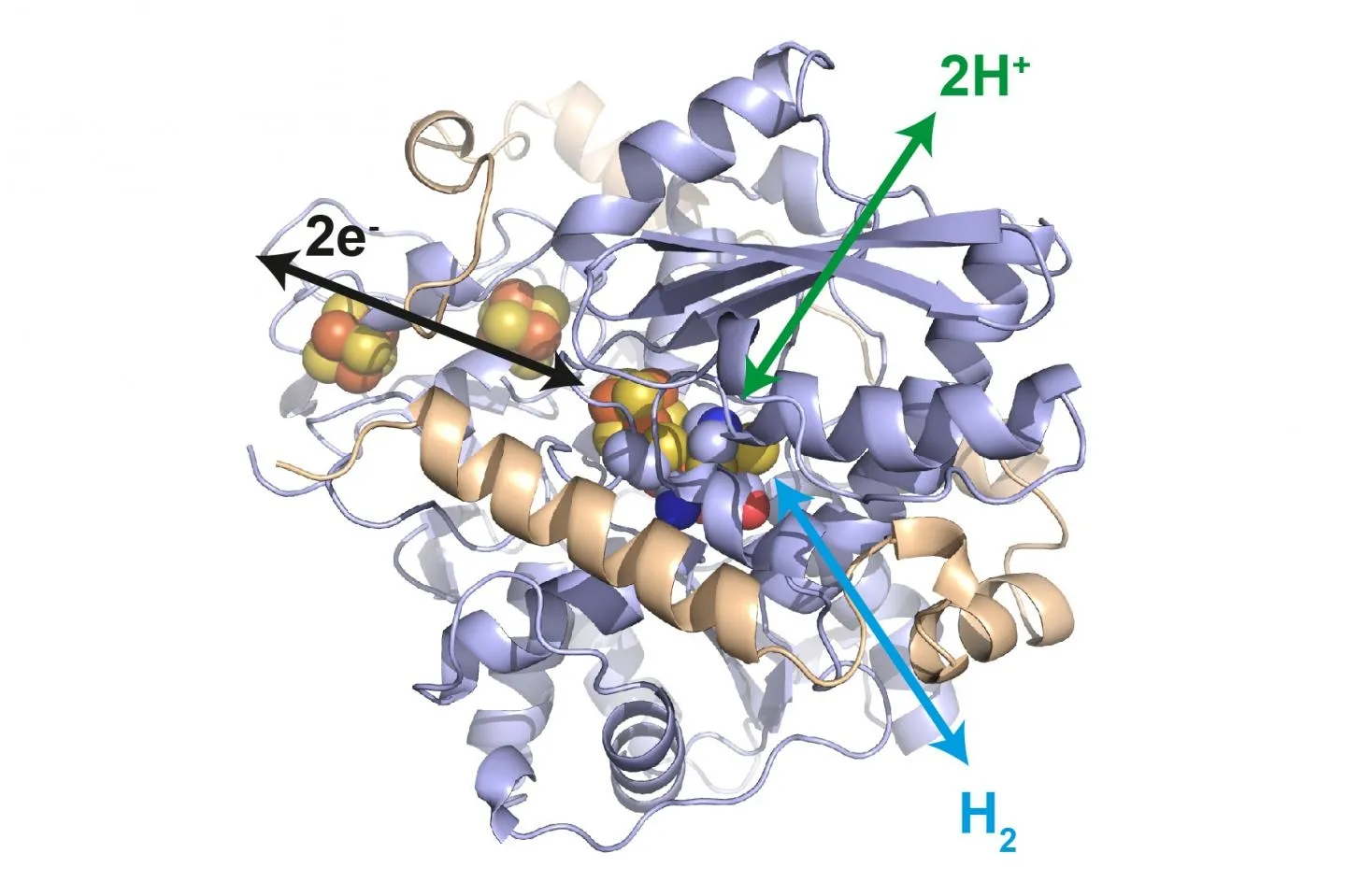
Platinum-free biocatalyst for fuel cells and water electrolysis

An enzyme system for the hydrogen industry
2021-05-12
(Press-News.org) An enzyme could make a dream come true for the energy industry: It can efficiently produce hydrogen using electricity and can also generate electricity from hydrogen. The enzyme is protected by embedding it in a polymer. An international research team with significant participation of scientists from Technical University of Munich (TUM) has presented the system in the renowned science journal Nature Catalysis.

Fuel cells turn hydrogen into electricity, while electrolysers use electricity to split water to produce hydrogen. Both need the rare and thus expensive precious metal platinum as a catalyst. Nature has created a different solution: Enzymes, referred to as hydrogenases. They catalyze the conversion of hydrogen very quickly and almost without energy loss.

However, in the past these biocatalysts were not considered suitable for industrial use because of their high sensitivity to oxygen. Now a research team from the Technical University of Munich (TUM), Ruhr-Universität Bochum (RUB), the French National Centre for Scientific Research (CNRS) in Marseille and the Max-Planck Institute for Chemical Energy Conversion has succeeded in embedding the sensitive enzymes in a protective polymer in a way that makes them viable for use in technical hydrogen conversion.

Durability vs. activity

"When the sensitive hydrogenases are embedded in suitable polymers they continue to work for several weeks, even in the presence of oxygen," says Nicolas Plumeré, Professor for Electrobiotechnology at the TUM Campus Straubing for Biotechnology and Sustainability. "Without this protection they lose their activity within a matter of minutes."

Embedding the hydrogenases in polymers whose side chains can transfer electrons, referred to as redox polymers, had nevertheless two decisive disadvantages: a high level of resistance countervailed the flow of electrons through the redox polymer. This required the investment of energy which was then lost in the form of heat. And the embedded hydrogenases completely lost their ability to generate hydrogen.

Fine tuning potential

With a clever selection of the right polymer side chains, the research team has now succeeded in setting the redox potential of the polymer in such a way that only a small overvoltage is necessary to overcome the resistance.

More detailed investigations then revealed that the potential of the side chains had shifted slightly to positive values due to the embedding in the polymer matrix. In a further attempt they used a side chain with a corresponding negative potential. This trick was the breakthrough: The hydrogenase was now capable of catalyzing the reaction in both directions without energy loss.

Biocatalyst for hydrogen conversion

Utilizing this system the research team then built a fuel cell, in which oxygen is reduced by the enzyme bilirubin oxidase from the bacterium Myrothecium verrucaria, while the hydrogenase embedded in the polymer film oxidizes the hydrogen from the bacterium desulfovibrio desulfuricans, generating electricity in the process.

The cell achieved a value, with an open circuit voltage of 1.16 V, the highest ever measured for a system of this type and close to the thermodynamic maximum. With three milliamperes per square centimeter the cell achieved a very high power density for biological cells at the same time.

The system can also be used for the reverse reaction, producing hydrogen by consuming electrons: The energy conversion efficiency is close to 100 percent, even with power densities of over four milliamperes per square centimeter.

Blueprint for new biocatalysts

"The reduction in energy loss has two decisive advantages," says Nicolas Plumeré. "First, it makes the system significantly more efficient; second, the heat generated in a fuel cell stack at high performance levels would pose a problem for biological systems."

In order to make their system competitive with systems that use platinum-based catalysts, the team's ongoing research is now focused on improving the stability of the hydrogenases at higher power densities.

Furthermore, the findings can also be transferred to other highly-active but sensitive catalysts for energy conversion and electrosynthesis. Direct objectives here are primarily carbon dioxide-reducing enzymes that can use electricity to produce liquid fuels or intermediate products from carbon dioxide.

INFORMATION:

The research was funded by a Starting Grant from the European Research Council (ERC), by the French Center National de la Recherche Scientifique (CNRS) and the Aix Marseille Université, the German Research Foundation (DFG) joint funding with the Agence Nationale de la Recherche, the DFG priority program "Iron - Sulfur for Life" (SPP 1927), the Max Planck Society and in the case of the RESOLV cluster of excellence by the Federal Ministry of Education and Research (BMBF) under the Excellence Strategy of the Federal Government and the German Federal States.

Publication:

Reversible H2 oxidation and evolution by hydrogenase embedded in a redox polymer film
Steffen Hardt, Stefanie Stapf, Dawit T. Filmon, James A. Birrell, Olaf Rüdiger, Vincent Fourmond, Christophe Léger & Nicolas Plumeré
Nature Catalysis Vol. 4, 251-258 (2021) - DOI: 10.1038/s41929-021-00586-1


[Attachments] See images for this press release:
An enzyme system for the hydrogen industry

ELSE PRESS RELEASES FROM THIS DATE:

Locomotion Vault will help guide innovations in virtual reality locomotion

2021-05-12
Experts in virtual reality locomotion have developed a new resource that analyses all the different possibilities of locomotion currently available. Moving around in a virtual reality world can be very different to walking or employing a vehicle in the real world and new approaches and techniques are continually being developed to meet the challenges of different applications. Called Locomotion Vault, the project was developed by researchers at the Universities of Birmingham, Copenhagen, and Microsoft Research. It aims to provide a central, freely-available ...

Xerocrassa montserratensis, an endemic and threatened snail in Catalonia

Xerocrassa montserratensis, an endemic and threatened snail in Catalonia
2021-05-12
A study published in the journal Scientific Reports reveals the genetic structure of the land snail Xerocrassa montserratensis and it provides new scientific tools for the improvement of the conservation of this endemic and threatened species in Catalonia. This land mollusc, identified in the late 19th century in the Montserrat mountain, has a reduced geographical distribution limited to the province of Barcelona, and it is a protected species in the area of the natural parks of Montserrat and Sant Llorenç del Munt i l'Obac. The study is led by the lecturer Marta Pascual, from the Faculty of Biology and the Biodiversity Research Institute of the University of Barcelona ...

20 days later -- The short story about muscles regeneration

20 days later -- The short story about muscles regeneration
2021-05-12
Skeletal muscles make a tremendous variety of actions stabilizing the body in different positions. Despite their endurance during daily activities, they can undergo several mild injuries caused by sport, accidental overstretching, or sudden overtwisting. Luckily mild injuries can be quickly healed; however, when a large part of muscles is damaged or resected surgically, the full recovery can be impossible. Muscle regeneration is challenging, but the development of innovative biocompatible materials tackles that problem. Recently, a multinational team of scientists led by dr. Marco Costantini from ...

Acta Pharmaceutica Sinica B Volume 11, Issue 4 publishes

Acta Pharmaceutica Sinica B Volume 11, Issue 4 publishes
2021-05-12
Acta Pharmaceutica Sinica B Volume 11, Issue 4 Publishes https://www.sciencedirect.com/journal/acta-pharmaceutica-sinica-b/vol/11/issue/4 Special Issue: The Biological Fate of Drug Nanocarriers This special issue includes seven review and nine research articles from some leading scientists in the field that further the discussion on subtopics of in vivo fate of drug nanocarriers. Guest Editors: Wei Wu, Professor, Department of Pharmaceutics, School of Pharmacy, Fudan University, Shanghai, China; Tonglei Li, Professor, Department of Industrial & Physical Pharmacy, Purdue University, West Lafayette, IN, USA; Ying Zheng, Professor, State Key Laboratory of Quality Research in Chinese Medicine, Institute of Chinese Medical Sciences, University of Macau, Macau, China. The Journal ...

Violinmaking meets artificial intelligence

Violinmaking meets artificial intelligence
2021-05-12
How to predict the sound produced by a tonewood block once carved into the shape of a violin plate? What is the best shape for the best sound? Artificial Intelligence offer answers to these questions. These are the conclusions that researchers of the Musical Acoustics Lab of Politecnico di Milano presented in a study that was recently published in Scientific Reports. In the article "A Data-Driven Approach to Violinmaking" the Chilean physicist and luthier Sebastian Gonzalez (post-doc researcher) and the professional mandolin player Davide Salvi (PhD student) show how a simple and effective neural network is able to predict the vibrational be-havior of violin plates. This prediction is obtained from a limited set of geometric and mechanical ...

LAMOST helps Gaia achieve millimagnitude photometry precision

LAMOST helps Gaia achieve millimagnitude photometry precision
2021-05-12
The Large Sky Area Multi-Object Fiber Spectroscopic Telescope (LAMOST) has helped Gaia achieve millimagnitude (mmag) precision in photometry, according to a study led by researchers from National Astronomical Observatories of Chinese Academy of Sciences (NAOC) and Beijing Normal University (BNU). Their study was published in The Astrophysical Journal. If you look at the sky on a clear, starry night, you may notice that Aldebran is relatively red and Rigel is blue. Why? The answer stems from their intrinsic physical properties. Precisely measuring magnitudes ...

Scientists observe rapid ozone fluctuations over the Antarctic polar vortex edge area

Scientists observe rapid ozone fluctuations over the Antarctic polar vortex edge area
2021-05-12
The polar vortex is a large area of upper-atmosphere cyclonic air circulation surrounding both poles. It is bounded by the polar jet stream and its associated cold air is usually confined to the polar regions. Within the Antarctic circle, and southern polar vortex, ozone quantities are the lowest, globally. A research published in Advances in Atmospheric Sciences, led by Dr. LUO Yuhan, corresponding author and Associate Professor at the Hefei Institutes of Physical Science (HFIPS), suggests that the polar vortex plays a key role in Antarctic stratospheric ozone depletion. "The atmosphere over Antarctica is controlled by a strong ...

Most frequently asked questions in rheumatology clinics answered

2021-05-12
May 1, 2021 - Rheumatologists in Hong Kong joined hands to develop a set of consensus statements on COVID-19 vaccination for local adult patients with autoimmune rheumatic diseases. These timely statements would serve to be a guide for rheumatologists, other specialists, family physicians, specialty nurses, and the public regarding COVID-19 vaccination for patients with rheumatic diseases. Vaccination against SAR-CoV-2 is a new campaign and a high immunization rate is believed to be the key to end the pandemic. Currently, there are two COVID-19 vaccines available in Hong Kong--the inactivated virus vaccine CoronaVac® ...

Drexel study: Parks not only safe, but essential during the pandemic

2021-05-12
Parks played an important role for people seeking respite from the toll of social isolation during the pandemic, and according to new research from Drexel University, they did so without increasing the spread of COVID-19. The study looked at how people used 22 parks in Philadelphia and New York during the height of the pandemic and it found no strong correlation between park use and the number of confirmed cases in surrounding neighborhoods. Published in the Journal of Extreme Events, Drexel's study "Urban Park Usage During the COVID-19 Pandemic" surveyed park visitors over a three-month period from May to July 2020 at small and mid-size parks in New York and Philadelphia. And it compared park usage numbers ...

New algorithm to ensure more accuracy in studying the interior of the Earth

New algorithm to ensure more accuracy in studying the interior of the Earth
2021-05-12
An essential preliminary to building and construction or resource extraction is studying the geological structure of the site. One of steps of this process is geophysical investigation. This provides a continuous overview of the geological horizons rather than just data on points: boreholes. The standard methods of geophysics help successfully solve this problem in comparatively simple conditions. Yet the classical direct current methods may lead to serious inaccuracy if we have to investigate geologically complex structures with thin layers of sandy and clayey soils. Among the most popular methods ...

LAST 30 PRESS RELEASES:

Scientists show how to predict world’s deadly scorpion hotspots

ASU researchers to lead AAAS panel on water insecurity in the United States

ASU professor Anne Stone to present at AAAS Conference in Phoenix on ancient origins of modern disease

Proposals for exploring viruses and skin as the next experimental quantum frontiers share US$30,000 science award

ASU researchers showcase scalable tech solutions for older adults living alone with cognitive decline at AAAS 2026

Scientists identify smooth regional trends in fruit fly survival strategies

Antipathy toward snakes? Your parents likely talked you into that at an early age

Sylvester Cancer Tip Sheet for Feb. 2026

Online exposure to medical misinformation concentrated among older adults

Telehealth improves access to genetic services for adult survivors of childhood cancers

Outdated mortality benchmarks risk missing early signs of famine and delay recognizing mass starvation

Newly discovered bacterium converts carbon dioxide into chemicals using electricity

Flipping and reversing mini-proteins could improve disease treatment

Scientists reveal major hidden source of atmospheric nitrogen pollution in fragile lake basin

Biochar emerges as a powerful tool for soil carbon neutrality and climate mitigation

Tiny cell messengers show big promise for safer protein and gene delivery

AMS releases statement regarding the decision to rescind EPA’s 2009 Endangerment Finding

Parents’ alcohol and drug use influences their children’s consumption, research shows

Modular assembly of chiral nitrogen-bridged rings achieved by palladium-catalyzed diastereoselective and enantioselective cascade cyclization reactions

Promoting civic engagement

AMS Science Preview: Hurricane slowdown, school snow days

Deforestation in the Amazon raises the surface temperature by 3 °C during the dry season

Model more accurately maps the impact of frost on corn crops

How did humans develop sharp vision? Lab-grown retinas show likely answer

Sour grapes? Taste, experience of sour foods depends on individual consumer

At AAAS, professor Krystal Tsosie argues the future of science must be Indigenous-led

From the lab to the living room: Decoding Parkinson’s patients movements in the real world

Research advances in porous materials, as highlighted in the 2025 Nobel Prize in Chemistry

Sally C. Morton, executive vice president of ASU Knowledge Enterprise, presents a bold and practical framework for moving research from discovery to real-world impact

Biochemical parameters in patients with diabetic nephropathy versus individuals with diabetes alone, non-diabetic nephropathy, and healthy controls

[Press-News.org] An enzyme system for the hydrogen industry
Platinum-free biocatalyst for fuel cells and water electrolysis