Nagoya University scientists reveal unprecedentedly versatile new DNA staining probe
New dye breaks new ground in versatility and capability, with applications in super high-resolution imaging and beyond
Published 2021-05-14 · Original archive entry · Explore research explainers
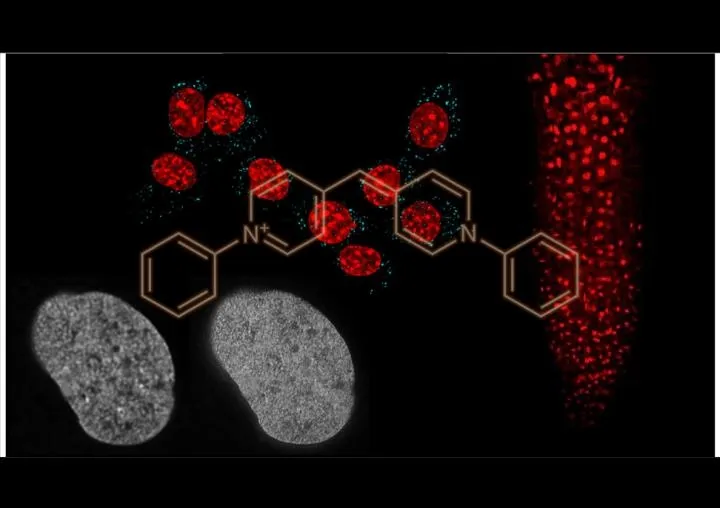
A group of scientists at Nagoya University, Japan, have developed an incredibly versatile DNA fluorescent dye, named 'Kakshine' after a former NU student of its members, Dr Kakishi Uno, but it also means to make the nucleus shine brightly, since the nucleus is pronounced 'Kaku' in Japanese. Dr Uno, with Dr Yoshikatsu Sato and Nagisa Sugimoto, the other two members of the research team at the Institute of Transformative Bio-Molecules (ITbM), succeeded in developing a DNA binding fluorescent dye with the pyrido cyanine backbone, which satisfied the three principal qualities required of such a dye - that it have high selectivity for DNA, ability to use visible light with limited phototoxicity, and be applicable to a wide range of organisms - in a way that no previous dye has been able to.
Adding to the central set of functions required for such a chemical, Kakshine and its derivatives are highly compatible with cutting-edge microscope techniques. They represent the first dye of its kind to achieve super-resolution imaging of mitochondrial DNA in living cells with STED imaging, a kind of microscopy whose resolution exceeds the diffraction limit of light. Additionally, they also enable deep tissue imaging by two-photon excitation imaging, discrimination of different organelle DNAs with a single dye by fluorescence lifetime imaging.
Kakshine is an exceptionally versatile new dyeing agent which improves upon the capabilities of and solves the shortcomings of current-generation fluorescent dyes in DNA imaging. Moreover, with applications in the medical and life science fields including electrophoresis, quantitative PCR and flow cytometry, Kakshine is expected to make a splash as the next-generation tool for DNA analysis.
Adding to the central set of functions required for such a chemical, Kakshine and its derivatives are highly compatible with cutting-edge microscope techniques. They represent the first dye of its kind to achieve super-resolution imaging of mitochondrial DNA in living cells with STED imaging, a kind of microscopy whose resolution exceeds the diffraction limit of light. Additionally, they also enable deep tissue imaging by two-photon excitation imaging, discrimination of different organelle DNAs with a single dye by fluorescence lifetime imaging.
Kakshine is an exceptionally versatile new dyeing agent which improves upon the capabilities of and solves the shortcomings of current-generation fluorescent dyes in DNA imaging. Moreover, with applications in the medical and life science fields including electrophoresis, quantitative PCR and flow cytometry, Kakshine is expected to make a splash as the next-generation tool for DNA analysis.
INFORMATION: