PRESS-NEWS.org - Press Release Distribution
PRESS RELEASES DISTRIBUTION

Novel SERS sensor helps to detect aldehyde gases

Novel SERS sensor helps to detect aldehyde gases
2021-06-10
(Press-News.org) Prof. HUANG Qing's group from the Hefei Institutes of Physical Science (HFIPS) developed a surface-enhanced Raman spectroscopy (SERS) gas sensor to detect aldehyde with high sensitivity and selectivity, which provided a new detection method for studying the adsorption of gas molecules on porous materials. The relevant research results have been published in Analytical Chemistry.

Adsorption technology is one of the main technologies for treating Volatile organic compounds (VOCs). Over the past years, metal-organic frameworks (MOFs) have attracted high interest for their outstanding adsorption property. Closely related to MOFs, layered double hydroxides (LDHs), also known as hydrotalcite-like systems or anionic clays, have received special attention for their improved adsorption properties due to the enhanced porosity and chemical affinity at multiple active sites.

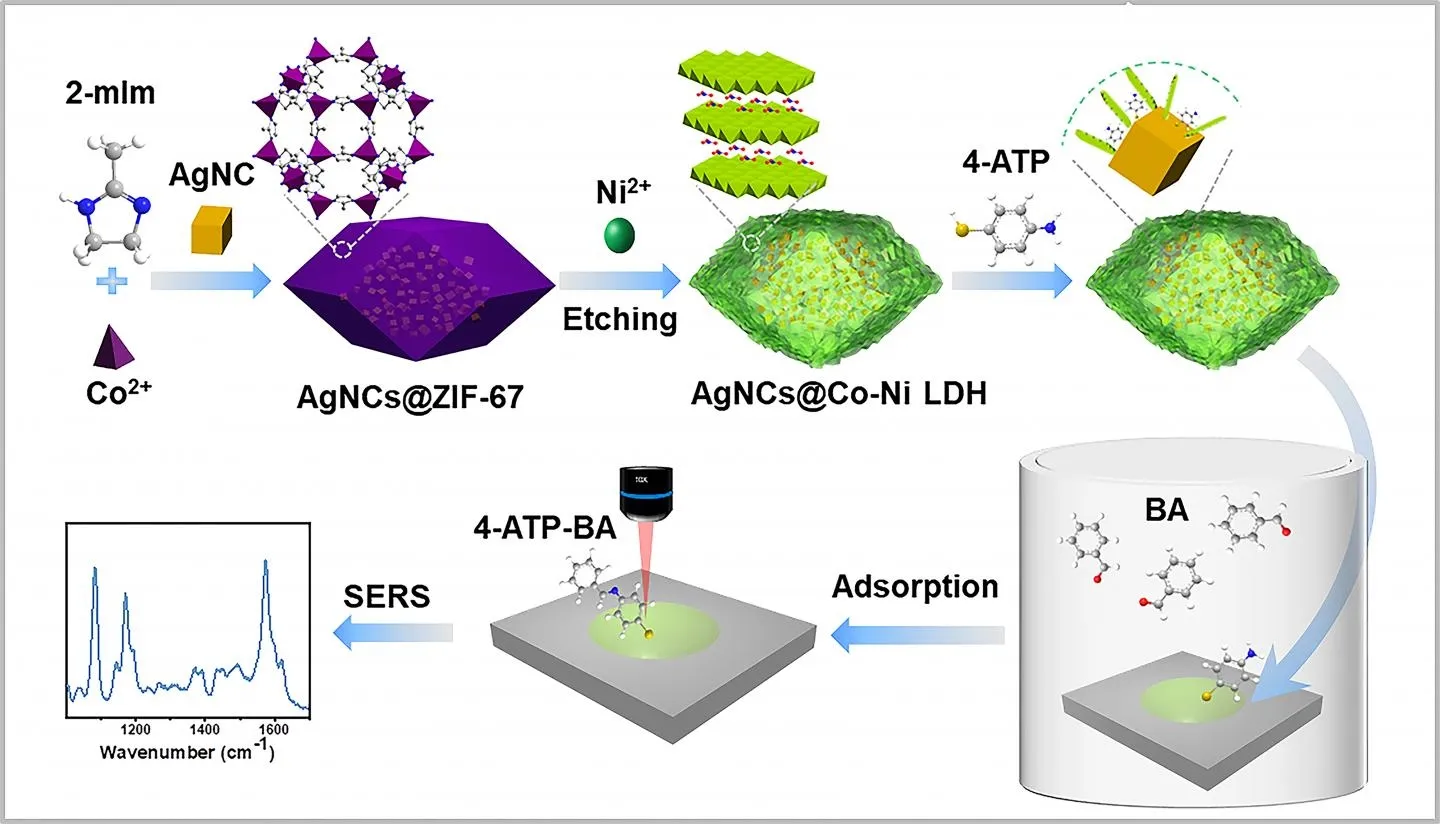
In this study, silver nanocubes (AgNCs) and Co-Ni LDH composite nanomaterials were prepared in template sacrifice method, and modified with 4-aminophenol (4-ATP) for both trapping and probe functions. Based on the as-prepared composite material, researchers constructed a high-efficiency gas sensor for selective detection of aldehyde gas.

"This SERS sensor has ultrahigh sensitivity for aldehyde gas," said XU Di, the first author of this paper, "we verified its accuracy, repeatability and selectivity in the experiment."

Combined with principal component analysis method, they successfully identified and analyzed the similar SERS spectrum of aldehyde gases with the sensor, indicating application value.

They further investigated the adsorption kinetics and thermodynamic process of benzaldehyde molecules on Co-Ni LDH with the sensor. The kinetic adsorption process could be fitted better by the pseudo-first-order kinetics with a higher correlation coefficient than by a pseudo-second-order model. The isotherm adsorption fits the Langmuir isotherm model, and its adsorption constant is 6.25 × 10⁶ L/mol, indicating that the adsorption sites of the composites were homogeneous and dominated by monolayer chemisorption.

This study established a new measurement method for probing the adsorption process with extremely low consumption of both adsorbates and adsorbents, but also may lay the groundwork for the construction of rapid and ultra-sensitive SERS sensors for probing VOCs in the future.

INFORMATION:

This work was supported by the National Natural Science Foundation of China.


[Attachments] See images for this press release:
Novel SERS sensor helps to detect aldehyde gases

ELSE PRESS RELEASES FROM THIS DATE:

Model shows sharp decrease in HIV incidence in England

2021-06-10
The annual number of new HIV infections among men who have sex with men (MSM) in England is likely to have fallen dramatically, from 2,770 in 2013 to 854 in 2018, showing elimination of HIV transmission by 2030 to be within reach - suggests work by researchers from the MRC Biostatistics Unit at the University of Cambridge and Public Health England (PHE), published in The Lancet HIV. To manage the HIV epidemic among MSM in England, enhanced testing and earlier treatment strategies were scaled-up between 2011 and 2015 and supplemented from 2015 by pre-exposure prophylaxis (PrEP). The researchers examined the effect of these interventions on the number of new infections and investigated ...

Research establishes safe water thresholds for antimicrobials, to help mitigate resistance

2021-06-10
Researchers have made progress towards a G7 commitment to establish safe standards for the release of antimicrobials into the environment, by developing a new framework that establishes safe thresholds. The threat of bacteria developing resistance to antimicrobial drugs (often called antibiotics) used to treat infection is one of the greatest global health challenges, potentially resulting in 10 million deaths per year by 2050. A major issue is the spread of antimicrobials and resistant bacteria through water systems. When we take antibiotics, 70 per cent passes through our bodies into wastewater. Farm animals are treated with antibiotics which ...

Botany: Scent of death attracts coffin flies to pipevine flowers

Botany: Scent of death attracts coffin flies to pipevine flowers
2021-06-10
Plants use numerous mechanisms for their pollination. Now botanists have discovered a particularly sophisticated system among pipevines that is based purely on deception. The flowers of the Greek plant Aristolochia microstoma emit a foul, musty scent that seems to mimic the smell of decaying insects. The fly pollinators from the genus Megaselia likely get attracted to this odor while searching for arthropod corpses to potentially mate over and lay their eggs. Then, when entering the tube of an Aristolochia flower, the flies are guided by downward-pointing hairs into a small chamber, which holds the female and male floral organs. Trapped inside, they deposit pollen they carry onto the stigma, before the stamens ripen and ...

Researchers' algorithm to make CRISPR gene editing more precise

2021-06-10
It eventually became a Nobel prize-winning revolution when researchers first engineered CRISPR as a gene editing technology for bacterial, plant, animal and human cells. The potential of the technology is great and span from curing genetically disposed diseases to applications in agricultural and industrial biotechnology, but there are challenges. One such challenge consists of selecting a so-called gRNA molecule which should be designed to guide the Cas9 protein to the right location in the DNA where it will make a cut in relation to the gene editing. "Typically, there are multiple possible gRNAs and they are not all equally efficient. Therefore, ...

New way to 3D-print custom medical devices to boost performance and bacterial resistance

New way to 3D-print custom medical devices to boost performance and bacterial resistance
2021-06-10
Using a new 3D printing process, University of Nottingham researchers have discovered how to tailor-make artificial body parts and other medical devices with built-in functionality that offers better shape and durability, while cutting the risk of bacterial infection at the same time. Study lead, Dr Yinfeng He, from the Centre for Additive Manufacturing, said: "Most mass-produced medical devices fail to completely meet the unique and complex needs of their users. Similarly, single-material 3D printing methods have design limitations that cannot produce a bespoke device with multiple biological or mechanical functions. "But for the first time, using a computer-aided, multi-material ...

RUDN University chemist proposed eco-friendly synthesis of fluorescent compounds for medicine

RUDN University chemist proposed eco-friendly synthesis of fluorescent compounds for medicine
2021-06-10
RUDN and Shahid Beheshti University(SBU) chemist proposed an eco-friendly method for the synthesis of pyrrole and pyrazole derivatives with a wide range of applications in medicine: from antidepressants to anticancer. Moreover, the synthesized compounds possess interesting fluorescence features, and the bioactive scaffolds might attract great interest in the fields of clinical diagnostics and biomedical research in the future. The results are published in the Organic & Biomolecular Chemistry. Heterocyclic compounds expose remarkable chemistry with significant applications in medicinal and organic chemistry, industry, and pharmaceutical. These compounds are widely ...

Machines can help wine grape industry survive labor shortage

Machines can help wine grape industry survive labor shortage
2021-06-10
Wine grape growers in California and elsewhere face increasing labor costs and severe labor shortages, making it difficult to manage and harvest a vineyard while maintaining profitability. Growers are increasingly turning to machines for pruning, canopy management and harvesting, but how well these practices are executed can substantially affect yield and quality. A new review by researchers at the University of California, Davis, published in the journal Catalyst, provides guidelines for growers to make the best use of machines. "Wine grape laborers have been virtually nonexistent. People don't want to work in vineyards anymore because it's remote, tough work," said Kaan Kurtural, professor of viticulture and enology and extension ...

IPBES/IPCC: Tackling the biodiversity and climate crises together, and their combined social impacts

IPBES/IPCC: Tackling the biodiversity and climate crises together, and their combined social impacts
2021-06-10
BONN, 10 June - Unprecedented changes in climate and biodiversity, driven by human activities, have combined and increasingly threaten nature, human lives, livelihoods and well-being around the world. Biodiversity loss and climate change are both driven by human economic activities and mutually reinforce each other. Neither will be successfully resolved unless both are tackled together. This is the message of a workshop report, published today by 50 of the world's leading biodiversity and climate experts. The peer-reviewed workshop report is the product of a four-day virtual workshop between ...

Nicotinamide can 'immunize' plants to protect from fungal disease

Nicotinamide can immunize plants to protect from fungal disease
2021-06-10
Kanazawa, Japan - Fungal diseases in cereal crops cause major economic losses and also threaten human and livestock health, because some fungi produce powerful toxins that might enter the food chain. Farmers use fungicides to control crop diseases, such as wheat head blight. Although agrochemicals are rigorously tested for safety, there can be concerns over chemical residues in food. Now, researchers at Kanazawa University, in collaboration with colleagues at Ehime University and Nagoya University, have shown that the natural substance nicotinamide (NIM - a vitamin found in food and used as a dietary supplement) can help stimulate ...

Lunar sample tells ancient story with help of Curtin's world-class facilities

2021-06-10
Curtin University researchers have helped uncover the four billion year old story of a lunar sample brought from the Moon to Earth, by the manned Apollo 17 mission more than 50 years ago. The global research collaboration, involving scientists from the UK, Canada, Sweden and Australia, aimed to analyse the ancient rock sample through a modern lens to find out its age, which crater it came from and its geological trajectory. That modern lens was provided, in part, by both Curtin's Geoscience Atom Probe Facility* and Space Science and Technology Centre* (SSTC) where the research team was ...

LAST 30 PRESS RELEASES:

AI machine learning can optimize patient risk assessments

Efficacy of immunosuppressive regimens for survival of stem cell-derived grafts

Glowing bacterial sensors detect gut illness in mice before symptoms emerge

GLP-1 RAs and prior major adverse limb events in patients with diabetes

Life-course psychosocial stress and risk of dementia and stroke in middle-aged and older adults

Cells have a built-in capacity limit for copying DNA, and it could impact cancer treatment

Study finds longer hospital stays and higher readmissions for young adults with complex childhood conditions

Study maps how varied genetic forms of autism lead to common features

New chip-sized, energy-efficient optical amplifier can intensify light 100 times

New light-based platform sets the stage for future quantum supercomputers

Pesticides significantly affect soil life and biodiversity

Corals sleep like us, but their symbiosis does not rest

Huayuan biota decodes Earth’s first Phanerozoic mass extinction

Beyond Polymers: New state-of-the-art 3D micro and nanofabrication technique overcomes material limitations

New platform could develop vaccines faster than ever before

TF-rs1049296 C>T variant modifies the association between hepatic iron stores and liver fibrosis in metabolic dysfunction-associated steatotic liver disease

ASH publishes clinical practice guidelines on diagnosis of light chain amyloidosis

SLAS receives grant from Alfred P. Sloan Foundation to develop lab automation educational guidelines

Serum interleukin-8 for differentiating invasive pulmonary aspergillosis from bacterial pneumonia in patients with HBV-associated acute-on-chronic liver failure

CIIS and the Kinsey Institute present "Desire on the Couch," an exhibition examining psychology and sexuality

MRI scan breakthrough could spare thousands of heart patients from risky invasive tests

Kraft Center at Mass General Brigham launches 2nd Annual Kraft Prize for Excellence and Innovation in Community Health

New tool shows how to enter and change pneumocystis fungi

Applications of artificial intelligence and smart devices in metabolic dysfunction-associated steatotic liver disease

New clinical trial demonstrates that eating beef each day does not affect risk factors for type 2 diabetes

Powering AI from space, at scale

New Watson College seed grants encourage interdisciplinary research

A new immune evasion pathway in cancer reveals statins as immunotherapy boosters

Understanding how smart polymer solutions transition to gels around body temperature

Thermal transport modulation in YbN-alloyed ALN thin films to the glassy limit

[Press-News.org] Novel SERS sensor helps to detect aldehyde gases