PRESS-NEWS.org - Press Release Distribution
PRESS RELEASES DISTRIBUTION

Saliva can be more effective than nasopharyngeal swabs for COVID-19 testing

Addition of a simple processing step to saliva samples before testing may improve COVID-19 detection rate, eliminate the challenges of nasopharyngeal testing, and facilitate mass surveillance, researchers report in The Journal of Molecular Diagnostics

Saliva can be more effective than nasopharyngeal swabs for COVID-19 testing
2021-06-10
(Press-News.org) Philadelphia, June 10, 2021 - The collection of nasopharyngeal swab (NPS) samples for COVID-19 diagnostic testing poses challenges including exposure risk to healthcare workers and supply chain constraints. Saliva samples are easier to collect but can be mixed with mucus or blood, and some studies have found they produce less accurate results. A team of researchers has found that an innovative protocol that processes saliva samples with a bead mill homogenizer before real-time PCR (RT-PCR) testing results in higher sensitivity compared to NPS samples. Their protocol appears in The Journal of Molecular Diagnostics, published by Elsevier.

"Saliva as a sample type for COVID-19 testing was a game changer in our fight against the pandemic. It helped us with increased compliance from the population for testing along with decreased exposure risk to the healthcare workers during the collection process," said lead investigator Ravindra Kolhe, MD, PhD, Department of Pathology, Medical College of Georgia, Augusta University, Augusta, GA, USA.

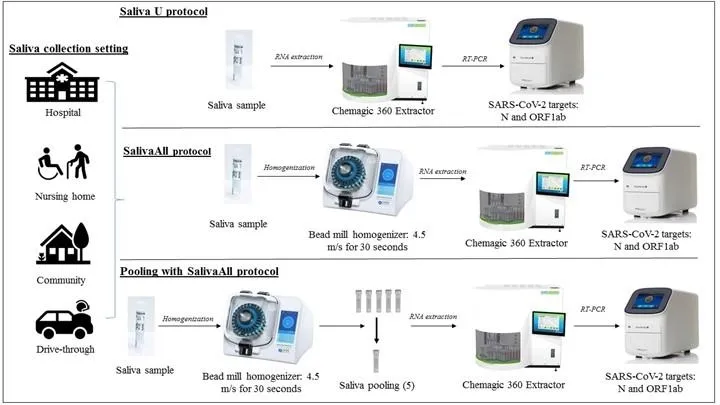
The study included samples from a hospital and nursing home as well as from a drive-through testing site. In the first phase (protocol U), 240 matched NPS and saliva sample pairs were tested prospectively for SARS-CoV-2 RNA by RT-PCR. In the second phase of the study (SalivaAll), 189 matched pairs, including 85 that had been previously evaluated with protocol U, were processed in an Omni bead mill homogenizer before RT-PCR testing. An additional study was conducted with samples with both protocol U and SalivaAll to determine if bead homogenization would affect the clinical sensitivity in NPS samples. Finally, a five-sample pooling strategy was evaluated. Twenty positive pools containing one positive and four negative samples were processed with the Omni bead homogenizer before pooling for SARS-CoV-2 RT-PCR testing and compared to controls.

In Phase I, 28.3 percent of samples tested positive for SARS-CoV-2 from either NPS, saliva, or both. The detection rate was lower in saliva compared to NPS (50.0 percent vs. 89.7 percent). In Phase II, 50.2 percent of samples tested positive for SARS-CoV-2 from either saliva, NPS, or both. The detection rate was higher in saliva compared to NPS samples (97.8 percent vs. 78.9 percent). Of the 85 saliva samples tested with both protocols, the detection rate was 100 percent for samples tested with SalivaAll and 36.7 percent with protocol U.

Dr. Kolhe observed that the underlying issues associated with lower sensitivity of saliva to RT-PCR testing could be attributed to the gel-like consistency of saliva samples, which made it difficult to accurately pipet samples into extraction plates for nucleic acid extraction. Adding the homogenization step rendered the saliva samples to uniform viscosity and consistency, making it easier to pipet for the downstream assay.

Dr. Kolhe and his colleagues also successfully validated saliva samples in the five-sample pooling strategy. The pooled testing results demonstrated a positive agreement of 95 percent, and the negative agreement was found to be 100 percent. Pooled testing will be critical for SARS-CoV-2 mass surveillance as schools reopen, travel and tourism resume, and people return to offices.

"Monitoring SARS-CoV-2 will remain a public health need," Dr. Kolhe said. "The use of a non-invasive collection method and easily accessible sample such as saliva will enhance screening and surveillance activities and bypass the need for sterile swabs, expensive transport media, and exposure risk, and even the need for skilled healthcare workers for sample collection."

INFORMATION:


[Attachments] See images for this press release:
Saliva can be more effective than nasopharyngeal swabs for COVID-19 testing

ELSE PRESS RELEASES FROM THIS DATE:

Printing flexible wearable electronics for smart device applications

Printing flexible wearable electronics for smart device applications
2021-06-10
WASHINGTON, June 10, 2021 -- The demand for flexible wearable electronics has spiked with the dramatic growth of smart devices that can exchange data with other devices over the internet with embedded sensors, software, and other technologies. Researchers consequently have focused on exploring flexible energy storage devices, such as flexible supercapacitators (FSCs), that are lightweight and safe and easily integrate with other devices. FSCs have high power density and fast charge and discharge rates. Printing electronics, manufacturing electronics devices and systems by using conventional printing techniques, has proved to be an economical, simple, and scalable strategy for fabricating FSCs. Traditional micromanufacturing ...

New family of atomic-thin electride materials discovered

New family of atomic-thin electride materials discovered
2021-06-10
An exploratory investigation into the behavior of materials with desirable electric properties resulted in the discovery of a structural phase of two-dimensional (2D) materials. The new family of materials are electrides, wherein electrons occupy a space usually reserved for atoms or ions instead of orbiting the nucleus of an atom or ion. The stable, low-energy, tunable materials could have potential applications in nanotechnologies. The international research team, led by Hannes Raebiger, associate professor in the Department of Physics at Yokohama National University in Japan, published their results on June 10th as frontispiece in Advanced Functional Materials. Initially, the team ...

Study shows how permafrost releases methane in the warming Arctic

2021-06-10
Researchers from Skoltech have designed and conducted experiments measuring gas permeability under various conditions for ice-containing sediments mimicking permafrost. Their results can be useful both in modeling and testing techniques for gas production from Arctic reservoirs and in tracing methane emission in high latitudes. The paper was published in the journal Energy&Fuels. Permafrost, even though it sounds very stable and permanent, is actually quite diverse: depending on the composition of the frozen ground, pressure, temperature and so on, it can have varying properties, which are extremely important if you want to build something on permafrost, ...

'Roadmaps' of the brain reveal regions vulnerable to Alzheimer's disease

2021-06-10
GRAND RAPIDS, Mich. (JUNE 10, 2021) -- Much like a supply truck crossing the countryside, the misfolded proteins that damage neurons in Alzheimer's disease travel the "roads" of the brain, sometimes stopping and sometimes re-routing to avoid roadblocks, reports a study published in END ...

COVID-19 creates hearing, balance disorders, aggravates tinnitus symptoms

2021-06-10
MELVILLE, N.Y., June 10, 2021 -- The physiological impacts of COVID-19 seem almost limitless. Complications can range from loss of taste to respiratory distress, with many effects lasting for months. Evidence suggests auditory and vestibular effects should be added to the growing list of symptoms. During the 180th Meeting of the Acoustical Society of America, which will be held virtually June 8-10, Colleen Le Prell, from the University of Texas at Dallas, will talk about hearing and balance disorders associated with coronavirus infection and how pandemic-related stress ...

First AI-based tool for predicting genomic subtypes of pancreatic cancer from histology slides

2021-06-10
Paris, France and New York, NY June 10, 2021 - AP-HP Greater Paris University Hospitals, the leading European clinical trial center with the largest amount of healthcare data in France dedicated to research and Owkin, a startup pioneering Federated Learning and AI technologies for medical research and clinical development, announced the recent results of their ongoing strategic collaboration at ASCO 2021. The abstract and poster entitled "Identification of pancreatic adenocarcinoma molecular subtypes on histology slides using deep learning models" demonstrates the first ...

AMP recommends minimum set of pharmacogenetic alleles to guide clinical CYP2D6 genotype testing, pro

2021-06-10
ROCKVILLE, Md. - June 10, 2021 - The Association for Molecular Pathology (AMP), the premier global, molecular diagnostic professional society, today published consensus recommendations to aid in the design and validation of clinical CYP2D6 assays, promote standardization of testing across different laboratories and improve patient care. The manuscript, "Recommendations for Clinical CYP2D6 Genotyping Allele Selection: A Joint Consensus Recommendation of the Association for Molecular Pathology, College of American Pathologists, Dutch Pharmacogenetics Working Group of the Royal Dutch Pharmacists Association, and European Society for Pharmacogenomics and Personalized Therapy," was released online ahead of publication in The Journal ...

New method to measure milk components has potential to improve dairy sustainability

2021-06-10
Champaign, IL, June 10, 2021 - Present in blood, urine, and milk, the chemical compound urea is the primary form of nitrogen excretion in mammals. Testing for urea levels in dairy cows helps scientists and farmers understand how effectively nitrogen from feed is used in cows' bodies, with important economic implications for farmers in terms of feed costs, physiological effects for cows such as reproductive performance, and environmental impacts from excretion of nitrogen in dairy cow waste. Thus, accuracy in testing dairy cow urea levels is essential. Since the 1990s, mid-infrared testing of milk urea nitrogen (MUN) has been the most efficient and least invasive way to measure nitrogen use by dairy cows in large numbers. In a recent ...

Combating maritime litter

Combating maritime litter
2021-06-10
Plastic bottles drifting in the sea; bags in the stomachs of turtles; Covid-19 masks dancing in the surf: few images are as unpleasant to look at as those that show the contamination of our oceans. And few environmental issues are as urgent and as present in the public awareness. "Most people have an emotional connection to the sea. They think of ocean pollution as an attack on a place they long for," said Nikoleta Bellou, marine scientist at Hereon's Institute of Coastal System - Analysis and Modeling. Between 1990 and 2015 alone, an estimated 100 million metric tons of mostly plastic waste entered the oceans. For that instance the study fits to the UN Decade of Ocean Science for Sustainable Development, which started this year to emphasize a sustainable use of ...

BU researchers create novel curriculum assessment tool to improve medical education about sexual and gender minority (LGBTQI) populations

2021-06-10
(Boston)--Medical education aspires to mitigate bias in future professionals by providing a robust curriculum that includes perspectives and practices for caring for sexual and gender minority (SGM) populations, including lesbian, gay, bisexual, transgender and intersex (LGBTQI) persons. To provide medical schools with a more systematic, uniform approach to teaching these topics in their curriculum, the Association of American Medical Colleges (AAMC) in 2014 published 30 SGM competencies and topics that curricula should address. However, implementation of these ideals remains challenging. Building off the AAMC's comprehensive ...

LAST 30 PRESS RELEASES:

Enzymes work as Maxwell's demon by using memory stored as motion

Methane’s missing emissions: The underestimated impact of small sources

Beating cancer by eating cancer

How sleep disruption impairs social memory: Oxytocin circuits reveal mechanisms and therapeutic opportunities

Natural compound from pomegranate leaves disrupts disease-causing amyloid

A depression treatment that once took eight weeks may work just as well in one

New study calls for personalized, tiered approach to postpartum care

The hidden breath of cities: Why we need to look closer at public fountains

Rewetting peatlands could unlock more effective carbon removal using biochar

Microplastics discovered in prostate tumors

ACES marks 150 years of the Morrow Plots, our nation's oldest research field

Physicists open door to future, hyper-efficient ‘orbitronic’ devices

$80 million supports research into exceptional longevity

Why the planet doesn’t dry out together: scientists solve a global climate puzzle

Global greening: The Earth’s green wave is shifting

You don't need to be very altruistic to stop an epidemic

Signs on Stone Age objects: Precursor to written language dates back 40,000 years

MIT study reveals climatic fingerprints of wildfires and volcanic eruptions

A shift from the sandlot to the travel team for youth sports

Hair-width LEDs could replace lasers

The hidden infections that refuse to go away: how household practices can stop deadly diseases

Ochsner MD Anderson uses groundbreaking TIL therapy to treat advanced melanoma in adults

A heatshield for ‘never-wet’ surfaces: Rice engineering team repels even near-boiling water with low-cost, scalable coating

Skills from being a birder may change—and benefit—your brain

Waterloo researchers turning plastic waste into vinegar

Measuring the expansion of the universe with cosmic fireworks

How horses whinny: Whistling while singing

US newborn hepatitis B virus vaccination rates

When influencers raise a glass, young viewers want to join them

Exposure to alcohol-related social media content and desire to drink among young adults

[Press-News.org] Saliva can be more effective than nasopharyngeal swabs for COVID-19 testing
Addition of a simple processing step to saliva samples before testing may improve COVID-19 detection rate, eliminate the challenges of nasopharyngeal testing, and facilitate mass surveillance, researchers report in The Journal of Molecular Diagnostics