Systolic blood pressure above 120 mmHg increases rate of cardiovascular disease
Provides insight on what blood pressure targets in patients with hypertension according to glucose status should be
Published 2021-06-23 · Original archive entry · Explore research explainers
Niigata, Japan - An estimated 1.13 billion people worldwide have hypertension or high blood pressure, and two-thirds of these individuals are living in low- and middle-income countries. Blood pressure is the force manifested by circulating blood against the walls of the body's arteries, the major blood vessels in the body. Hypertension is when blood pressure is too high.
Blood pressure is written as two numbers. The first (systolic) number represents the pressure in blood vessels when the heart contracts or beats. The second (diastolic) number represents the pressure in the vessels when the heart rests between beats. Hypertension is diagnosed if, when it is measured on two different days, the systolic blood pressure (SBP) readings on both days is ≥140 mmHg and/or the diastolic blood pressure (DBP) readings on both days is ≥90 mmHg.
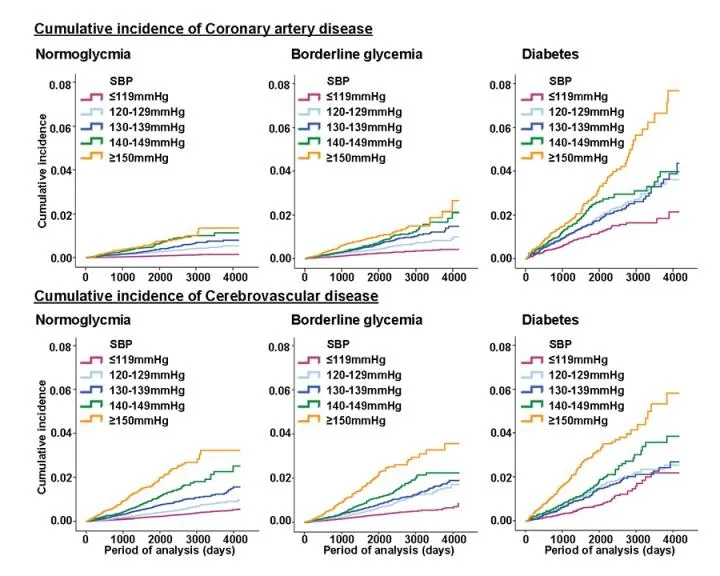
Worldwide, high blood pressure is a common and strong risk factor for the development of cardiovascular disease. As reported by previous studies in Asia and elsewhere, as the level of SBP rises, the risk of developing cardiovascular disease increases, too. Similarly, the likelihood of dying from a cardiovascular event increases as the SBP rises. However, whether these observations hold for increases in DBP is not known. Moreover, although a high blood glucose status is itself associated with a high likelihood for the development of cardiovascular disease, it is not known whether the blood glucose status plays any role in the relationship between high blood pressure and cardiovascular events.
This theory led the authors to propose a hypothesis for their study. Commenting further, Dr. Kazuya Fujihara of the Department of Internal Medicine, Faculty of Medicine, Niigata University, said "The 2017 American College of Cardiology (ACC)/American Heart Association (AHA) BP guideline defined blood pressure >130/80 mm Hg as hypertension. This guideline showed that the normal level is less than 120/80 mm Hg and SBP 120-129 mm Hg and DBP END
Blood pressure is written as two numbers. The first (systolic) number represents the pressure in blood vessels when the heart contracts or beats. The second (diastolic) number represents the pressure in the vessels when the heart rests between beats. Hypertension is diagnosed if, when it is measured on two different days, the systolic blood pressure (SBP) readings on both days is ≥140 mmHg and/or the diastolic blood pressure (DBP) readings on both days is ≥90 mmHg.
Worldwide, high blood pressure is a common and strong risk factor for the development of cardiovascular disease. As reported by previous studies in Asia and elsewhere, as the level of SBP rises, the risk of developing cardiovascular disease increases, too. Similarly, the likelihood of dying from a cardiovascular event increases as the SBP rises. However, whether these observations hold for increases in DBP is not known. Moreover, although a high blood glucose status is itself associated with a high likelihood for the development of cardiovascular disease, it is not known whether the blood glucose status plays any role in the relationship between high blood pressure and cardiovascular events.
This theory led the authors to propose a hypothesis for their study. Commenting further, Dr. Kazuya Fujihara of the Department of Internal Medicine, Faculty of Medicine, Niigata University, said "The 2017 American College of Cardiology (ACC)/American Heart Association (AHA) BP guideline defined blood pressure >130/80 mm Hg as hypertension. This guideline showed that the normal level is less than 120/80 mm Hg and SBP 120-129 mm Hg and DBP END