PRESS-NEWS.org - Press Release Distribution
PRESS RELEASES DISTRIBUTION

New catalyst helps turn plastic waste into useful organosilane compounds
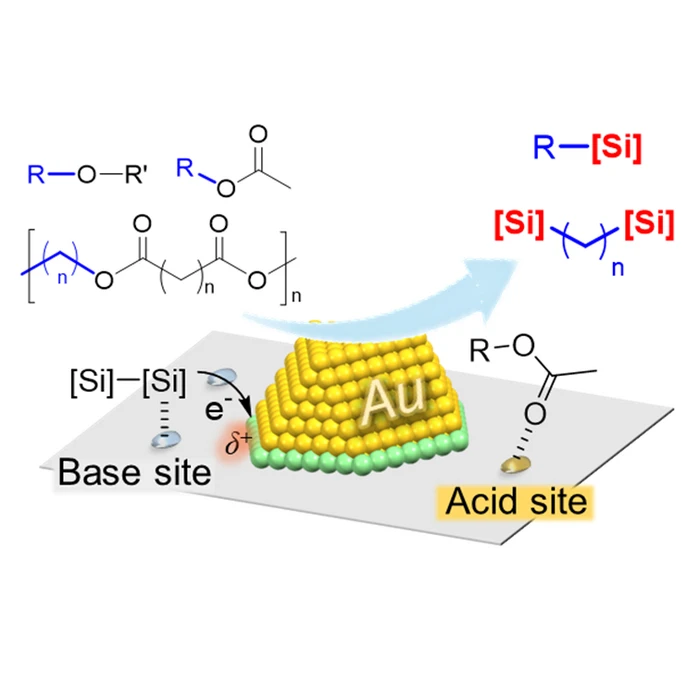
Supported gold nanoparticle catalyst can upcycle polyester and biomass

New catalyst helps turn plastic waste into useful organosilane compounds
2023-03-18
(Press-News.org)

Tokyo, Japan – Researchers from Tokyo Metropolitan University have found that gold nanoparticles supported on a zirconium oxide surface help turn waste materials like biomass and polyester into organosilane compounds, valuable chemicals used in a wide range of applications. The new protocol leverages the cooperation between gold nanoparticles and the amphoteric (both acid and base) nature of the zirconium oxide support. The result is a reaction that requires less demanding conditions, a greener method for upcycling waste.


Recycling is a big part of humanity’s solution to the global issue of plastic waste. Much of it is about turning plastic waste into plastic products. However, scientists have also been exploring alternative approaches to encourage the use of waste materials as a resource. This includes upcycling, the conversion of waste material into entirely new compounds and products which can be more valuable than the materials used to make them.

A team of researchers from Tokyo Metropolitan University led by Associate Professor Hiroki Miura has been working on the conversion of plastic and biomass to organosilanes, organic molecules with a silicon atom attached to form a carbon-silicon bond. Organosilanes are valuable materials in high-performance coatings and intermediates in the production of pharmaceuticals and agrochemicals. However, the addition of the silicon atom often involves reagents which are sensitive to air, moisture and require high temperatures, not to mention harshly acidic or basic conditions. This potentially makes the conversion process itself an environmental burden.

Now, the team has applied a hybrid catalyst material consisting of gold nanoparticles supported on a zirconium oxide support. The catalyst takes ether and ester groups, both abundant in plastics like polyester and biomass compounds like cellulose and helps them react with a silicon containing compound known as a disilane. Under mild heating in solution, they successfully created organosilane groups where the ester or ether group was situated. Through detailed studies of the mechanism, the team found that the cooperation between the gold nanoparticles and the amphoteric (both basic and acidic) nature of the support was responsible for the effective, high-yield conversion of the raw material under mild conditions.

Given that plastic waste disposal often requires combustion or harshly acidic/basic conditions, the process itself already provides an easy route to decompose polyesters under much less demanding conditions. However, the key point here is that the products of the reaction are themselves valuable compounds, ready for new applications. The team hopes that this new route to organosilane production forms part of our pathway to a carbon neutral future, where plastics do not make their way into the environment, but into more useful products in society.

This work was supported by the Program for Element Strategy Initiative for Catalysts and Batteries (ESICB) (Grant Number JPMXP0112101003), the JST FOREST Program (Grant Number JPMJFR203V), Grants-in-Aid for Scientific Research (B) (Grant Number 21H01719), Challenging Research (Exploratory) (Grant Number 22K18927), and Scientific Research on Innovative Areas (Grant 17H06443) commissioned by MEXT, Japan.

END


[Attachments] See images for this press release:
New catalyst helps turn plastic waste into useful organosilane compounds

ELSE PRESS RELEASES FROM THIS DATE:

DOE funds next-generation Center for Bioenergy Innovation to advance renewable jet fuel

DOE funds next-generation Center for Bioenergy Innovation to advance renewable jet fuel
2023-03-17
The Center for Bioenergy Innovation has been renewed by the Department of Energy as one of four bioenergy research centers across the nation to advance robust, economical production of plant-based fuels and chemicals. CBI, led by Oak Ridge National Laboratory, is focused on the development of nonfood biomass crops and specialty processes for the production of sustainable jet fuel to help decarbonize the aviation sector. The DOE announcement provides $590 million to the centers over the next five years. Initial funding for the four ...

DOE renews CABBI for five more years

DOE renews CABBI for five more years
2023-03-17
The U.S. Department of Energy (DOE) has committed another round of funding to the University of Illinois Urbana-Champaign to lead the second phase of its Bioenergy Research Center — one of four large-scale DOE-funded research centers focused on innovation in biofuels, bioproducts, and a clean energy future for the country. Earlier today the DOE announced a five-year extension of funding for the Center for Advanced Bioenergy and Bioproducts Innovation (CABBI), to a total of $237.9 million for the period from 2017 to 2027. CABBI ...

Study attempts to identify bacterial indicator species of obesity and metabolic syndrome in adult and pediatric patients

2023-03-17
Alexandria, VA – A study aiming to identify biomarker species associated with obesity and metabolic syndrome (MetS) was presented at the 52nd Annual Meeting & Exhibition of the AADOCR, held in conjunction with the 47th Annual Meeting of the CADR. The AADOCR/CADR Annual Meeting & Exhibition took place at the Oregon Convention Center in Portland on March 15-18, 2023. The study, led by Tanveer Vasdev of the University of Iowa, analyzed 208 saliva and subgingival samples from periodontally, healthy, frequency-matched patients belonging to adult and pediatric obesity and MetS. Bacterial ...

Aging | Senescence-associated exosomes transfer fibrosis to neighboring cells

Aging | Senescence-associated exosomes transfer fibrosis to neighboring cells
2023-03-17
“This shows that SA-EXOs can serve as potent SASP mediators that activate invasive characteristics in neighboring cells.” BUFFALO, NY- March 17, 2023 – A new research paper was published in Aging (listed by MEDLINE/PubMed as "Aging (Albany NY)" and "Aging-US" by Web of Science) Volume 15, Issue 5, entitled, “Senescence-associated exosomes transfer miRNA-induced fibrosis to neighboring cells.” Radiation-induced fibrosis is a common side effect of radiotherapy, which is the most common ...

Sutharshan named ORNL deputy for operations

Sutharshan named ORNL deputy for operations
2023-03-17
Balendra Sutharshan has been named chief operating officer for Oak Ridge National Laboratory. He will begin serving as ORNL’s deputy for operations and as executive vice president, operations, for UT-Battelle LLC effective April 1. He will succeed Alan Icenhour, who is retiring this spring after serving in the role since 2021. UT-Battelle operates ORNL for the Department of Energy. Sutharshan joined ORNL in February 2021 as the associate laboratory director for the Isotope Science and Engineering Directorate. Under his leadership, ISED has achieved remarkable growth in isotope research and development, as well as production ...

Carnegie Mellon to lead NASA Space Technology Research Institute

Carnegie Mellon to lead NASA Space Technology Research Institute
2023-03-17
In space travel, custom parts for vehicles such as rockets and satellites are often needed quickly to accommodate changes in design, as well as for repair and functionality purposes. Additive manufacturing is an ideal technology to meet these needs, as components can be made through a relatively short cycle of design, build, and test. However, this cycle must be continually refined in order to ensure the quality and reliability of the 3D printed parts. A new NASA Space Technology Research Institute (STRI) led by Carnegie Mellon University seeks to shorten the cycle required to design, manufacture, and test parts that can withstand ...

DOE announces $590 million to increase bioenergy research

2023-03-17
WASHINGTON, D.C. — The U.S. Department of Energy (DOE) today announced $590 million to renew its four existing Bioenergy Research Centers (BRCs). This funding will help support the Department’s research into the next generation of sustainable, cost-effective bioproducts and bioenergy from domestic biomass resources, which is critical to reducing harmful greenhouse gas emissions, ensuring future energy security, and creating new economic opportunities in rural areas. Since their inception, the BRCs have made groundbreaking scientific contributions to and advancements ...

The University of Queensland-Ochsner Health Medical Program celebrates high residency match; see Ochsner’s full Match Day results for 2023

2023-03-17
NEW ORLEANS, La. – The University of Queensland-Ochsner Health (UQ-Ochsner) Doctor of Medicine (MD) program and Ochsner Graduate Medical Education on March 17 celebrated Match Day 2023 – a rite of passage in which applicants from around the globe learn who has been selected for which U.S. residency program to start the next chapter of medical training. This year, 78 medical graduates from UQ-Ochsner’s Class of 2022 entered the match and received a 96% match rate through the National Residency Match Program (NRMP) – one that exceeded the national match rate for U.S. medical schools. Leonardo ...

On World Sleep Day, new research reveals the socioeconomic impact of insomnia on global populations

2023-03-17
Insomnia is the most common sleep disorder and exacts a significant toll on an individual’s mental and physical health, quality of life and productivity. But the consequences of insomnia go well beyond the individual, with cascading effects on families, employers and global economies.  Amid growing evidence that the condition is increasing globally, new research from RAND Europe, funded by Idorsia Pharmaceuticals Ltd, Switzerland and published on World Sleep Day 2023, reveals the societal ...

Researcher-community partnership uses collaborative process to yield novel insights

Researcher-community partnership uses collaborative process to yield novel insights
2023-03-17
RIVERSIDE, Calif. -- Until recently, psychologist Kalina Michalska had never used community-based participatory research, or CBPR, in her work, but now she can’t imagine not using it. CBPR, which dates to the early 1930s, is an intensive research approach that involves partnerships between researchers and community members throughout the research process, giving communities a voice in how the research proceeds and allowing them to make use of the findings more effectually. The study led by Michalska, an ...

LAST 30 PRESS RELEASES:

Ancient American pronghorns were built for speed

Two-stage hydrothermal process turns wastewater sludge into cleaner biofuel

Soil pH shapes nitrogen competition between wheat and microbes, new study finds

Scientists develop algae-derived biochar nanoreactor to tackle persistent PFAS pollution

New research delves into strengthening radiology education during a time of workforce shortages and financial constraints

Mediterranean diet associated with lower risk of all stroke types

Personalized palliative care shows signs of improving quality of life for children with advanced cancer

Pediatric Investigation review highlights the future of newborn screening with next-generation sequencing

Molecular nature of ‘sleeping’ pain neurons becomes clearer

A clearer view for IVF: New "invisible" culture dishes improve embryo selection

Common bacteria discovered in the eye linked to cognitive decline

Neuroticism may be linked with more frequent sexual fantasies

The ideal scent detection dog is confident, persistent and resilient, without insecurities or neuroticism, according to a study featuring Dutch police dog handlers

Elusive beaked whales off the Louisiana coast may sometimes be diving right to the seafloor, finds new 3D acoustic technology which accurately pinpoints their locations using their echolocation clicks

The vulnerable Amazonian manatee is most often found where human activity is low, with a new eDNA-based method most commonly detecting the freshwater mammal in the remote western Amazon

Dog behavioral traits are linked with salivary hormone cortisol and neurotransmitter serotonin

Breakthrough in human norovirus research: Researchers overcome major obstacle to grow and study the virus

Call for papers: 10th anniversary special issue of Big Earth Data

Embargoed: DNA marker in malaria mosquitoes may be pivotal in tackling insecticide resistance

Large increases in PM2.5 exposure from wildfires have exaggerated progress in reducing inequities in traditional sources of PM2.5 in California

Janus meta-imager enables asymmetric image transmission and transformation in opposite directions

Unlocking “hidden” modes: A new physics-driven approach to label-free cancer cell phenotyping

More isn’t always better: Texas A&M research links high-dose antioxidants to offspring birth defects

Study: Synthetic protein potentially improves outcomes for certain subgroups following intracerebral hemorrhage

Sub-shot-noise optical readout achieved in a Rydberg atomic medium

Unlocking dual-spin achromatic meta-optics with hybrid-phase dispersion engineering

On-chip dual microcombs drive nanomaterial-enhanced fiber sensors for high-selectivity multi-gas mapping

New transgenic zebrafish models decades of muscle atrophy in weeks

A double-edged sword: Chronic cellular stress promotes liver cancer—but also makes tumors vulnerable to immunotherapy

Ancient rocks reveal evidence of the first continents and crust recycling processes on Earth

[Press-News.org] New catalyst helps turn plastic waste into useful organosilane compounds
Supported gold nanoparticle catalyst can upcycle polyester and biomass