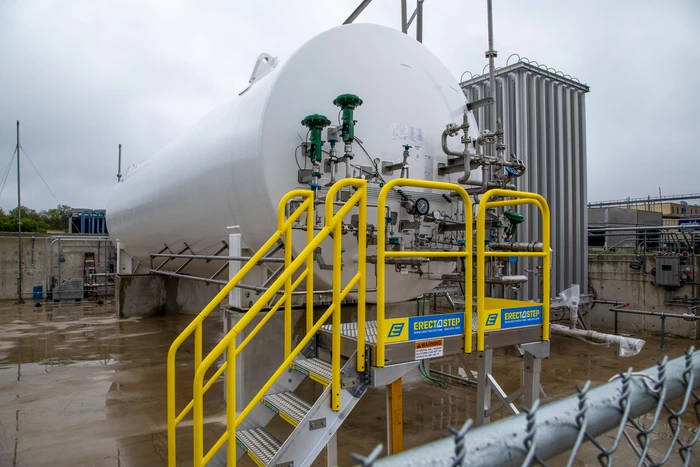
(Press-News.org) SAN ANTONIO – April 3, 2023 — Southwest Research Institute has installed a large-capacity liquid hydrogen tank to expand its advanced hydrogen energy research initiatives. Leveraging the tank’s capabilities alongside a multidisciplinary research approach, SwRI endeavors to explore technology opportunities and address obstacles related to hydrogen energy research and development.
The SwRI liquid hydrogen storage tank has a capacity of 17,000 gallons and will provide the Institute with a cost-effective, reliable supply of hydrogen for its multifaceted research initiatives. Previously, the Institute fueled its hydrogen research using commercial compressed hydrogen trailers.
“Ultimately, we believe that the installation of this liquid storage tank solves a lot of logistical challenges for SwRI’s hydrogen-related research efforts,” said Ryan D. Johnson, the manager in the SwRI Large Engine Development Section who oversees management of the tank. “Instead of bringing in multiple compressed hydrogen trailers each week to fuel our hydrogen research, we now have large amounts of hydrogen readily on hand.”
SwRI has multidisciplinary teams dedicated to hydrogen energy research initiatives across a broad spectrum of industries, including hydrogen combustion, hydrogen fuel cell research and testing, safety and hydrogen gas compressor research, among others.
SwRI engineers and scientists are currently investigating opportunities for hydrogen generation, safety and distribution, while also exploring the challenges presented by hydrogen/natural gas blends. Other programs are looking at hydrogen fuel in power generation and transportation applications.
The SwRI tank leverages cutting-edge cryogenic technology to enable its high-capacity liquid hydrogen storage. This super-cooled, high-density fuel allows the Institute to supply large, high-power engines for longer periods of time. The tank includes cryogenic pumps and ambient air vaporizers that can continuously supply up to 150 kilograms per hour of gaseous hydrogen to research facilities. A separate port on the tank enables direct withdrawal of liquid hydrogen to support future specialized research needs.
According to Johnson, SwRI’s liquid hydrogen storage tank has the added benefit of reducing overall hydrogen costs significantly, savings which can be passed along to Institute clientele.
“Numerous projects benefit from the installation of this tank on our campus,” said Johnson. “We will now be able to run 100 percent hydrogen in large stationary engines, turbines, or fuel cells capable of generating up to 2 megawatts of power. That, on its own, is exciting to me. It certainly hasn’t been done in the U.S. previously, and it serves as an example of how Southwest Research Institute is committed to serving as a pioneer in hydrogen energy research.”
The Institute’s deep expertise in hydrogen energy has so far led to the development of R&D solutions with hydrogen technology used in rockets, alternative combustion, fuel cells, energy storage and industrial processing plants.
For more information, visit https://www.swri.org/industry/advanced-power-systems/hydrogen-energy-research.
END
SwRI expands hydrogen energy research capabilities with new liquid hydrogen storage tank
On-site storage holds up to 17,000 gallons of liquid hydrogen, advancing SwRI’s clean energy research opportunities
2023-04-03
ELSE PRESS RELEASES FROM THIS DATE:
International research team analyzes February 2023 Ohio train derailment
2023-04-03
On February 3, 2023, a train derailed in the United States near East Palestine, Ohio, leading to the combustion of vinyl chloride. Following that accident, an international team of researchers undertook an in-depth analysis of the environmental consequences of the accident.
Their analysis is published in the journal Frontiers of Environmental Science & Engineering on March 15, 2023.
In their analysis, the team examined a series of questions related to the environmental risk and management of the chemical accident. “We emphasized that it is unscientific to overestimate or underestimate the environmental ...
Using artificial intelligence to design innovative materials
2023-04-03
Advanced materials are urgently needed for everyday life, be it in high technology, mobility, infrastructure, green energy or medicine. However, traditional ways of discovering and exploring new materials encounter limits due to the complexity of chemical compositions, structures and targeted properties. Moreover, new materials should not only enable novel applications, but also include sustainable ways of producing, using and recycling them. Researchers from the Max-Planck-Institut für Eisenforschung (MPIE) review the status of physics-based modelling ...
Jet lag’s harmful health impacts found to be caused by biological clock misalignment
2023-04-03
New research at the University of Massachusetts Amherst zeroes in on the root cause of adverse health effects from disruption of the body’s circadian rhythms, which typically occurs from jet lag and rotating work shifts.
The research, published in the journal eNeuro, also shows that the circadian clock gene Cryptochrome 1 (Cry 1) regulates adult neurogenesis – the ongoing formation of neurons in the brain’s hippocampus. Adult neurogenesis supports learning and memory, and its disruption has been linked to dementia and mental illness.
“Circadian disruption impacts a lot of things,” says lead author Michael Seifu Bahiru, a Ph.D. candidate in the ...
Using AI to address aging and disease: Insilico Medicine’s Alex Zhavoronkov, PhD presents at the Geroscience Summit
2023-04-03
Insilico Medicine founder and CEO Alex Zhavoronkov, PhD, a pioneer in generative AI for drug discovery and in uncovering dual pathways for aging and disease, will present at The Fourth Summit: Geroscience for the Next Generation organized by the Geroscience Interest Group of the National Institutes of Health (NIH) and the U.S. Department of Health and Human Services, happening April 24-26 at the NIH Main Campus in Bethesda, Maryland. Zhavoronkov will speak April 25, 1:40pm ET as part of the session on Mathematical Modeling of Aging and Health for Geroscience on “Selecting and Extracting Features Relevant to ...
A sensor that might someday enable ‘mind-controlled’ robots
2023-04-03
It sounds like something from science fiction: Don a specialized, electronic headband and control a robot using your mind. But now, recent research published in ACS Applied Nano Materials has taken a step toward making this a reality. By designing a special, 3D-patterned structure that doesn’t rely on sticky conductive gels, the team has created “dry” sensors that can measure the brain’s electrical activity, even amidst hair and the bumps and curves of the head.
Physicians monitor electrical signals ...
Older adults perceive artificial intelligence as more human-like than younger adults do
2023-04-03
Older adults perceive artificial intelligence as more human-like than younger adults do
Toronto, April 3, 2023 – Artificial intelligence (AI) is increasingly present in all of our lives, from newer offerings like ChatGPT to more established voice systems such as automated phone services, self-checkouts, Apple’s Siri and Amazon’s Alexa. While these technologies largely benefit us, they can also be used in adverse ways – for instance, in fraudulent or scam calls – making it important for us to be able to identify them.
According to a recent Baycrest study, older adults appear to be less able to distinguish ...
E-health reduces patient pain, opioids in clinical study
2023-04-03
SPOKANE, Wash. – An online “e-health” program helped more people with chronic pain reduce their opioid medications and pain intensity than a control group that had only regular treatment in a recent clinical study.
In the study published in the journal Pain, about 400 participants who had been prescribed long-term opioid treatment for their pain were divided into two groups: one received treatment as usual and another received treatment and access to a self-guided, e-health program. Of the e-health group, more than half, 53.6%, were able to reduce their ...
Purified curcumin instead of artificial additives can be used to preserve and enhance probiotic yogurt
2023-04-03
Researchers have succeeded for the first time in adding a highly purified form of curcumin to yogurt in a way that ensures it remains dissolved in the dairy product and preserves it, while tasting good.
Their discovery, which is published today (Monday) in Frontiers in Nutrition, makes it possible to create a probiotic yogurt that contains no artificial preservatives but that still has a long shelf life and properties that may enhance good health.
Curcumin is a naturally-occurring chemical that provides the yellow colour in turmeric. Studies have shown that it has anti-inflammatory and anti-oxidative properties, that it can inhibit the growth ...
English language pushes everyone – even AI chatbots - to improve by adding
2023-04-03
A linguistic bias in the English language that leads us to ‘improve’ things by adding to them, rather than taking away, is so common that it is even ingrained in AI chatbots, a new study reveals.
Language related to the concept of ‘improvement’ is more closely aligned with addition, rather than subtraction. This can lead us to make decisions which can overcomplicate things we are trying to make better.
The study is published today (Monday 3rd April) in Cognitive Science, by an international ...
Privately sponsored refugees likely to receive better prenatal care than government-assisted refugees in Canada
2023-04-03
Government-assisted refugees were less likely to receive adequate prenatal care than privately sponsored refugees, found a new study published in CMAJ (Canadian Medical Association Journal) https://www.cmaj.ca/lookup/doi/10.1503/cmaj.221207.
Canada has 2 main pathways to resettle refugees: government assistance and private sponsorship by family members or non-family volunteers.
To determine whether refugees receive adequate prenatal care (defined as initiation of prenatal care by 13 weeks' gestation; receipt of a minimum number of prenatal care visits, as recommended by the Society of Obstetricians and Gynaecologists of Canada; and receipt of a prenatal fetal anatomy ultrasound ...
LAST 30 PRESS RELEASES:
Advancing brain–computer interfaces for rehabilitation and assistive technologies
Detecting Alzheimer's with DNA aptamers—new tool for an easy blood test
Chinese Neurosurgical Journal study develops radiomics model to predict secondary decompressive craniectomy
New molecular switch that boosts tooth regeneration discovered
Jeonbuk National University researchers track mineral growth on bioorganic coatings in real time at nanoscale
Convergence in the Canopy: Why the Gracixalus weii treefrog sounds like a songbird
Subway systems are uncomfortably hot — and worsening
Granular activated carbon-sorbed PFAS can be used to extract lithium from brine
How AI is integrated into clinical workflow lowers medical liability perception
New biotech company to accelerate treatments for heart disease
One gene makes the difference: research team achieves breakthrough in breeding winter-hardy faba beans
Predicting brain health with a smartwatch
How boron helps to produce key proteins for new cancer therapies
Writing the catalog of plasma membrane repair proteins
A comprehensive review charts how psychiatry could finally diagnose what it actually treats
Thousands of genetic variants shape epilepsy risk, and most remain hidden
First comprehensive sex-specific atlas of GLP-1 in the mouse brain reveals why blockbuster weight-loss drugs may work differently in females and males
When rats run, their gut bacteria rewrite the chemical conversation with the brain
Movies reconstructed from mouse brain activity
Subglacial weathering may have slowed Earth's escape from snowball Earth
Simple test could transform time to endometriosis diagnosis
Why ‘being squeezed’ helps breast cancer cells to thrive
Mpox immune test validated during Rwandan outbreak
Scientists pinpoint protein shapes that track Alzheimer’s progression
Researchers achieve efficient bicarbonate-mediated integrated capture and electrolysis of carbon dioxide
Study reveals ancient needles and awls served many purposes
Key protein SYFO2 enables 'self-fertilization’ of leguminous plants
AI tool streamlines drug synthesis
Turning orchard waste into climate solutions: A simple method boosts biochar carbon storage
New ACP papers say health care must be more accessible and inclusive for patients and physicians with disabilities
[Press-News.org] SwRI expands hydrogen energy research capabilities with new liquid hydrogen storage tankOn-site storage holds up to 17,000 gallons of liquid hydrogen, advancing SwRI’s clean energy research opportunities