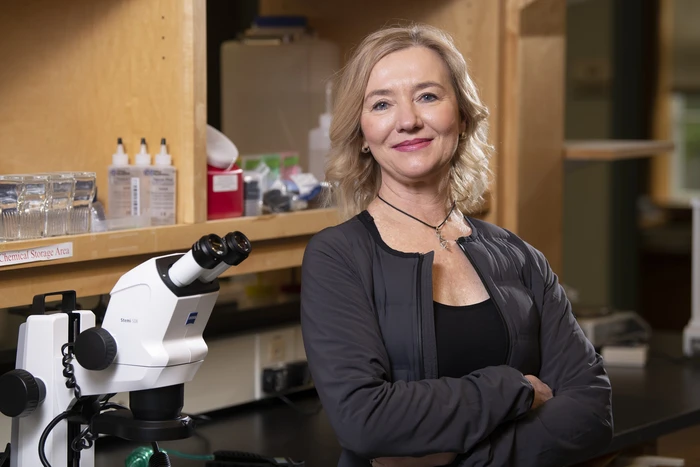
(Press-News.org) Halyna Shcherbata, Ph.D., will lead a new research group at MDI Biological Laboratory, in the Kathryn W. Davis Center for Regenerative Biology and Aging. Shcherbata's work has focused on regulatory and other roles of non-coding microRNA in gene expression and maintenance, and disorders such as muscular dystrophy and developmental delay. She is already developing new facilities for Drosophila melanogaster fruit flies on campus, returning an esteemed stand-in for human physiology to the Laboratory’s roster of animal models.
In her new lab on Maine's Mt. Desert Island, Shcherbata plans initial research on a multi-functional protein, RBFOX-1, that may play an important role in musculaer dystrophies, developmental delay and other disorders as well, such as attention-deficit hyperactivity, autism, and diabetes. RBFOX1 alterations could have a general regulating effect on gene expression, she says, and a better understanding of the relationships between rbfox-1 and microRNA could lead to new therapeutic targets.
“I am very excited about this,” Shcherbata said.
So is the entire MDI Bio Lab community.
“Dr. Shcherbata is doing important, original work on degenerative diseases and gene expression that will complement our faculty’s parallel investigations of aging and regeneration," said Herman Haller, M.D., MDI Bio Lab's president. "We are honored to welcome her to campus.”
Shcherbata is a native of Ukraine; she earned her Ph.D. at the Lviv National University of Ivan Franko in 1996. Since then, she’s held positions at the University of Washington, the Max Planck Institute for Biophysical Chemistry in Göttingen, and most recently at Hannover Medical School.
She says the non-profit MDI Bio Lab offers a unique opportunity to perform basic biomedical research in a collegial environment.
“What is unusual about the laboratory is this scholarly atmosphere; there are many amazing people who are genuinely interested in science,” she says. “I had the feeling there that this is not really work. And I love this… it kind of frees your mind. Makes it free to think.”
She will be joined on MDI Bio Lab's campus by her longtime colleague, Travis Carney, Ph.D., who has taken a full-time postion as Senior Scientist
MDI Bio Lab is a 125-year old, non-profit biomedical research and education center situated on Maine's rugged coast. It hosts 12 laboratory groups and leads a network of 14 research and educational institutions sharing technology and expertise to train the next generation of bioscience leaders.
END
Accomplished molecular biologist to lead new group at MDI Biological Laboratory
Halyna Shcherbata, Ph.D., studies molecular and genetic mechanisms of muscular dystrophies and brain disease
2023-05-16
ELSE PRESS RELEASES FROM THIS DATE:
Muscle fat linked to higher mortality risk
2023-05-16
OAK BROOK, Ill. – Asymptomatic adults with a high accumulation of fat in their muscles, known as myosteatosis, are at an increased risk of major adverse events and death, according to a study published in Radiology, a journal of the Radiological Society of North America (RSNA).
One of the methods used by physicians to estimate body fat in patients is the body mass index (BMI). Since BMI is calculated using only a patient’s height and weight, it’s not an accurate reflection of body composition ...
ChatGPT passes radiology board exam
2023-05-16
OAK BROOK, Ill. – The latest version of ChatGPT passed a radiology board-style exam, highlighting the potential of large language models but also revealing limitations that hinder reliability, according to two new research studies published in Radiology, a journal of the Radiological Society of North America (RSNA).
ChatGPT is an artificial intelligence (AI) chatbot that uses a deep learning model to recognize patterns and relationships between words in its vast training data to generate human-like responses based on a prompt. But since there is no source of truth in its training data, the tool can generate responses that are factually ...
MD Anderson awarded over $5.7 million from Break Through Cancer to support AML research
2023-05-16
HOUSTON – The University of Texas MD Anderson Cancer Center was awarded more than $5.7 million in grants from Break Through Cancer to support collaborative research teams working to discover novel molecular targets to eradicate minimal residual disease in acute myeloid leukemia (AML) and to treat clonal hematopoiesis, a precursor to AML.
MD Anderson received $2.7 million to fund research for the Targeting Clonal Hematopoiesis to Prevent AML TeamLab and $3 million for the Eradicating Minimal Residual Disease in AML TeamLab. The projects expand upon work initiated within MD Anderson’s Myelodysplastic Syndromes and Acute Myeloid ...
Magnetic stimulation may improve the pain, nausea of diabetic gastroparesis
2023-05-16
AUGUSTA, Ga. (May 16, 2023) – Magnetic stimulation of a group of nerves key to how our gut and brain communicate may help correct the conversation that goes awry in painful, debilitating diabetic gastroparesis, researchers say.
Patients come to Amol Sharma, MD, because their stomachs constantly hurt, they are always nauseous and they can’t or won’t eat or drink. Sometimes they can’t get out of the hospital because of nausea and vomiting.
“Gastroparesis is suspected in about 2% of the population, which is the about the population of Missouri, but only confirmed in .2% ...
Genetic analysis of Indigenous Taiwanese peoples sheds light on Austronesian expansion
2023-05-16
The Austronesian language family is one of the largest in the world, comprising over 1,200 languages spoken from Madagascar to Hawaii. Dang Liu, Albert Min-Shan Ko and Mark Stoneking collected genome-wide data from 55 individuals from seven Taiwanese Austronesian groups and two Han-Taiwanese groups to study the genetic structure of Taiwan, the point of origin for all Austronesian-speaking peoples. There are over 20 different Indigenous groups in Taiwan, divided into “highland” and “lowland” peoples. Many lowland peoples have intermarried with Han people, and their languages are endangered or extinct. ...
Emissions reductions of Chinese EVs
2023-05-16
Chinese electric vehicles (EVs) drive larger emissions reductions over time, due to increased operating efficiency and a greener electricity mix, according to a study. More than 10% of Chinese car sales are now electric, but the full life cycle of EVs still creates carbon emissions. Shaojun Zhang and colleagues conducted “cradle-to-grave” life cycle assessments for EVs in 2015 and 2020, including fuel-cycle and material-cycle phases, and compiled life-cycle projections for 2030. The authors considered factors including sources of electricity, vehicle fuel economy, major automotive metals, and battery ...
Cognitive training helpful for some but not a panacea for fall prevention
2023-05-16
INDIANAPOLIS – One out of four adults, age 65 or older, falls every year in the U.S. Falls cause approximately 36,000 deaths annually in this age group, making it the leading cause of death from injury for older adults in the U.S.
A new study, led by Regenstrief Institute Research Scientist Briana Sprague, PhD, examines whether cognitive training – specifically, speed of processing, memory and reasoning training -- can lower the risk of falling. Significantly, the researchers found no effects of the training on likelihood of falling for those at low risk of falling. Dr. Sprague also is a faculty member at Indiana ...
Jaw shapes of 90 shark species show: Evolution driven by habitat
2023-05-16
An international research team led by Faviel A. López-Romero of the University of Vienna investigated how the jaw shape of sharks has changed over the course of evolution. Their conclusion: in the most widespread shark species, the jaws show relatively little variation in shape over millions of years; most variable jaws were found for deep-sea sharks. The results of this study were published in the journal Communications Biology.
One of the most prominent traits in sharks is the shape of their lower jaws, which bear also impressive teeth. With their jaws, sharks are able to feed on a wide variety of prey, which also places them among the Ocean's top predators. ...
NCCN Global Policy Leader named Co-Chair of Global Health Council Roundtable Advancing International Coordination in Cancer Care
2023-05-16
PLYMOUTH MEETING, PA [May 16, 2023] — The National Comprehensive Cancer Network® (NCCN®) today announced the appointment of Katy Winckworth-Prejsnar, MPH, NCCN’s Senior Manager of Global Policy and Strategic Alliances, as Co-Chair of the Global Health Council (GHC)’s Non-Communicable Diseases (NCD) Roundtable. In this role, Winckworth-Prejsnar will help drive coordination between organizations worldwide that are working to improve policy and outcomes for cancer and other global health concerns. She will serve alongside Co-Chair Eliana Monteforte, Director of Special Projects, GHC.
“NCDs—including ...
Sexually active women are not judged more harshly than men
2023-05-16
Maybe you too have bought into the idea that men with numerous sexual partners are actually admired, while women with the same are condemned – the so-called sexual double standard. But that turns out to be a myth, according to a new survey.
“We haven’t found that women are subjected to the traditional double standards,” says Leif Edward Ottesen Kennair, a professor at the Norwegian University of Science and Technology's (NTNU) Department of Psychology.
On the contrary, men are judged a little ...
LAST 30 PRESS RELEASES:
ASU researchers to lead AAAS panel on water insecurity in the United States
ASU professor Anne Stone to present at AAAS Conference in Phoenix on ancient origins of modern disease
Proposals for exploring viruses and skin as the next experimental quantum frontiers share US$30,000 science award
ASU researchers showcase scalable tech solutions for older adults living alone with cognitive decline at AAAS 2026
Scientists identify smooth regional trends in fruit fly survival strategies
Antipathy toward snakes? Your parents likely talked you into that at an early age
Sylvester Cancer Tip Sheet for Feb. 2026
Online exposure to medical misinformation concentrated among older adults
Telehealth improves access to genetic services for adult survivors of childhood cancers
Outdated mortality benchmarks risk missing early signs of famine and delay recognizing mass starvation
Newly discovered bacterium converts carbon dioxide into chemicals using electricity
Flipping and reversing mini-proteins could improve disease treatment
Scientists reveal major hidden source of atmospheric nitrogen pollution in fragile lake basin
Biochar emerges as a powerful tool for soil carbon neutrality and climate mitigation
Tiny cell messengers show big promise for safer protein and gene delivery
AMS releases statement regarding the decision to rescind EPA’s 2009 Endangerment Finding
Parents’ alcohol and drug use influences their children’s consumption, research shows
Modular assembly of chiral nitrogen-bridged rings achieved by palladium-catalyzed diastereoselective and enantioselective cascade cyclization reactions
Promoting civic engagement
AMS Science Preview: Hurricane slowdown, school snow days
Deforestation in the Amazon raises the surface temperature by 3 °C during the dry season
Model more accurately maps the impact of frost on corn crops
How did humans develop sharp vision? Lab-grown retinas show likely answer
Sour grapes? Taste, experience of sour foods depends on individual consumer
At AAAS, professor Krystal Tsosie argues the future of science must be Indigenous-led
From the lab to the living room: Decoding Parkinson’s patients movements in the real world
Research advances in porous materials, as highlighted in the 2025 Nobel Prize in Chemistry
Sally C. Morton, executive vice president of ASU Knowledge Enterprise, presents a bold and practical framework for moving research from discovery to real-world impact
Biochemical parameters in patients with diabetic nephropathy versus individuals with diabetes alone, non-diabetic nephropathy, and healthy controls
Muscular strength and mortality in women ages 63 to 99
[Press-News.org] Accomplished molecular biologist to lead new group at MDI Biological LaboratoryHalyna Shcherbata, Ph.D., studies molecular and genetic mechanisms of muscular dystrophies and brain disease