PRESS-NEWS.org - Press Release Distribution
PRESS RELEASES DISTRIBUTION

Only 13% of global methane emissions are covered by policy, and those policies are often ineffective
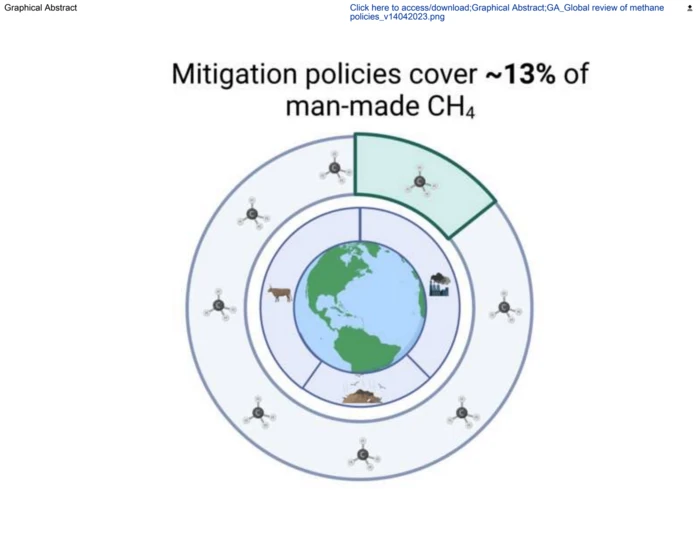
Only 13% of global methane emissions are covered by policy, and those policies are often ineffective
2023-05-19
(Press-News.org) Methane, a greenhouse gas known to do about 80 times more damage to the atmosphere than carbon dioxide over a 20-year period, is often overlooked by policymakers and governments. In a review publishing in the journal One Earth on May 19, researchers analyzed the coverage, stringency, and real-world impact of current global methane emissions policies for the first time. They found that only 13% of emissions are currently covered by direct mitigation policies.

In order to limit climate warming to 1.5 degrees Celsius in accordance with the Paris Agreement, global methane emissions need to be cut by at least 40%–45%, according to the 2021 Global Methane Assessment—a feat that the authors assert can be accomplished if governments adopt stricter methane policies and measure emissions more accurately.

“The need for comprehensive and targeted methane mitigation strategies is highlighted by a growing body of literature. But methane emissions are increasing faster than at any time since the 1980s,” write environmental policy experts Maria Olczak, Andris Piebalgs, and Paul Balcombe of the Queen Mary University of London/Environmental Defense Fund Europe, the European University Institute’s Florence School of Regulation, and the Queen Mary University of London, respectively.

To determine how effective current methane emissions restrictions are, the team reviewed 281 policies across the highest methane-producing sectors, including energy, waste, and agriculture. They found that the number of methane policies varies dramatically between regions and that the policies currently in place are not stringent enough, largely because they were created based on inaccurate data. Often, the methane emissions estimates used by policymakers come from underreported greenhouse gas estimates, datasets that are not open to the public, or figures that vary substantially depending on the method used to measure the amount of methane.

“A consistent approach for accurate identification, quantification, and verification of methane emissions sources alongside greater policy coverage and stringency must be put into place to realize the significant methane emissions reduction opportunities,” write the researchers.

Mitigating man-made methane emissions is one of the cheapest ways to slow down climate change and improve air quality, according to the Global Methane Assessment. However, the authors argue, progress will depend on a global, unified effort to limit methane emissions, and quick action needs to be taken on both a national and a regional level in order to meet climate goals.

“Effective methane mitigation requires stronger social support and political consensus. Yet, methane reduction is still perceived as a choice rather than a necessity complementing the ongoing decarbonization efforts focused largely on CO2,” the researchers write. “The upcoming climate conference COP28 in Dubai (United Arab Emirates), when collective progress towards the Paris Agreement objectives will be assessed for the first time, offers an enormous opportunity for change.”

###

One Earth, Olczak et al. “A global review of methane policies reveals only 13% of emissions are covered with unclear effectiveness” https://www.cell.com/one-earth/fulltext/S2590-3322(23)00195-1

One Earth (@OneEarth_CP), published by Cell Press, is a monthly journal that features papers from the fields of natural, social, and applied sciences. One Earth is the home for high-quality research that seeks to understand and address today’s environmental Grand Challenges, publishing across the spectrum of environmental change and sustainability science. A sister journal to Cell, Chem, and Joule, One Earth aspires to break down barriers between disciplines and stimulate the cross-pollination of ideas with a platform that unites communities, fosters dialogue, and encourages transformative research. Visit http://www.cell.com/one-earth. To receive Cell Press media alerts, contact press@cell.com.

END


[Attachments] See images for this press release:
Only 13% of global methane emissions are covered by policy, and those policies are often ineffective

ELSE PRESS RELEASES FROM THIS DATE:

Scientists urge crackdown on methane emissions with only 13% regulated

2023-05-19
New research from Queen Mary University of London shows that only around 13% of global methane emissions are regulated, despite methane emissions causing at least 25% of current global warming. The global review, published on 19 May in One Earth, also found that little is known about the effectiveness of the policies that exist, with potentially unrepresentative methane emission estimations used rather than actual measurements. Inaccurate estimations can also mean the issue is taken less seriously by decision-makers by masking its severity. The researchers argue that the lack ...

Novel gene-editing strategy leverages unusual genetic alteration to block HIV spread in cells

Novel gene-editing strategy leverages unusual genetic alteration to block HIV spread in cells
2023-05-19
(Philadelphia, PA) – Genetic alterations that give rise to a rare, fatal disorder known as MOGS-CDG paradoxically also protect cells against infection by viruses. Now, scientists at the Lewis Katz School of Medicine at Temple University have harnessed this unusual protective ability in a novel gene-editing strategy aimed at eliminating HIV-1 infection with no adverse effects on cell mortality. The new approach, described online April 28 in the journal Molecular Therapy – Nucleic Acids, is based on a combination of two gene-editing constructs, one that ...

Perceived influence of incentives on COVID-19 vaccination decision-making and trust

2023-05-19
About The Study: This survey study found that although there has been substantial policy attention around incentivizing COVID-19 vaccination, fewer than 1 in 10 vaccinated individuals in a nationally representative sample of U.S. adults reported receiving an incentive. Most vaccinated respondents reported that an incentive did not make a difference in their decision-making to get the COVID-19 vaccine. Authors: Laura J. Faherty, M.D., M.P.H., M.S.H.P., of the RAND Corporation in Boston, is the corresponding author.  To access the ...

Estimated pediatric hospitalizations and school absenteeism associated with accelerated COVID-19 bivalent booster vaccination

2023-05-19
About The Study: In this decision analytical model, increased uptake of bivalent booster vaccination among eligible age groups was associated with decreased hospitalizations and school absenteeism in the pediatric population. These findings suggest that although COVID-19 prevention strategies often focus on older populations, the benefits of booster campaigns for children may be substantial.  Authors: Alison P. Galvani, Ph.D., of the Yale School of Public Health in New Haven, Connecticut, is the corresponding author.  To access the embargoed study: Visit our For The Media website at this ...

COVID-19 booster vaccination in early pregnancy and surveillance for spontaneous abortion

2023-05-19
About The Study: In this case-control surveillance study of more than 100,000 pregnancies, COVID-19 booster vaccination in pregnancy was not associated with spontaneous abortion. These findings support the safety of recommendations for COVID-19 booster vaccination, including in pregnant populations.  Authors: Elyse O. Kharbanda, M.D., M.P.H., of HealthPartners Institute in Minneapolis, is the corresponding author.  To access the embargoed study: Visit our For The Media website at this link https://media.jamanetwork.com/  (doi:10.1001/jamanetworkopen.2023.14350) Editor’s ...

New study finds COVID-19 mRNA booster vaccinations in early pregnancy did not increase miscarriage risk

2023-05-19
HealthPartners Institute researchers have published new data in JAMA Network Open that shows monovalent COVID-19 booster vaccinations administered in early pregnancy (before 20 weeks’ gestation) were not associated with miscarriage. The research adds to the growing understanding about the safety of COVID-19 booster vaccinations among people who are pregnant. The researchers analyzed data from more than 100,000 pregnancies between six and 19 weeks’ gestation from eight large health systems participating in the Vaccine Safety Datalink (VSD). The data was collected between Nov. ...

Synthetic biology: proteins set vesicles in motion

2023-05-19
Biophysicists have designed a new cell-like transport system that represents an important milestone on the road to artificial cells. Creating artificial cells with life-like characteristics out of a minimal set of components is a major goal of synthetic biology. Autonomous motion is a key capability here, and one that is difficult to reproduce in the test tube. A team led by physicist Erwin Frey, Professor of Statistical and Biological Physics at LMU, and Petra Schwille from the Max Planck Institute of Biochemistry, has now made ...

New subtypes identified in difficult-to-treat ovarian cancer – Potential for discovering new treatments

2023-05-19
Every year, more than 40,000 women die of ovarian cancer in Europe. Ovarian cancer is a genetically very heterogeneous disease, which makes it exceptionally difficult to study and treat. The prognosis is particularly poor in ovarian high grade serous carcinoma (HGSC), a subtype of ovarian cancer. Less than 40% of patients with this subtype survive five years after their diagnosis. The researchers were able to classify HGSC tumours into three groups on the basis of genomic changes. The groups differ in the intracellular signalling pathways, the ways in which the tumours grow, and response ...

Hyperpolarization: Multi-million funding for joint Collaborative Research Centre of Leipzig University and Chemnitz University of Technology

Hyperpolarization: Multi-million funding for joint Collaborative Research Centre of Leipzig University and Chemnitz University of Technology
2023-05-19
The Collaborative Research Centre, to be known as HYP*MOL, will bring together 29 professors and early career researchers from both universities, as well as other external research partners, to study electron and nuclear spin hyperpolarization in molecular systems. “This funding is both a cause for celebration and a great incentive for everyone involved,” says Professor Eva Inés Obergfell, Rector of Leipzig University. “Hyperpolarization is an exciting and rapidly evolving field of research. I believe that our research team will contribute new insights that will be appreciated at an international level.” Leipzig University is now involved ...

Novel tin-based metal–organic frameworks for reducing carbon dioxide to formate

Novel tin-based metal–organic frameworks for reducing carbon dioxide to formate
2023-05-19
The never-ending demand for carbon-rich fuels to drive the economy keeps adding more and more carbon dioxide (CO2) to the atmosphere. While efforts are being made to reduce CO2 emissions, that alone cannot counter the adverse effects of the gas already present in the atmosphere. So, scientists have come up with innovative ways to use existing atmospheric CO2 by transforming it into useful chemicals such as formic acid (HCOOH) and methanol. A popular method for carrying out such conversions is to use visible ...

LAST 30 PRESS RELEASES:

ASU researchers to lead AAAS panel on water insecurity in the United States

ASU professor Anne Stone to present at AAAS Conference in Phoenix on ancient origins of modern disease

Proposals for exploring viruses and skin as the next experimental quantum frontiers share US$30,000 science award

ASU researchers showcase scalable tech solutions for older adults living alone with cognitive decline at AAAS 2026

Scientists identify smooth regional trends in fruit fly survival strategies

Antipathy toward snakes? Your parents likely talked you into that at an early age

Sylvester Cancer Tip Sheet for Feb. 2026

Online exposure to medical misinformation concentrated among older adults

Telehealth improves access to genetic services for adult survivors of childhood cancers

Outdated mortality benchmarks risk missing early signs of famine and delay recognizing mass starvation

Newly discovered bacterium converts carbon dioxide into chemicals using electricity

Flipping and reversing mini-proteins could improve disease treatment

Scientists reveal major hidden source of atmospheric nitrogen pollution in fragile lake basin

Biochar emerges as a powerful tool for soil carbon neutrality and climate mitigation

Tiny cell messengers show big promise for safer protein and gene delivery

AMS releases statement regarding the decision to rescind EPA’s 2009 Endangerment Finding

Parents’ alcohol and drug use influences their children’s consumption, research shows

Modular assembly of chiral nitrogen-bridged rings achieved by palladium-catalyzed diastereoselective and enantioselective cascade cyclization reactions

Promoting civic engagement

AMS Science Preview: Hurricane slowdown, school snow days

Deforestation in the Amazon raises the surface temperature by 3 °C during the dry season

Model more accurately maps the impact of frost on corn crops

How did humans develop sharp vision? Lab-grown retinas show likely answer

Sour grapes? Taste, experience of sour foods depends on individual consumer

At AAAS, professor Krystal Tsosie argues the future of science must be Indigenous-led

From the lab to the living room: Decoding Parkinson’s patients movements in the real world

Research advances in porous materials, as highlighted in the 2025 Nobel Prize in Chemistry

Sally C. Morton, executive vice president of ASU Knowledge Enterprise, presents a bold and practical framework for moving research from discovery to real-world impact

Biochemical parameters in patients with diabetic nephropathy versus individuals with diabetes alone, non-diabetic nephropathy, and healthy controls

Muscular strength and mortality in women ages 63 to 99

[Press-News.org] Only 13% of global methane emissions are covered by policy, and those policies are often ineffective