Webb detects water vapor in rocky planet-forming zone
Published 2023-07-24 · Original archive entry · Explore research explainers
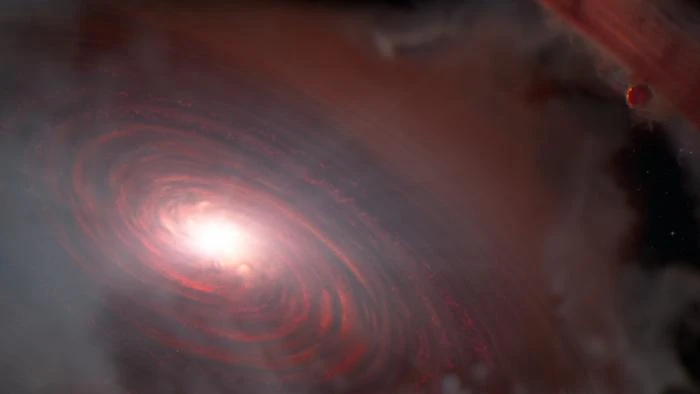
Water is essential for life as we know it. However, scientists debate how it reached the Earth and whether the same processes could seed rocky exoplanets orbiting distant stars. New insights may come from the planetary system PDS 70, located 370 light-years away. The star hosts both an inner disk and outer disk of gas and dust, separated by a 5 billion-mile-wide (8 billion kilometer) gap, and within that gap are two known gas-giant planets.
New measurements by NASA’s James Webb Space Telescope’s MIRI (Mid-Infrared Instrument) have detected water vapor in the system’s inner disk, at distances of less than 100 million miles (160 million kilometers) from the star – the region where rocky, terrestrial planets may be forming. (The Earth orbits 93 million miles from our Sun.) This is the first detection of water in the terrestrial region of a disk already known to host two or more protoplanets.
“We’ve seen water in other disks, but not so close in and in a system where planets are currently assembling. We couldn’t make this type of measurement before Webb,” said lead author Giulia Perotti of the Max Planck Institute for Astronomy (MPIA) in Heidelberg, Germany.
“This discovery is extremely exciting, as it probes the region where rocky planets similar to Earth typically form,” added MPIA director Thomas Henning, a co-author on the paper. Henning is co-principal investigator of Webb’s MIRI (Mid-Infrared Instrument), which made the detection, and the principal investigator of the MINDS (MIRI Mid-Infrared Disk Survey) program that took the data.
A Steamy Environment for Forming Planets
PDS 70 is a K-type star, cooler than our Sun, and is estimated to be 5.4 million years old. This is relatively old in terms of stars with planet-forming disks, which made the discovery of water vapor surprising.
Over time, the gas and dust content of planet-forming disks declines. Either the central star’s radiation and winds blow out such material, or the dust grows into larger objects that eventually form planets. As previous studies failed to detect water in the central regions of similarly aged disks, astronomers suspected it might not survive the harsh stellar radiation, leading to a dry environment for the formation of any rocky planets.
Astronomers haven’t yet detected any planets forming within the inner disk of PDS 70. However, they do see the raw materials for building rocky worlds in the form of silicates. The detection of water vapor implies that if rocky planets are forming there, they will have water available to them from the beginning.
“We find a relatively high amount of small dust grains. Combined with our detection of water vapor, the inner disk is a very exciting place,” said co-author Rens Waters of Radboud University in The Netherlands.
What is the Water’s Origin?
The discovery raises the question of where the water came from. The MINDS team considered two different scenarios to explain their finding.
One possibility is that water molecules are forming in place, where we detect them, as hydrogen and oxygen atoms combine. A second possibility is that ice-coated dust particles are being transported from the cool outer disk to the hot inner disk, where the water ice sublimates and turns into vapor. Such a transport system would be surprising, since the dust would have to cross the large gap carved out by the two giant planets.
Another question raised by the discovery is how water could survive so close to the star, when the star’s ultraviolet light should break apart any water molecules. Most likely, surrounding material such as dust and other water molecules serves as a protective shield. As a result, the water detected in the inner disk of PDS 70 could survive destruction.
Ultimately, the team will use two more of Webb’s instruments, NIRCam (Near-Infrared Camera) and NIRSpec (Near-Infrared Spectrograph) to study the PDS 70 system in an effort to glean an even greater understanding.
These observations were taken as part of Guaranteed Time Observation program 1282. This finding has been published in the journal Nature.
The James Webb Space Telescope is the world’s premier space science observatory. Webb is solving mysteries in our solar system, looking beyond to distant worlds around other stars, and probing the mysterious structures and origins of our universe and our place in it. Webb is an international program led by NASA with its partners, ESA (European Space Agency) and the Canadian Space Agency.
END
New measurements by NASA’s James Webb Space Telescope’s MIRI (Mid-Infrared Instrument) have detected water vapor in the system’s inner disk, at distances of less than 100 million miles (160 million kilometers) from the star – the region where rocky, terrestrial planets may be forming. (The Earth orbits 93 million miles from our Sun.) This is the first detection of water in the terrestrial region of a disk already known to host two or more protoplanets.
“We’ve seen water in other disks, but not so close in and in a system where planets are currently assembling. We couldn’t make this type of measurement before Webb,” said lead author Giulia Perotti of the Max Planck Institute for Astronomy (MPIA) in Heidelberg, Germany.
“This discovery is extremely exciting, as it probes the region where rocky planets similar to Earth typically form,” added MPIA director Thomas Henning, a co-author on the paper. Henning is co-principal investigator of Webb’s MIRI (Mid-Infrared Instrument), which made the detection, and the principal investigator of the MINDS (MIRI Mid-Infrared Disk Survey) program that took the data.
A Steamy Environment for Forming Planets
PDS 70 is a K-type star, cooler than our Sun, and is estimated to be 5.4 million years old. This is relatively old in terms of stars with planet-forming disks, which made the discovery of water vapor surprising.
Over time, the gas and dust content of planet-forming disks declines. Either the central star’s radiation and winds blow out such material, or the dust grows into larger objects that eventually form planets. As previous studies failed to detect water in the central regions of similarly aged disks, astronomers suspected it might not survive the harsh stellar radiation, leading to a dry environment for the formation of any rocky planets.
Astronomers haven’t yet detected any planets forming within the inner disk of PDS 70. However, they do see the raw materials for building rocky worlds in the form of silicates. The detection of water vapor implies that if rocky planets are forming there, they will have water available to them from the beginning.
“We find a relatively high amount of small dust grains. Combined with our detection of water vapor, the inner disk is a very exciting place,” said co-author Rens Waters of Radboud University in The Netherlands.
What is the Water’s Origin?
The discovery raises the question of where the water came from. The MINDS team considered two different scenarios to explain their finding.
One possibility is that water molecules are forming in place, where we detect them, as hydrogen and oxygen atoms combine. A second possibility is that ice-coated dust particles are being transported from the cool outer disk to the hot inner disk, where the water ice sublimates and turns into vapor. Such a transport system would be surprising, since the dust would have to cross the large gap carved out by the two giant planets.
Another question raised by the discovery is how water could survive so close to the star, when the star’s ultraviolet light should break apart any water molecules. Most likely, surrounding material such as dust and other water molecules serves as a protective shield. As a result, the water detected in the inner disk of PDS 70 could survive destruction.
Ultimately, the team will use two more of Webb’s instruments, NIRCam (Near-Infrared Camera) and NIRSpec (Near-Infrared Spectrograph) to study the PDS 70 system in an effort to glean an even greater understanding.
These observations were taken as part of Guaranteed Time Observation program 1282. This finding has been published in the journal Nature.
The James Webb Space Telescope is the world’s premier space science observatory. Webb is solving mysteries in our solar system, looking beyond to distant worlds around other stars, and probing the mysterious structures and origins of our universe and our place in it. Webb is an international program led by NASA with its partners, ESA (European Space Agency) and the Canadian Space Agency.
END
Attachments