Butterfly-inspired films create vibrant colors while passively cooling objects
New nanofilms could significantly reduce the energy needed for cooling buildings or vehicles
Published 2023-08-03 · Original archive entry · Explore research explainers
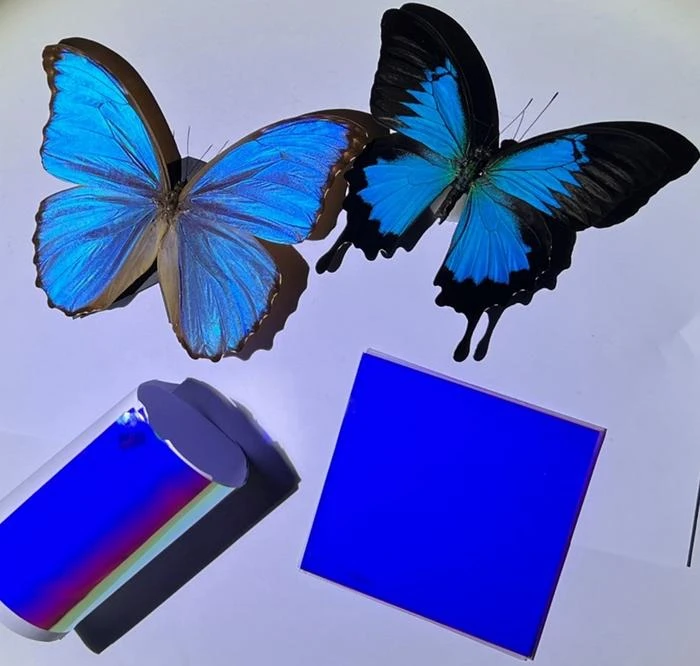
WASHINGTON —On a hot summer day, white clothing feels cooler than other colors due to reflecting—not absorbing—sunlight. Other colors like blue or black, will undergo a heating effect as they absorb light. To circumvent this heating effect in colored cooling films, researchers drew inspiration from nanostructures in butterfly wings.
The new films, which don’t absorb any light, could be used on the outside of buildings, vehicles and equipment to reduce the energy needed for cooling while preserving vivid color properties.
“In buildings, large amounts of energy are used for cooling and ventilation, and running the air conditioner in electric cars can reduce the driving range by more than half,” said research team leader Wanlin Wang from Shenzhen University in China. “Our cooling films could help advance energy sustainability and carbon neutrality.”
In Optica, Optica Publishing Group’s journal for high-impact research, the researchers show that the films they developed lower the temperature of colorful objects to about 2 °C below the ambient temperature. They also found that when left outside all day, the blue version of the films was approximately 26℃ cooler than traditional blue car paint. This represents an annual energy savings of approximately 1377 MJ/m2 per year.
“With our new films, excellent cooling performance can be achieved, no matter the desired color, saturation or brightness,” said Wang. “They could even be used on textiles to create clothes of any color that are comfortable in hot temperatures.”
Inspired by nature
A car with blue paint appears blue because it absorbs yellow light and reflects blue light. The large amount of light that is absorbed heats the car. Morpho butterflies, however, produce their highly saturated blue color based on the nanostructure of their wings. The design of the cooling nanofilm mimics these structures to produce vibrant colors that don’t absorb light like traditional paint.
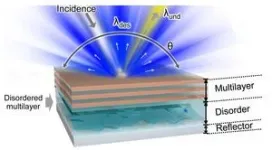
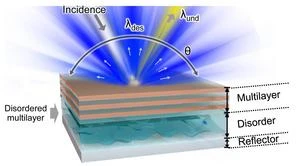
To create their Morpho-inspired nanofilms, the researchers placed a disordered material (rough frosted glass) under a multilayer material made of titanium dioxide and aluminum dioxide. They then placed this structure on a silver layer that reflects all light, thus preventing the absorption of solar radiation and the heating associated with that absorption.
The film’s color is determined by how components within its multilayered structure reflect light. To create blue, for example, the multilayer material is designed to reflect yellow light in a very narrow range of angles while the disordered structure diffuses the blue light across a broad area.
Although this type of passive photonic thermal management has been accomplished before, it has only been used with white or clear objects because it is difficult to maintain a wide viewing angle and high color saturation.
Passive cooling of colorful objects
“Thanks to the layered structure we developed, we were able to extend the passive cooling method from colorless objects to colorful ones while preserving color performance,” said Wang. “In other words, our blue film looks blue across a large range of viewing angles and doesn’t heat up because it reflects all the light. In addition, high saturation and brightness can be achieved by optimizing the structure.”
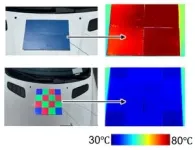
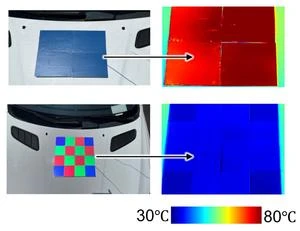
To test the new technology, the researchers created blue, yellow and colorless films, which they placed outdoors at Shenzhen University, on surfaces such as roofs, cars, cloth and cell phones, from 9 a.m. to 4 p.m. in both winter and summer. Using thermocouple sensors and infrared cameras to measure temperature, they found that the cooling films were more than about 15 ℃ cooler than the surfaces they were placed on in the winter and about 35 ℃ cooler in the summer.
The researchers point out that replacing the silver film with an aluminum film would make the films less expensive and manufacturable by a scalable fabrication method such as electron beam evaporation and magnetron sputtering. Now that they have demonstrated the cooling and color performance of the films, the researchers plan to study and optimize other properties such as mechanical and chemical robustness.
Paper: W. Wang, H. Xing, X. Shu, X. Zhao, X. Yan, B. Hong, L. Sun, W. Zhang, G. P. Wang, “Cooling colors below the ambient temperature 10, 8 (2023).
DOI: doi.org/10.1364/OPTICA.487561.
About Optica
Optica is an open-access journal dedicated to the rapid dissemination of high-impact peer-reviewed research across the entire spectrum of optics and photonics. Published monthly by Optica Publishing Group, the Journal provides a forum for pioneering research to be swiftly accessed by the international community, whether that research is theoretical or experimental, fundamental or applied. Optica maintains a distinguished editorial board of more than 60 associate editors from around the world and is overseen by Editor-in-Chief Prem Kumar, Northwestern University, USA. For more information, visit Optica.
About Optica Publishing Group (formerly OSA)
Optica Publishing Group is a division of Optica (formerly OSA), Advancing Optics and Photonics Worldwide. It publishes the largest collection of peer-reviewed content in optics and photonics, including 18 prestigious journals, the society’s flagship member magazine, and papers from more than 835 conferences, including 6,500+ associated videos. With over 400,000 journal articles, conference papers and videos to search, discover and access, Optica Publishing Group represents the full range of research in the field from around the globe.
END
The new films, which don’t absorb any light, could be used on the outside of buildings, vehicles and equipment to reduce the energy needed for cooling while preserving vivid color properties.
“In buildings, large amounts of energy are used for cooling and ventilation, and running the air conditioner in electric cars can reduce the driving range by more than half,” said research team leader Wanlin Wang from Shenzhen University in China. “Our cooling films could help advance energy sustainability and carbon neutrality.”
In Optica, Optica Publishing Group’s journal for high-impact research, the researchers show that the films they developed lower the temperature of colorful objects to about 2 °C below the ambient temperature. They also found that when left outside all day, the blue version of the films was approximately 26℃ cooler than traditional blue car paint. This represents an annual energy savings of approximately 1377 MJ/m2 per year.
“With our new films, excellent cooling performance can be achieved, no matter the desired color, saturation or brightness,” said Wang. “They could even be used on textiles to create clothes of any color that are comfortable in hot temperatures.”
Inspired by nature
A car with blue paint appears blue because it absorbs yellow light and reflects blue light. The large amount of light that is absorbed heats the car. Morpho butterflies, however, produce their highly saturated blue color based on the nanostructure of their wings. The design of the cooling nanofilm mimics these structures to produce vibrant colors that don’t absorb light like traditional paint.
To create their Morpho-inspired nanofilms, the researchers placed a disordered material (rough frosted glass) under a multilayer material made of titanium dioxide and aluminum dioxide. They then placed this structure on a silver layer that reflects all light, thus preventing the absorption of solar radiation and the heating associated with that absorption.
The film’s color is determined by how components within its multilayered structure reflect light. To create blue, for example, the multilayer material is designed to reflect yellow light in a very narrow range of angles while the disordered structure diffuses the blue light across a broad area.
Although this type of passive photonic thermal management has been accomplished before, it has only been used with white or clear objects because it is difficult to maintain a wide viewing angle and high color saturation.
Passive cooling of colorful objects
“Thanks to the layered structure we developed, we were able to extend the passive cooling method from colorless objects to colorful ones while preserving color performance,” said Wang. “In other words, our blue film looks blue across a large range of viewing angles and doesn’t heat up because it reflects all the light. In addition, high saturation and brightness can be achieved by optimizing the structure.”
To test the new technology, the researchers created blue, yellow and colorless films, which they placed outdoors at Shenzhen University, on surfaces such as roofs, cars, cloth and cell phones, from 9 a.m. to 4 p.m. in both winter and summer. Using thermocouple sensors and infrared cameras to measure temperature, they found that the cooling films were more than about 15 ℃ cooler than the surfaces they were placed on in the winter and about 35 ℃ cooler in the summer.
The researchers point out that replacing the silver film with an aluminum film would make the films less expensive and manufacturable by a scalable fabrication method such as electron beam evaporation and magnetron sputtering. Now that they have demonstrated the cooling and color performance of the films, the researchers plan to study and optimize other properties such as mechanical and chemical robustness.
Paper: W. Wang, H. Xing, X. Shu, X. Zhao, X. Yan, B. Hong, L. Sun, W. Zhang, G. P. Wang, “Cooling colors below the ambient temperature 10, 8 (2023).
DOI: doi.org/10.1364/OPTICA.487561.
About Optica
Optica is an open-access journal dedicated to the rapid dissemination of high-impact peer-reviewed research across the entire spectrum of optics and photonics. Published monthly by Optica Publishing Group, the Journal provides a forum for pioneering research to be swiftly accessed by the international community, whether that research is theoretical or experimental, fundamental or applied. Optica maintains a distinguished editorial board of more than 60 associate editors from around the world and is overseen by Editor-in-Chief Prem Kumar, Northwestern University, USA. For more information, visit Optica.
About Optica Publishing Group (formerly OSA)
Optica Publishing Group is a division of Optica (formerly OSA), Advancing Optics and Photonics Worldwide. It publishes the largest collection of peer-reviewed content in optics and photonics, including 18 prestigious journals, the society’s flagship member magazine, and papers from more than 835 conferences, including 6,500+ associated videos. With over 400,000 journal articles, conference papers and videos to search, discover and access, Optica Publishing Group represents the full range of research in the field from around the globe.
END
Attachments