Demon Hunting: Physicists confirm 67-year-old prediction of massless, neutral composite particle
Published 2023-08-18 · Original archive entry · Explore research explainers
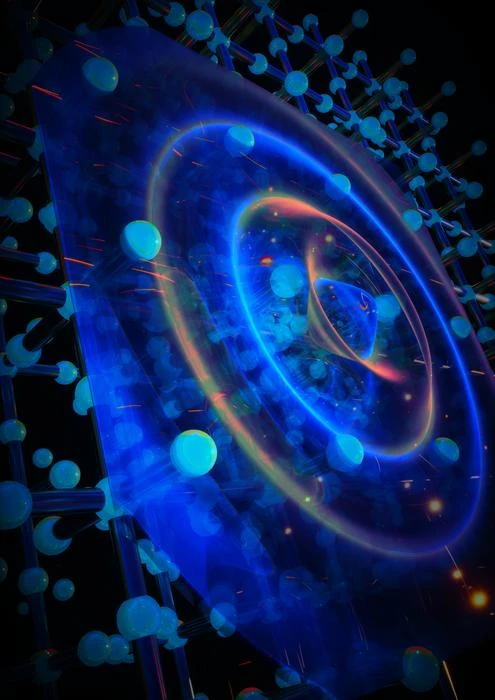
In 1956, theoretical physicist David Pines predicted that electrons in a solid can do something strange. While they normally have a mass and an electric charge, Pines asserted that they can combine to form a composite particle that is massless, neutral, and does not interact with light. He called this particle a “demon.” Since then, it has been speculated to play an important role in the behaviors of a wide variety of metals. Unfortunately, the same properties that make it interesting have allowed it to elude detection since its prediction.
Now, a team of researchers led by Peter Abbamonte, a professor of physics at the University of Illinois Urbana-Champaign, have finally found Pines’ demon 67 years after it was predicted. As the researchers report in the journal Nature, they used a nonstandard experimental technique that directly excites a material’s electronic modes, allowing them to see the demon’s signature in the metal strontium ruthenate.
“Demons have been theoretically conjectured for a long time, but experimentalists never studied them,” Abbamonte said. “In fact, we weren’t even looking for it. But it turned out we were doing exactly the right thing, and we found it.”
The elusive demon
One of the most important discoveries of condensed matter physics is that electrons lose their individuality in solids. Electric interactions make the electrons combine to form collective units. With enough energy, the electrons can even form composite particles called plasmons with a new charge and mass determined by the underlying electric interactions. However, the mass is usually so large that plasmons cannot form with the energies available at room temperature.
Pines found an exception. If a solid has electrons in more than one energy band, as many metals do, he argued that their respective plasmons can combine in an out-of-phase pattern to form a new plasmon that is massless and neutral: a demon. Since demons are massless, they can form with any energy, so they may exist at all temperatures. This has led to speculation that they have important effects on the behavior of multi-band metals.
Demons’ neutrality means that they do not leave a signature in standard condensed matter experiments. “The vast majority of experiments are done with light and measure optical properties, but being electrically neutral means that demons don’t interact with light,” Abbamonte said. “A completely different kind of experiment was needed.”
A serendipitous discovery
Abbamonte recalls that he and his collaborators were studying strontium ruthenate for an unrelated reason—the metal is similar to high-temperature superconductors without being one. Hoping to find clues to why the phenomenon occurs in other systems, they were conducting the first survey of the metal’s electronic properties.
The research group of Yoshi Maeno, a professor of physics at Kyoto University, synthesized high-quality samples of the metal which Abbamonte and former graduate student Ali Husain examined with momentum-resolved electron energy-loss spectroscopy. A nonstandard technique, it uses energy from electrons shot into the metal to directly observe the metal’s features, including plasmons that form. As the researchers were looking through the data, though, they found something unusual: an electronic mode with no mass.
Husain, now a research scientist at Quantinuum, recalled, “At first, we had no idea what it was. Demons are not in the mainstream. The possibility came up early on, and we basically laughed it off. But, as we started ruling things out, we started to suspect that we had really found the demon.”
Edwin Huang, a Moore Postdoctoral Scholar at UIUC and condensed matter theorist, was eventually asked to calculate the features of strontium ruthenate’s electronic structure. “Pines’ prediction of demons necessitates rather specific conditions, and it was not clear to anyone whether strontium ruthenate should have a demon at all,” he said. “We had to perform a microscopic calculation to clarify what was going on. When we did this, we found a particle consisting of two electron bands oscillating out-of-phase with nearly equal magnitude, just like Pines described.”
The importance of just measuring stuff
According to Abbamonte, it was no accident that his group discovered the demon “serendipitously.” He emphasized that he and his group were using a technique that is not widely employed on a substance that has not been well studied. That they found something unexpected and significant is a consequence of simply trying something different, he believes.
“It speaks to the importance of just measuring stuff,” he said. “Most big discoveries are not planned. You go look somewhere new and see what’s there.”
***
Abbamonte is a member of the Materials Research Laboratory at UIUC. Huang is a member of the Institute for Condensed Matter Theory at UIUC.
Professors Philip Phillips of UIUC, Matteo Mitrano of Harvard University, Bruno Uchoa of the University of Oklahoma, and Philip Baston of Rutgers University contributed to this work.
Support was provided by the U.S. Department of Energy, the Japan Society for the Promotion of Science, the National Science Foundation, and the Gordon and Betty Moore Foundation.
END
Now, a team of researchers led by Peter Abbamonte, a professor of physics at the University of Illinois Urbana-Champaign, have finally found Pines’ demon 67 years after it was predicted. As the researchers report in the journal Nature, they used a nonstandard experimental technique that directly excites a material’s electronic modes, allowing them to see the demon’s signature in the metal strontium ruthenate.
“Demons have been theoretically conjectured for a long time, but experimentalists never studied them,” Abbamonte said. “In fact, we weren’t even looking for it. But it turned out we were doing exactly the right thing, and we found it.”
The elusive demon
One of the most important discoveries of condensed matter physics is that electrons lose their individuality in solids. Electric interactions make the electrons combine to form collective units. With enough energy, the electrons can even form composite particles called plasmons with a new charge and mass determined by the underlying electric interactions. However, the mass is usually so large that plasmons cannot form with the energies available at room temperature.
Pines found an exception. If a solid has electrons in more than one energy band, as many metals do, he argued that their respective plasmons can combine in an out-of-phase pattern to form a new plasmon that is massless and neutral: a demon. Since demons are massless, they can form with any energy, so they may exist at all temperatures. This has led to speculation that they have important effects on the behavior of multi-band metals.
Demons’ neutrality means that they do not leave a signature in standard condensed matter experiments. “The vast majority of experiments are done with light and measure optical properties, but being electrically neutral means that demons don’t interact with light,” Abbamonte said. “A completely different kind of experiment was needed.”
A serendipitous discovery
Abbamonte recalls that he and his collaborators were studying strontium ruthenate for an unrelated reason—the metal is similar to high-temperature superconductors without being one. Hoping to find clues to why the phenomenon occurs in other systems, they were conducting the first survey of the metal’s electronic properties.
The research group of Yoshi Maeno, a professor of physics at Kyoto University, synthesized high-quality samples of the metal which Abbamonte and former graduate student Ali Husain examined with momentum-resolved electron energy-loss spectroscopy. A nonstandard technique, it uses energy from electrons shot into the metal to directly observe the metal’s features, including plasmons that form. As the researchers were looking through the data, though, they found something unusual: an electronic mode with no mass.
Husain, now a research scientist at Quantinuum, recalled, “At first, we had no idea what it was. Demons are not in the mainstream. The possibility came up early on, and we basically laughed it off. But, as we started ruling things out, we started to suspect that we had really found the demon.”
Edwin Huang, a Moore Postdoctoral Scholar at UIUC and condensed matter theorist, was eventually asked to calculate the features of strontium ruthenate’s electronic structure. “Pines’ prediction of demons necessitates rather specific conditions, and it was not clear to anyone whether strontium ruthenate should have a demon at all,” he said. “We had to perform a microscopic calculation to clarify what was going on. When we did this, we found a particle consisting of two electron bands oscillating out-of-phase with nearly equal magnitude, just like Pines described.”
The importance of just measuring stuff
According to Abbamonte, it was no accident that his group discovered the demon “serendipitously.” He emphasized that he and his group were using a technique that is not widely employed on a substance that has not been well studied. That they found something unexpected and significant is a consequence of simply trying something different, he believes.
“It speaks to the importance of just measuring stuff,” he said. “Most big discoveries are not planned. You go look somewhere new and see what’s there.”
***
Abbamonte is a member of the Materials Research Laboratory at UIUC. Huang is a member of the Institute for Condensed Matter Theory at UIUC.
Professors Philip Phillips of UIUC, Matteo Mitrano of Harvard University, Bruno Uchoa of the University of Oklahoma, and Philip Baston of Rutgers University contributed to this work.
Support was provided by the U.S. Department of Energy, the Japan Society for the Promotion of Science, the National Science Foundation, and the Gordon and Betty Moore Foundation.
END