PRESS-NEWS.org - Press Release Distribution
PRESS RELEASES DISTRIBUTION

Hairy polymer balls help get genetic blueprints inside T-cells for blood cancer therapy
Designer polyion complexes promise next-gen gene carriers for CAR T-cell therapy

Hairy polymer balls help get genetic blueprints inside T-cells for blood cancer therapy
2023-09-30
(Press-News.org)

Tokyo, Japan – Scientists from Tokyo Metropolitan University have realized a new polymer that can effectively transport plasmid DNA into T-cells during chimeric antigen receptor (CAR) T-cell therapy, a key treatment for blood cancer. Importantly, it can get genes into floating T-cells, not only ones fixed to surfaces. It is stable, non-toxic, and doesn’t use viruses. It outperforms polyion compounds considered a gold standard in the field, paving the way for new therapies.

T-cells, or lymphocytes, are a type of white blood cell that helps our immune system fight germs and protect us from disease. Recently, technology has become available that helps reprogram T-cells to fight cancer. Chimeric antigen receptor (CAR) T-cell therapy works by introducing new genes into T-cells; these new “instructions” help create receptors on the cell surface which can bind to cancer cells, effectively making cancer cells a prime target for our own immune systems.

The key step in the process is effectively delivering DNA, the genetic blueprint, into T-cells taken from a patient, in a process known as ex-vivo transfection. Many methods use viruses, which are naturally good at delivering genes. However, this has its own set of problems, as there are safety concerns around the viruses themselves, and our immune system might attack them outright. That is why researchers are turning to alternative means, specifically polyion complex (PICs), where large polymer structures bind DNA and help carry it into T-cells. However, PICs are known to only be able to get genes into T-cells bound to surfaces, not floating around as they would in a normal sample.

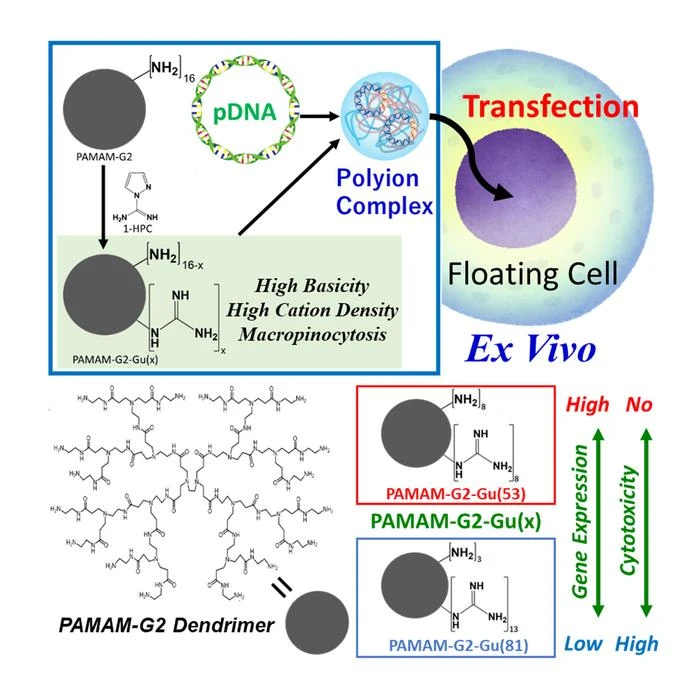
Now, a team led by Professor Shoichiro Asayama from Tokyo Metropolitan University have created a new polymer compound that can effectively get plasmid DNA (pDNA) into floating T-cells. They used a dendrimer, large polymers with a branching structure that resembles a hairy ball. Specifically, they used a second generation polyamidoamine (PAMAM-G2); second generation, in this case, refers to the number of times new branches are formed going out from the central structure. Experimenting with modifications to the ends of the branches, they found that they could realize a wide range of binding behavior of pDNA to PAMAM-G2.

In particular, the team found that PAMAM-G2 with a specific ratio of primary amine groups at the ends of branches replaced by highly basic guanidine (Gu) groups produced excellent carriers for pDNA. PAMAM-G2-Gu had a very high charge and were the right size for macropinocytosis, a common mechanism whereby cells “swallow” and incorporate outside material. With the right recipe, the PICs were also non-toxic and stable in blood plasma. Crucially, PAMAM-G2-Gu(53) (53% replacement by guanidine) significantly out-performed branched poly(ethylenimine) or bPEI, a gold standard PIC for gene transfection, in tests on floating T-cells.

Given their low toxicity and outstanding carrier properties, the team believe they have a viable candidate for ex-vivo transfection in the next generation of CAR T-cell treatments, a crucial therapy option for sufferers of a wide range of life-threatening illnesses.

This work was partially supported by a Grant-in-Aid for Scientific Research (B) from the Japan Society for the Promotion of Science (JSPS KAKENHI Grant Number 21H03820).

END


[Attachments] See images for this press release:
Hairy polymer balls help get genetic blueprints inside T-cells for blood cancer therapy

ELSE PRESS RELEASES FROM THIS DATE:

Reducing fishing gear could save whales with low impacts to California’s crab fishermen

2023-09-30
(Santa Barbara, Calif.) — Sometimes simple solutions are better. It all depends on the nature of the problem. For humpback whales, the problem is the rope connecting a crab trap on the seafloor to the buoy on the surface. And for fishermen, it’s fishery closures caused by whale entanglements. Managing this issue is currently a major item on California’s agenda, and it appears less fishing gear may be the optimal solution. So says a team of researchers led by Christopher Free, at UC Santa Barbara, after modeling the benefits and impacts that several management strategies would have on whales and fishermen. ...

Engineering researchers to study wireless communication and machine learning with NSF grant

2023-09-30
A virtual reality (VR) game crashes. A robot rolls dangerously close to the edge of a cliff. An autonomous vehicle speeds toward a pedestrian. Without intelligent control happening every millisecond, accidents can occur. This control can mean applying the brake of an autonomous vehicle to save a life or creating a more user-friendly augmented reality experience. Two professors in the Department of Electrical and Computer Engineering at Texas A&M University are working to enhance and advance the future ...

Wheat's long non-coding RNAs unveiled: A leap in understanding grain development

Wheats long non-coding RNAs unveiled: A leap in understanding grain development
2023-09-30
Wheat is a global staple food and plays a pivotal role in the livelihoods of billions of people. Although long non-coding RNAs (lncRNAs) have been recognized as crucial regulators of numerous biological processes, our knowledge of lncRNAs associated with wheat (Triticum aestivum) grain development remains minimal. Seed Biology published an online paper entitled “A comprehensive atlas of long non-coding RNAs provides insight into grain development in wheat” on 04 September 2023. To ...

New study will examine irritable bowel syndrome as long COVID symptom

New study will examine irritable bowel syndrome as long COVID symptom
2023-09-30
Researchers with the ongoing Arizona CoVHORT research study at the University of Arizona Mel and Enid Zuckerman College of Public Health were awarded $3.2 million by the National Institute of Diabetes and Digestive and Kidney Diseases for a five-year study of gastrointestinal symptoms, specifically irritable bowel syndrome, as a condition of long COVID. Led by epidemiologist Kristen Pogreba-Brown, PhD, MPH, the CoVHORT study is a longitudinal research study of COVID-19 and post-COVID conditions. The ...

Department of Energy announces up to $500 million for basic research to advance the frontiers of science

2023-09-29
WASHINGTON, D.C. - The U.S. Department of Energy (DOE) today announced up to $500 million in funding for basic research in support of DOE’s clean energy, economic, and national security goals. The funding will advance the priorities of DOE’s Office of Science and its major programs, including Advanced Scientific Computing Research, Basic Energy Sciences, Biological and Environmental Research, Fusion Energy Sciences, High Energy Physics, Nuclear Physics, Isotope R&D and Production, and Accelerator R&D and Production. This funding opportunity will help achieve the Biden Administration’s ...

Neural activity associated with motor commands changes depending on context

Neural activity associated with motor commands changes depending on context
2023-09-29
Standing at a crosswalk, the signal changes from “don’t walk,” to “walk.” You might step out into the street straight away, or you might look both ways before you cross. In either scenario, you see the light change, you cross the street. But the context is different; in one case, you didn’t think twice. In the other, you waited; looked to the left and right; saw the coast was clear; then stepped into the street. Researchers have known that certain brain activity when you see the light change and certain brain activity when you step out into the street are the same no matter the context -- there’s a known “pathway” ...

Argonne joins Illinois manufacturers for ​“Makers on the Move” tour

2023-09-29
Manufacturers throughout Illinois will have the chance to learn about working with the Materials Manufacturing Innovation Center (MMIC) at the U.S. Department of Energy’s (DOE) Argonne National Laboratory, when the MMIC gets on the bus for the second annual Makers on the Move tour.  The Illinois Manufacturing Association and Illinois Manufacturing Excellence Center (IMEC) sponsor the eight-day, 1,000-mile tour, designed to showcase high-tech, clean, diverse and sustainable modern manufacturing. The branded Makers on the Move bus will stand out on the state’s roadways as it visits facilities, colleges ...

High cure rate, low toxicity maintained with shortened radiation treatment for intermediate risk prostate cancer, study finds

2023-09-29
ARLINGTON, Va., September 29, 2023 — People with intermediate risk, localized prostate cancer can be treated as effectively using fewer and higher doses of radiation therapy delivered over five treatment sessions as they can with lower doses delivered over several weeks, a new phase III randomized trial suggests. The findings, which are the latest from a series of studies investigating the benefits of stereotactic body radiation therapy (SBRT) for people diagnosed with prostate cancer, will be presented Monday at the American Society for Radiation Oncology (ASTRO) Annual Meeting. The PACE ...

True progression or pseudoprogression in glioblastoma patients?

True progression or pseudoprogression in glioblastoma patients?
2023-09-29
MIAMI, FLORIDA (STRICTLY EMBARGOED UNTIL SEPT. 29, 2023 AT 5PM ET) – Is it true progression or pseudoprogression in tumor growth? That’s the critical question for radiation and medical oncologists treating patients with glioblastoma, the most common and aggressive form of brain cancer. Distinguishing between these types of progression is vitally important for treatment management. “Knowing if it’s true progression, indicative of a poor response to treatment, or pseudoprogression, a favorable response that may look worse due to swelling or tumor necrosis, is essential for clinicians,” said Eric Mellon, MD, PhD, a radiation oncologist and researcher ...

ASTRO 2023 Session shines spotlight on physician burnout

ASTRO 2023 Session shines spotlight on physician burnout
2023-09-29
MIAMI, FLORIDA (EMBARGOED UNTIL SEPT. 29, 2023, AT 5 PM ET, 2023) – Physician burnout was already a trending topic within the medical community before 2020, when the COVID-19 pandemic brought national attention to the issue. Typical stressors such as long hours, poor work-life balance, frustrating insurance denials and cumbersome medical documentation were compounded by new challenges from a novel, deadly virus that killed millions worldwide and necessitated a paradigm shift in care delivery. The side effects were widespread and readily apparent. By late 2021, research by the American Medical Association, Mayo Clinic and Stanford ...

LAST 30 PRESS RELEASES:

CHANGE-seq-BE finds off-target changes in the genome from base editors

The Journal of Nuclear Medicine Ahead-of-Print Tip Sheet: January 2, 2026

Delayed or absent first dose of measles, mumps, and rubella vaccination

Trends in US preterm birth rates by household income and race and ethnicity

Study identifies potential biomarker linked to progression and brain inflammation in multiple sclerosis

Many mothers in Norway do not show up for postnatal check-ups

Researchers want to find out why quick clay is so unstable

Superradiant spins show teamwork at the quantum scale

Cleveland Clinic Research links tumor bacteria to immunotherapy resistance in head and neck cancer

First Editorial of 2026: Resisting AI slop

Joint ground- and space-based observations reveal Saturn-mass rogue planet

Inheritable genetic variant offers protection against blood cancer risk and progression

Pigs settled Pacific islands alongside early human voyagers

A Coral reef’s daily pulse reshapes microbes in surrounding waters

EAST Tokamak experiments exceed plasma density limit, offering new approach to fusion ignition

Groundbreaking discovery reveals Africa’s oldest cremation pyre and complex ritual practices

First breathing ‘lung-on-chip’ developed using genetically identical cells

How people moved pigs across the Pacific

Interaction of climate change and human activity and its impact on plant diversity in Qinghai-Tibet plateau

From addressing uncertainty to national strategy: an interpretation of Professor Lim Siong Guan’s views

Clinical trials on AI language model use in digestive healthcare

Scientists improve robotic visual–inertial trajectory localization accuracy using cross-modal interaction and selection techniques

Correlation between cancer cachexia and immune-related adverse events in HCC

Human adipose tissue: a new source for functional organoids

Metro lines double as freight highways during off-peak hours, Beijing study shows

Biomedical functions and applications of nanomaterials in tumor diagnosis and treatment: perspectives from ophthalmic oncology

3D imaging unveils how passivation improves perovskite solar cell performance

Enriching framework Al sites in 8-membered rings of Cu-SSZ-39 zeolite to enhance low-temperature ammonia selective catalytic reduction performance

AI-powered RNA drug development: a new frontier in therapeutics

Decoupling the HOR enhancement on PtRu: Dynamically matching interfacial water to reaction coordinates

[Press-News.org] Hairy polymer balls help get genetic blueprints inside T-cells for blood cancer therapy
Designer polyion complexes promise next-gen gene carriers for CAR T-cell therapy