Bumblebees drop to shake off Asian hornets
Published 2023-10-05 · Original archive entry · Explore research explainers
Bumblebees have a remarkably successful method for fighting off Asian hornets, new research shows.
When attacked, buff-tailed bumblebees drop to the ground – taking the hornets down with them. This either causes the hornet to lose its grip, or the bee raises its sting and tussles until the hornet gives up.
University of Exeter scientists witnessed over 120 such attacks, and were stunned to find that bumblebees fought off the hornets every time.
Despite this, they found bumblebee colonies had reduced growth rates in areas with high numbers of Asian hornets – suggesting the hornets still had a negative impact, even if their attacks at colony entrances usually failed.
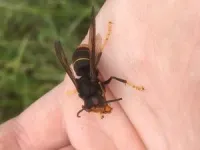
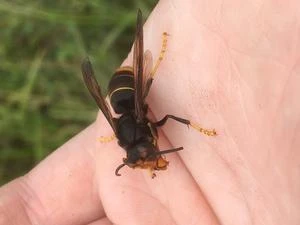
Asian hornets (also known as yellow-legged hornets) have already invaded much of mainland Europe and parts of east Asia, and have recently been reported in the US for the first time.
Sightings in the UK and continental Europe are at record levels this year – raising fears for pollinators and prompting substantial control efforts.
“Asian hornets prey on a wide range of insects, including honey bees, but little is known about their impact on other pollinators,” said Thomas O'Shea-Wheller, of the Environment and Sustainability Institute on Exeter’s Penryn Campus in Cornwall.
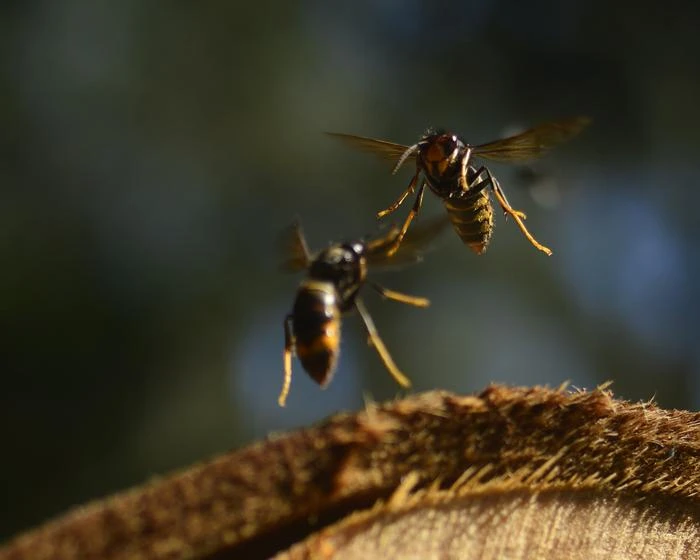
“With honey bees, the hornets do something called ‘hawking’ – hovering outside the bees’ nest and attacking returning foragers as they fly past.
“We recorded hornets doing the same thing to bumblebees, but with the surprising difference that in our observations, they were entirely unsuccessful.”
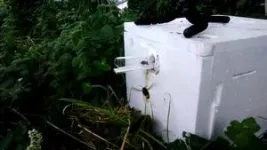
In the study, commercially reared bumblebee colonies were placed at 12 locations across the province of Pontevedra, Spain, with varying local Asian hornet densities.
Colonies were weighed every two days (weight change is a measure of colony growth) and those in areas with higher Asian hornet densities grew more slowly.
“We can’t say for certain why this is,” O'Shea-Wheller said.
“It’s possible that some external factor is good for Asian hornets, allowing them to thrive, but bad for bumblebees.
“However, it’s perhaps more likely that the presence of Asian hornets limits the success of bumblebee colonies.
“Although the attacks we witnessed at colony entrances were unsuccessful, bumblebees have been reported in the diet of Asian hornets, and the hornets are known to prey on them elsewhere.
“Furthermore, defending against such attacks is likely energetically costly – and when hornet abundance is high, this could be a major problem for bees out foraging.
“Hornets also consume nectar from flowers, meaning they compete directly with bees for food and harass them at flower patches via constant attacks.”
Commenting on the hornets’ low success rate during attacks, O'Shea-Wheller said: “I have seen hornets attack bumblebees of all sizes, including some that are larger than them.
“They are very persistent and generalist predators, so these attacks may still be worthwhile despite the high failure rate, as long as they sometimes get a kill.”
Buff-tailed bumblebees (Bombus terrestris) have not evolved alongside Asian hornets (Vespa velutina), so O'Shea-Wheller said their successful defensive strategy may well be an “evolutionary coincidence”.
“While honey bees are often unable to escape the clutches of Asian hornets once grappled in the air, the bumblebees’ defensive response of dropping to the ground appears to be more successful,” he said.
In addition to the University of Exeter, the research team included scientists from the University of Vigo and the University of Santiago de Compostela.
The study was funded by the Biotechnology and Biological Sciences Research Council (BBSRC) and the European Regional Development Fund (ERDF).
The paper, published in the journal Communications Biology, is entitled: “Quantifying the impact of an invasive hornet on Bombus terrestris colonies.”
END
When attacked, buff-tailed bumblebees drop to the ground – taking the hornets down with them. This either causes the hornet to lose its grip, or the bee raises its sting and tussles until the hornet gives up.
University of Exeter scientists witnessed over 120 such attacks, and were stunned to find that bumblebees fought off the hornets every time.
Despite this, they found bumblebee colonies had reduced growth rates in areas with high numbers of Asian hornets – suggesting the hornets still had a negative impact, even if their attacks at colony entrances usually failed.
Asian hornets (also known as yellow-legged hornets) have already invaded much of mainland Europe and parts of east Asia, and have recently been reported in the US for the first time.
Sightings in the UK and continental Europe are at record levels this year – raising fears for pollinators and prompting substantial control efforts.
“Asian hornets prey on a wide range of insects, including honey bees, but little is known about their impact on other pollinators,” said Thomas O'Shea-Wheller, of the Environment and Sustainability Institute on Exeter’s Penryn Campus in Cornwall.
“With honey bees, the hornets do something called ‘hawking’ – hovering outside the bees’ nest and attacking returning foragers as they fly past.
“We recorded hornets doing the same thing to bumblebees, but with the surprising difference that in our observations, they were entirely unsuccessful.”
In the study, commercially reared bumblebee colonies were placed at 12 locations across the province of Pontevedra, Spain, with varying local Asian hornet densities.
Colonies were weighed every two days (weight change is a measure of colony growth) and those in areas with higher Asian hornet densities grew more slowly.
“We can’t say for certain why this is,” O'Shea-Wheller said.
“It’s possible that some external factor is good for Asian hornets, allowing them to thrive, but bad for bumblebees.
“However, it’s perhaps more likely that the presence of Asian hornets limits the success of bumblebee colonies.
“Although the attacks we witnessed at colony entrances were unsuccessful, bumblebees have been reported in the diet of Asian hornets, and the hornets are known to prey on them elsewhere.
“Furthermore, defending against such attacks is likely energetically costly – and when hornet abundance is high, this could be a major problem for bees out foraging.
“Hornets also consume nectar from flowers, meaning they compete directly with bees for food and harass them at flower patches via constant attacks.”
Commenting on the hornets’ low success rate during attacks, O'Shea-Wheller said: “I have seen hornets attack bumblebees of all sizes, including some that are larger than them.
“They are very persistent and generalist predators, so these attacks may still be worthwhile despite the high failure rate, as long as they sometimes get a kill.”
Buff-tailed bumblebees (Bombus terrestris) have not evolved alongside Asian hornets (Vespa velutina), so O'Shea-Wheller said their successful defensive strategy may well be an “evolutionary coincidence”.
“While honey bees are often unable to escape the clutches of Asian hornets once grappled in the air, the bumblebees’ defensive response of dropping to the ground appears to be more successful,” he said.
In addition to the University of Exeter, the research team included scientists from the University of Vigo and the University of Santiago de Compostela.
The study was funded by the Biotechnology and Biological Sciences Research Council (BBSRC) and the European Regional Development Fund (ERDF).
The paper, published in the journal Communications Biology, is entitled: “Quantifying the impact of an invasive hornet on Bombus terrestris colonies.”
END
Attachments