(Press-News.org) SAN ANTONIO — October 17, 2023 —Southwest Research Institute (SwRI) will continue advancing the Elastic Plastic Impact Computations (EPIC) dynamic finite-element code as part of an Other Transaction Prototype Agreement with the U.S Army Corps of Engineers. The first year’s funding of $500,000 has been awarded, with optional additional funding across the next three years totaling $3.5 million.
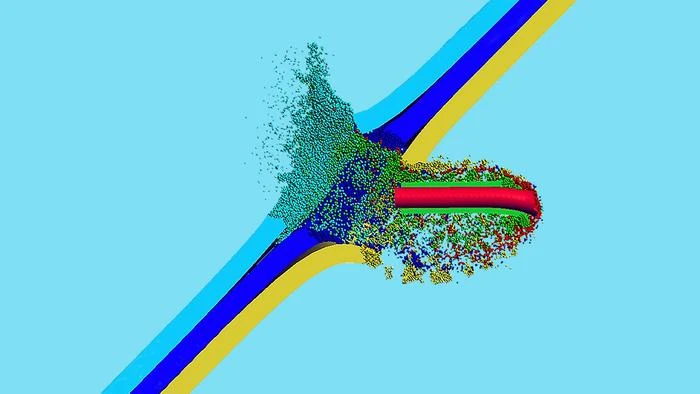
“EPIC uses finite element and particle methods to simulate complex impact and explosion scenarios,” said SwRI Staff Engineer Dr. Stephen Beissel, who leads the EPIC project and has been involved in EPIC’s development since the mid-1990s. “The numerical algorithms and the material models allow EPIC to handle highly dynamic and energetic events. Through simulations with the EPIC code, engineers can perform analyses of how a particular design for a ground vehicle, ship or aircraft component would react under stress in real-world conditions.”
The development of the EPIC code began in the 1970s to cost-effectively design warheads, body armor and armored vehicles, and to model their interactions. In 2007 the EPIC development team joined SwRI, which opened an office in Minneapolis, Minnesota to support them. At that time, SwRI took over maintenance and development of the project.
EPIC uses the finite element analysis, an efficient computational technique, to model a full range of impact scenarios, including high-speed impacts, which generate large pressures, high strain rates and permanent deformations in solid materials. It also uses particle methods, an approach similar to the finite-element method, which continuously reassesses the local regions over which information is exchanged.
“One of EPIC’s unique features is the accurate transition from finite elements to particle methods when the deformations become very large. It is an important tool for designing effective warheads, as well as effective armor for vehicles, aircraft and soldiers, and to provide protection against a wide range of threats,” Beissel said. “It simulates high-velocity impact events and, in the case of warheads, it simulates explosive detonation.”
Over the next four years, SwRI will improve and update EPIC, aiming to increase its accuracy, expand the types of problems and scenarios it is able to address, and increase its computational efficiency when used on supercomputers and GPU clusters.
“As our adversaries continue to work on new munitions, such as hypersonic missiles, we need tools to help us counter by designing new armor that can withstand them and new approaches to defeating those threats,” Beissel said. “Creating physical prototypes and testing them is expensive and time-consuming, especially in destructive events. Simulating these dynamic and explosive large-strain events, instead of constantly recreating a physical prototype, makes the design cycle more efficient and cost-effective.”
For more information, visit https://www.swri.org/industry/ballistics-explosives/epic-dynamic-finite-element-code.
END
SwRI will advance impact modeling software for U.S. Army Corps of Engineers
Elastic Plastic Impact Computations (EPIC) will be updated for the evolving computational needs of the U.S. Department of Defense
2023-10-17
ELSE PRESS RELEASES FROM THIS DATE:
The earthworm effect: unraveling soil weathering dynamics
2023-10-17
17 October 2023
The Geological Society of America
Release No. 23-42
Contact: Justin Samuel
+1-303-357-1026
jsamuel@geosociety.org
For Immediate Release
Contributed by Sarah Derouin
Pittsburgh, Pa., USA: Earthworms, the hardworking invertebrates that grace the upper layers of soil, have long been considered helpful in our home gardens. Earthworms are prolific munchers, grinding up organic material and sediment grains that make up soils. Although they are very different animals, worms, like many poultry, have gizzards. “Worms will ingest some larger soil grains, and then they use the strongest and largest of those grains, retaining them in their gizzard,” ...
New dating of cave art reveals history of Puerto Rican people
2023-10-17
17 October 2023
The Geological Society of America
Release No. 23-40
Contact: Justin Samuel
+1-303-357-1026
jsamuel@geosociety.org
For Immediate Release
Leer en español.
Contributed by Sarah Derouin
Pittsburgh, Pa., USA: In the karstic caves of Puerto Rico, cave art paints the rock walls. Previous research has assigned ages to this art based on the ages of nearby archaeological artifacts within the caves, but these ages are relative and may not reflect the true timing of the art creation.
Now, a new study to be presented Wednesday at the Geological Society of America’s GSA Connects 2023 meeting shows that researchers have refined the age of this rupestrian ...
U.S. groundwater is getting saltier—what that means for infrastructure, ecosystems, and human health
2023-10-17
17 October 2023
The Geological Society of America
Release No. 23-41
Contact: Justin Samuel
+1-303-357-1026
jsamuel@geosociety.org
For Immediate Release
Contributed by Sarah Derouin
Pittsburgh, Pa., USA: Scientists from the U.S. Geological Survey (USGS) have been monitoring groundwater quality in wells across the country for more than three decades, looking for harmful chemicals or residual substances that may cause harm to ecosystems or humans. In all, they have measured up to 500 chemical constituents, including major ions, metals, pesticides, volatile organic compounds, fertilizers, and radionuclides.
Of ...
Pathogen that plagues food processing plants eradicated by blue light
2023-10-17
Washington, D.C. – Blue light kills both dried cells and biofilms of the pathogen Listeria monocytogenes, a frequent contaminant of food processing facilities. Demise of L. monocytogenes occurred quickest when cells or biofilms were placed on polystyrene, a widely used, transparent form of plastic. The research is published in Applied and Environmental Microbiology, a journal of the American Society for Microbiology.
“These results contribute to advancing our understanding of the potential of blue light to treat inert surfaces contaminated with L. monocytogenes,” said corresponding author ...
Public health interventions prevented transmission within BU most SARS-CoV-2 cases
2023-10-17
(Boston)— SARS-CoV-2, the causative agent of COVID-19, began impacting the U.S. in March 2020 with many schools and universities shifting to remote education by early April 2020 in response to the public health emergency. Despite public health interventions (increased ventilation, masking policies, surveillance testing, contact tracing of confirmed cases and quarantine procedures for infected students, faculty and staff) there were still concerns that institutes of higher education would be a hotbed of transmission, including transmission from students into surrounding communities.
But, were these fears warranted?
A ...
CastleVax Inc. receives BARDA project NextGen award valued at up to $338 million to advance intranasal NDV-based COVID-19 booster vaccine into phase 2b clinical efficacy testing
2023-10-17
CastleVax, a clinical stage vaccine platform company, has received a Project NexGen award valued at up to $338 million from the Biomedical Advanced Research and Development Authority (BARDA), part of the Administration for Strategic Preparedness and Response (ASPR) in the U.S. Department of Health and Human Services (HHS), to support the development of a next-generation, booster vaccine to protect against COVID-19 for years to come. The initial phase of the award provides approximately $8.5 million to plan a Phase 2b clinical trial that would compare CastleVax’s vaccine to currently ...
New cancer therapy target stops tumor cells from sharing resources
2023-10-17
Researchers at University of California San Diego have discovered a process in which liver cells share molecules via vesicle exchange in order to multiply under conditions that would ordinarily suppress cell proliferation. They also found evidence that this process occurs in various types of cancer cells, paving the way for a new approach to tackling treatment resistance in cancer. The findings were published on October 17, 2023 in eLife.
“Understanding cell proliferation is a fundamental issue in both cancer research and biomedical science as a whole,” said Gen-Sheng Feng, PhD, a professor of pathology at UC San Diego School of Medicine and of molecular biology ...
International team reveals source of largest ever Mars quake
2023-10-17
A global team of scientists have announced the results of an unprecedented collaboration to search for the source of the largest ever seismic event recorded on Mars. The study, led by the University of Oxford, rules out a meteorite impact, suggesting instead that the quake was the result of enormous tectonic forces within Mars’ crust.
The quake, which had a magnitude of 4.7 and caused vibrations to reverberate through the planet for at least six hours, was recorded by NASA’s InSight lander on May 4 2022. ...
The dark side of the American lawn
2023-10-17
The American residential lawn is, for many, an iconic landscape and about half of homeowners in the US use fertilizer to keep their yards green and lush. Some proportion of the nitrogen in this fertilizer enters the broader environment, with negative consequences including algal blooms and deoxygenated waters. Peter Groffman and colleagues studied residential landscapes in the Baltimore, Maryland metropolitan area, which drains to the Chesapeake Bay, seeking to identify locations (hotspots) or times (hot moments) with disproportionately high rates of nitrogen export. The authors went to lawns in exurban, ...
New study sheds light on the developmental mechanism of allergic conjunctivitis
2023-10-17
When it comes to eye allergies, the transition from allergen contact to bothersome symptoms has always been quick, appearing within a span of a few minutes. The initial stage of allergic conjunctivitis involves the penetration of allergen through the epithelial cell layer (cells covering the outer surface of the body). However, the exact mechanism underlying the rapid allergen transfer has remained a mystery so far.
Fortunately, in a new ground-breaking study published in the journal JCI Insight on October 11, 2023, researchers from Juntendo ...
LAST 30 PRESS RELEASES:
Racial/ethnic disparities among people fatally shot by U.S. police vary across state lines
US gender differences in poverty rates may be associated with the varying burden of childcare
3D-printed robotic rattlesnake triggers an avoidance response in zoo animals, especially species which share their distribution with rattlers in nature
Simple ‘cocktail’ of amino acids dramatically boosts power of mRNA therapies and CRISPR gene editing
Johns Hopkins scientists engineer nanoparticles able to seek and destroy diseased immune cells
A hidden immune circuit in the uterus revealed: Findings shed light on preeclampsia and early pregnancy failure
Google Earth’ for human organs made available online
AI assistants can sway writers’ attitudes, even when they’re watching for bias
Still standing but mostly dead: Recovery of dying coral reef in Moorea stalls
3D-printed rattlesnake reveals how the rattle is a warning signal
Despite their contrasting reputations, bonobos and chimpanzees show similar levels of aggression in zoos
Unusual tumor cells may be overlooked factors in advanced breast cancer
Plants pause, play and fast forward growth depending on types of climate stress
University of Minnesota scientists reveal how deadly Marburg virus enters human cells, identify therapeutic vulnerability
Here's why seafarers have little confidence in autonomous ships
MYC amplification in metastatic prostate cancer associated with reduced tumor immunogenicity
The gut can drive age-associated memory loss
Enhancing gut-brain communication reversed cognitive decline, improved memory formation in aging mice
Mothers exposure to microbes protect their newborn babies against infection
How one flu virus can hamper the immune response to another
Researchers uncover distinct tumor “neighborhoods”, with each cell subtype playing a specific role, in aggressive childhood brain cancer
Researchers develop new way to safely insert gene-sized DNA into the genome
Astronomers capture birth of a magnetar, confirming link to some of universe’s brightest exploding stars
New photonic device, developed by MIT researchers, efficiently beams light into free space
UCSB researcher bridges the worlds of general relativity and supernova astrophysics
Global exchange of knowledge and technology to significantly advance reef restoration efforts
Vision sensing for intelligent driving: technical challenges and innovative solutions
To attempt world record, researchers will use their finding that prep phase is most vital to accurate three-point shooting
AI is homogenizing human expression and thought, computer scientists and psychologists say
Severe COVID-19, flu facilitate lung cancer months or years later, new research shows
[Press-News.org] SwRI will advance impact modeling software for U.S. Army Corps of EngineersElastic Plastic Impact Computations (EPIC) will be updated for the evolving computational needs of the U.S. Department of Defense