The Long Jump: Athletic, insect-scale long jumping robots reach where others can't.
Published 2023-11-13 · Original archive entry · Explore research explainers
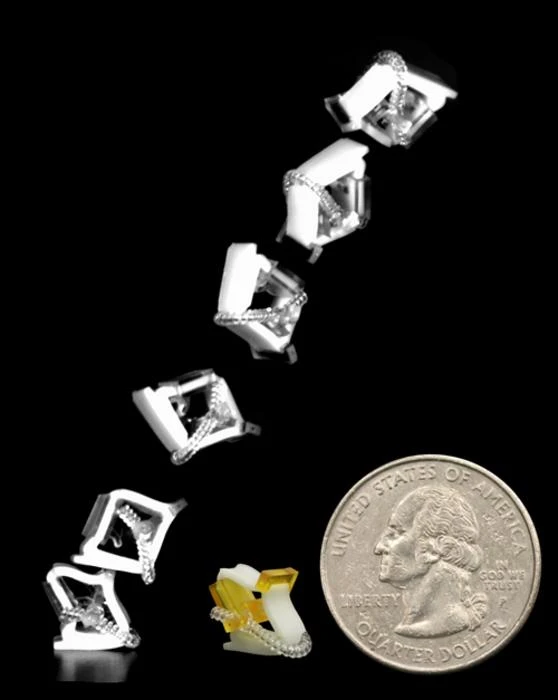
A team of engineers from the University of Illinois has published the first known study documenting the long-jumping motion of 3D-printed insect-scale robots.
The new study, published in the journal Smart Materials and Structures, follows a previous publication that documented the same lab’s investigation of vertical jumping in insect-scale robots. The study is led by Professor Sameh Tawfick, an associate professor and Ralph A. Andersen Faculty Scholar in the Department of Mechanical Science and Engineering. His lab, the Kinetic Materials Research Group, studies the development of artificial muscles as part of its focus on bio-inspired materials manufacturing.
“To my knowledge, this is the first time anyone has demonstrated long jumping in insect-scale robots,” Tawfick said of his lab’s accomplishment. “This is significant because it gives the robot planned mobility, where it can now jump from A to B, traversing terrain rougher than its own size.”
Jump performance in insect-scale robots was previously hindered by small-scale manufacturing processes and limited availability of materials and miniature actuators. Tawfick’s team used coiled artificial muscle actuators and projection additive manufacturing to produce a monolithic elastomeric robot design inspired by a locust’s jumping mechanism.
“Our dream for the future is to have a small mission in which the robot executes multiple jumps until they reach a target.”
Sameh Tawfick, Associate Professor, Department of Mechanical Science and Engineering
“We used a four-bar linkage design for jumping, inspired by the locust, which is an outstanding jumper,” said Tawfick, explaining that while a locust’s four legs are not linked, allowing it to both walk and jump, the robot in their study relies one single muscle serving a linkage system.
The insect-scale prototype has a lightweight elastomer body and an artificial muscle made from coiled, heat-treated nylon fishing line. Tawfick’s lab previously developed machines to produce these miniature coils. The researchers designed and tested 108 robot iterations produced through additive manufacturing, with the smallest having a mass of 0.216 grams and the ability to jump 60 times its body size in horizontal distance.
Jump performance in insect-scale robots was previously hindered by small-scale manufacturing processes and limited availability of materials and miniature actuators. Tawfick’s team used coiled artificial muscle actuators and projection additive manufacturing to produce a monolithic elastomeric robot design inspired by a locust’s jumping mechanism.
“We used a four-bar linkage design for jumping, inspired by the locust, which is an outstanding jumper,” said Tawfick, explaining that while a locust’s four legs are not linked, allowing it to both walk and jump, the robot in their study relies one single muscle serving a linkage system.
The insect-scale prototype has a lightweight elastomer body and an artificial muscle made from coiled, heat-treated nylon fishing line. Tawfick’s lab previously developed machines to produce these miniature coils. The researchers designed and tested 108 robot iterations produced through additive manufacturing, with the smallest having a mass of 0.216 grams and the ability to jump 60 times its body size in horizontal distance.
The development of a long-jumping insect-scale robot is significant for agricultural and maintenance applications that benefit from non-destructive evaluation. For example, future robots could be equipped with sensors to gather data from contacting a crop or exploring inside a machine.
“These robots can reach locations that drones currently cannot,” Tawfick said of long jumping robots’ predicted ability to gather crop data. “They are inexpensive to mass manufacture, which gives them a lot of utility for sensing as a fleet.”
The team’s next steps will be to explore motion planning so that the robots execute jumps efficiently while maximizing battery life and find the most efficient motion path. They will also use a framework to investigate uncertainty factors introduced by the jumping motion.
“Our dream for the future is to have a small mission in which the robot executes multiple jumps until they reach a target,” Tawfick said. “This would allow us to test its ability to go to a designated point, gather images, and return to its start.”
The researchers are also excited to see their methods employed by others in the field.
“One of the strengths of our study is that other researchers can use our theoretical model to produce something similar,” Tawfick said. “We’re excited for the world to know that we now have a robot that can perform long jumping.”
END
The new study, published in the journal Smart Materials and Structures, follows a previous publication that documented the same lab’s investigation of vertical jumping in insect-scale robots. The study is led by Professor Sameh Tawfick, an associate professor and Ralph A. Andersen Faculty Scholar in the Department of Mechanical Science and Engineering. His lab, the Kinetic Materials Research Group, studies the development of artificial muscles as part of its focus on bio-inspired materials manufacturing.
“To my knowledge, this is the first time anyone has demonstrated long jumping in insect-scale robots,” Tawfick said of his lab’s accomplishment. “This is significant because it gives the robot planned mobility, where it can now jump from A to B, traversing terrain rougher than its own size.”
Jump performance in insect-scale robots was previously hindered by small-scale manufacturing processes and limited availability of materials and miniature actuators. Tawfick’s team used coiled artificial muscle actuators and projection additive manufacturing to produce a monolithic elastomeric robot design inspired by a locust’s jumping mechanism.
“Our dream for the future is to have a small mission in which the robot executes multiple jumps until they reach a target.”
Sameh Tawfick, Associate Professor, Department of Mechanical Science and Engineering
“We used a four-bar linkage design for jumping, inspired by the locust, which is an outstanding jumper,” said Tawfick, explaining that while a locust’s four legs are not linked, allowing it to both walk and jump, the robot in their study relies one single muscle serving a linkage system.
The insect-scale prototype has a lightweight elastomer body and an artificial muscle made from coiled, heat-treated nylon fishing line. Tawfick’s lab previously developed machines to produce these miniature coils. The researchers designed and tested 108 robot iterations produced through additive manufacturing, with the smallest having a mass of 0.216 grams and the ability to jump 60 times its body size in horizontal distance.
Jump performance in insect-scale robots was previously hindered by small-scale manufacturing processes and limited availability of materials and miniature actuators. Tawfick’s team used coiled artificial muscle actuators and projection additive manufacturing to produce a monolithic elastomeric robot design inspired by a locust’s jumping mechanism.
“We used a four-bar linkage design for jumping, inspired by the locust, which is an outstanding jumper,” said Tawfick, explaining that while a locust’s four legs are not linked, allowing it to both walk and jump, the robot in their study relies one single muscle serving a linkage system.
The insect-scale prototype has a lightweight elastomer body and an artificial muscle made from coiled, heat-treated nylon fishing line. Tawfick’s lab previously developed machines to produce these miniature coils. The researchers designed and tested 108 robot iterations produced through additive manufacturing, with the smallest having a mass of 0.216 grams and the ability to jump 60 times its body size in horizontal distance.
The development of a long-jumping insect-scale robot is significant for agricultural and maintenance applications that benefit from non-destructive evaluation. For example, future robots could be equipped with sensors to gather data from contacting a crop or exploring inside a machine.
“These robots can reach locations that drones currently cannot,” Tawfick said of long jumping robots’ predicted ability to gather crop data. “They are inexpensive to mass manufacture, which gives them a lot of utility for sensing as a fleet.”
The team’s next steps will be to explore motion planning so that the robots execute jumps efficiently while maximizing battery life and find the most efficient motion path. They will also use a framework to investigate uncertainty factors introduced by the jumping motion.
“Our dream for the future is to have a small mission in which the robot executes multiple jumps until they reach a target,” Tawfick said. “This would allow us to test its ability to go to a designated point, gather images, and return to its start.”
The researchers are also excited to see their methods employed by others in the field.
“One of the strengths of our study is that other researchers can use our theoretical model to produce something similar,” Tawfick said. “We’re excited for the world to know that we now have a robot that can perform long jumping.”
END