National Poll: Parents of young children increasingly turn to social media for parenting advice
Most mothers and over two-thirds of fathers of children ages 0-4 use social media for questions on topics like feeding and behavior challenges
Published 2023-11-20 · Original archive entry · Explore research explainers
ANN ARBOR, Mich. – Potty training, getting kids to sleep and toddler tantrums are just some of the challenges parents of young children face.
And four in five parents in a new national poll say they go to the same place to discuss such parenting issues: social media.
Nearly half of parents rate social media as very useful for getting new ideas to try, according to the University of Michigan Health C.S. Mott Children’s Hospital National Poll on Children’s Health.
“Many parents turn to online communities to exchange advice or discuss parenting challenges because it may seem faster and easier than asking a health professional,” said Mott Poll co-director Sarah Clark, M.P.H.
“Finding parent comradery in this space can have benefits but parents should keep in mind that every family’s experience is different and not everything they hear online may be accurate or the right thing for their child.”
The nationally representative report is based on responses from 614 parents with at least one child aged 0-4. Most mothers and over two-thirds of fathers of children these ages look to social media for parenting advice or to share their experiences – a significant increase since a previous Mott poll explored similar questions in 2015.
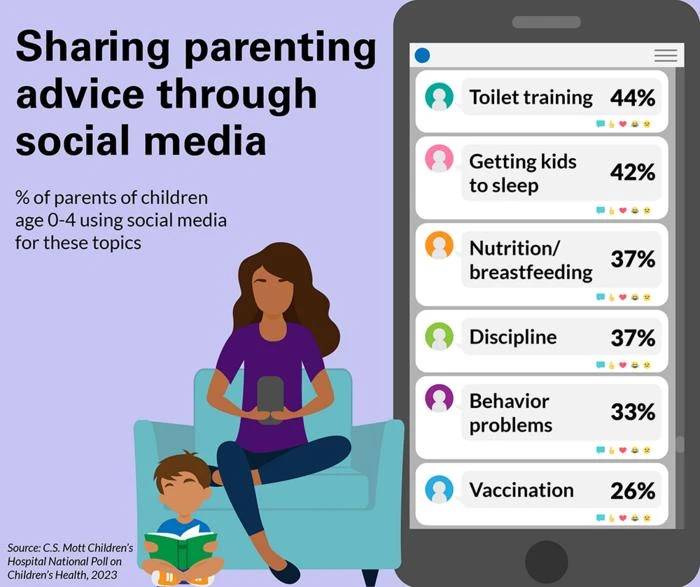
The most common discussions included toilet training (44%), kids’ sleep (42%) nutrition/breastfeeding (37%), discipline (37%), behavior problems (33%), vaccination (26%), daycare/preschool (24%), and getting along with other kids (21%).
Three fifths of parents say they talk about these topics on social media because they want to hear different ideas while one in four say it’s convenient or they want to do things differently than their parents. Fewer say they use these platforms because they don’t have family or friends nearby, don’t have enough opportunities to ask their child’s healthcare provider or are too embarrassed to ask in person.
“Often there isn’t a clear ‘best’ way to do things and many parents use a trial-and-error approach to find what works for their child,” Clark said.
More than a third of parents also rate social media as very useful for making them feel like they’re not alone and learning what not to do while a fourth say it helps them decide whether to buy certain products.
One in ten parents of young children who use social media also described it as very useful in deciding when to take their child to the doctor. However, with young children, Clark notes, “it is usually prudent to contact the child’s primary care provider with any questions.”
Telehealth visits and messaging through patient portals, she adds, are efficient ways for parents to ask for guidance and determine if the child needs to be seen in person.
Sharenting concerns
Most parents identify at least one aspect of social media sharing that concerns them, such as seeing other parents doing something unhealthy or dangerous for their child or others finding out their family’s private information or sharing photos of their child without their child’s permission.
Nearly 80% of parents also feel other parents overshare on social media by bragging about their child or sharing too often or too much. Meanwhile, over 60 % believe parents may give personal information that could identify the child’s location or embarrass the child when they’re older.
Nearly half also say they have seen parents post information that is false while more than a quarter have noticed some parents sharing inappropriate photos of a child’s body.
“Parents acknowledge concerns related to sharing too much about their kids on social media,” Clark said.
“Families should consider whether their child may one day be embarrassed about having personal information shared without their consent; a good rule is if you have any doubt, don’t share it. In addition, parents should consult with parents of other children in photos for approval before sharing them on social media.”
More than half of parents, however, do use privacy settings or restrict who can see posts about their children. Nearly a third also avoid posting photos or videos of their child while about one in five participate in closed groups.
A small percentage of parents use their child’s initials instead of their name or block out their child’s face.
“Before posting, think about whether you’re sharing enough information to get someone else's advice without giving away too much personal information about your family,” Clark said. “It’s really about stopping and thinking before you post.”
She says oversharing may create risks, for example, if it reveals a family is on vacation and their home may be unattended.
Weeding out bad information
Another emerging concern, the poll suggests, is parents sharing information that is false or inaccurate either knowingly or unknowingly.
Two in five parents think it’s difficult to distinguish good versus bad advice on social media.
Particularly for first-time parents, access to so many sources may be both helpful and overwhelming, Clark says. But it’s up to them to verify accuracy in what they’re hearing.
“There are so many decisions to make about the best way to care for children during the infant and toddler years, which can be an exciting and overwhelming time,” Clark said.
“Social media is a convenient way for parents to seek information about parenting challenges in real time, especially in between checkups. But it’s important that parents identify reputable sources of information about children’s health and parenting, and that they consult those sources before attempting new strategies with their own child.”
END
And four in five parents in a new national poll say they go to the same place to discuss such parenting issues: social media.
Nearly half of parents rate social media as very useful for getting new ideas to try, according to the University of Michigan Health C.S. Mott Children’s Hospital National Poll on Children’s Health.
“Many parents turn to online communities to exchange advice or discuss parenting challenges because it may seem faster and easier than asking a health professional,” said Mott Poll co-director Sarah Clark, M.P.H.
“Finding parent comradery in this space can have benefits but parents should keep in mind that every family’s experience is different and not everything they hear online may be accurate or the right thing for their child.”
The nationally representative report is based on responses from 614 parents with at least one child aged 0-4. Most mothers and over two-thirds of fathers of children these ages look to social media for parenting advice or to share their experiences – a significant increase since a previous Mott poll explored similar questions in 2015.
The most common discussions included toilet training (44%), kids’ sleep (42%) nutrition/breastfeeding (37%), discipline (37%), behavior problems (33%), vaccination (26%), daycare/preschool (24%), and getting along with other kids (21%).
Three fifths of parents say they talk about these topics on social media because they want to hear different ideas while one in four say it’s convenient or they want to do things differently than their parents. Fewer say they use these platforms because they don’t have family or friends nearby, don’t have enough opportunities to ask their child’s healthcare provider or are too embarrassed to ask in person.
“Often there isn’t a clear ‘best’ way to do things and many parents use a trial-and-error approach to find what works for their child,” Clark said.
More than a third of parents also rate social media as very useful for making them feel like they’re not alone and learning what not to do while a fourth say it helps them decide whether to buy certain products.
One in ten parents of young children who use social media also described it as very useful in deciding when to take their child to the doctor. However, with young children, Clark notes, “it is usually prudent to contact the child’s primary care provider with any questions.”
Telehealth visits and messaging through patient portals, she adds, are efficient ways for parents to ask for guidance and determine if the child needs to be seen in person.
Sharenting concerns
Most parents identify at least one aspect of social media sharing that concerns them, such as seeing other parents doing something unhealthy or dangerous for their child or others finding out their family’s private information or sharing photos of their child without their child’s permission.
Nearly 80% of parents also feel other parents overshare on social media by bragging about their child or sharing too often or too much. Meanwhile, over 60 % believe parents may give personal information that could identify the child’s location or embarrass the child when they’re older.
Nearly half also say they have seen parents post information that is false while more than a quarter have noticed some parents sharing inappropriate photos of a child’s body.
“Parents acknowledge concerns related to sharing too much about their kids on social media,” Clark said.
“Families should consider whether their child may one day be embarrassed about having personal information shared without their consent; a good rule is if you have any doubt, don’t share it. In addition, parents should consult with parents of other children in photos for approval before sharing them on social media.”
More than half of parents, however, do use privacy settings or restrict who can see posts about their children. Nearly a third also avoid posting photos or videos of their child while about one in five participate in closed groups.
A small percentage of parents use their child’s initials instead of their name or block out their child’s face.
“Before posting, think about whether you’re sharing enough information to get someone else's advice without giving away too much personal information about your family,” Clark said. “It’s really about stopping and thinking before you post.”
She says oversharing may create risks, for example, if it reveals a family is on vacation and their home may be unattended.
Weeding out bad information
Another emerging concern, the poll suggests, is parents sharing information that is false or inaccurate either knowingly or unknowingly.
Two in five parents think it’s difficult to distinguish good versus bad advice on social media.
Particularly for first-time parents, access to so many sources may be both helpful and overwhelming, Clark says. But it’s up to them to verify accuracy in what they’re hearing.
“There are so many decisions to make about the best way to care for children during the infant and toddler years, which can be an exciting and overwhelming time,” Clark said.
“Social media is a convenient way for parents to seek information about parenting challenges in real time, especially in between checkups. But it’s important that parents identify reputable sources of information about children’s health and parenting, and that they consult those sources before attempting new strategies with their own child.”
END