Forest modeling shows which harvest rotations lead to maximum carbon sequestration
Published 2023-11-21 · Original archive entry · Explore research explainers
CORVALLIS, Ore. – Forest modeling by Oregon State University scientists shows that a site’s productivity – an indicator of how fast trees grow and how much biomass they accumulate – is the main factor that determines which time period between timber harvests allows for maximum above-ground carbon sequestration.
The findings, published in the journal Forests, are important for Pacific Northwest forest managers seeking to strike an optimal balance between harvesting and carbon sequestration, an important tool in the fight against climate change.
The study by Catherine Carlisle, Temesgen Hailemariam and Stephen Fitzgerald of the OSU College of Forestry notes that the carbon trapped in the woody biomass of U.S. forests offsets 13% of the nation’s greenhouse gas emissions. Green plants pull carbon dioxide from the air during photosynthesis, the process through which they use sunlight to make food from carbon dioxide, soil nutrients and water.
Forests in the Northwest stretch across nearly 25 million acres and are among the most productive in the world, the authors say, with forests in the Oregon Coast Range boasting especially high biomass and carbon densities thanks to the range’s wet and mild growing conditions.
“Whether short or long harvest rotations are better for maximizing carbon sequestration has been the subject of considerable debate,” said Carlisle, who led the study as a graduate student. “Future management decisions will need to strive to meet harvest requirements while also striving to maintain high rates of carbon sequestration.”
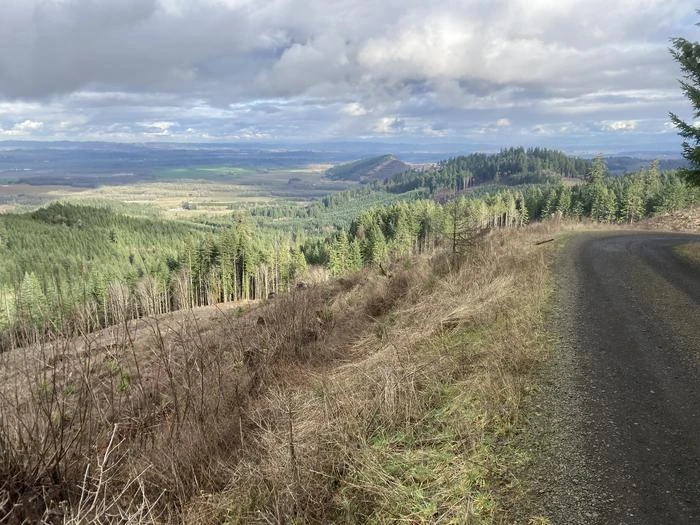
The study area for the modeling was the McDonald-Dunn Research Forest, an 11,000-acre woodland northwest of Corvallis owned and managed by the College of Forestry. The forest is in the eastern foothills of the Coast Range, and the dominant species in the McDonald-Dunn overstory is Douglas-fir, Oregon’s state tree and a versatile timber tree that’s a source of boards, railroad ties, plywood veneer and wood fiber.
The researchers inventoried more than 300 stands known from past research to have four different productivity levels – high, medium high, medium low and low – and input stand data into the Forest Vegetation Simulator, a software suite that predicts changes in vegetation in response to natural disturbances or management activities.
“Some forest scientists have argued that multiple but shorter rotations lead to greater sequestration rates because of the accelerated growth rates of younger trees compared to mature or old-growth trees,” said Carlisle, who graduated in 2023 and is now a forest carbon analyst at Finite Carbon. “Others say frequent harvesting won’t allow forest carbon to rebound after each subsequent rotation, and thus longer periods between clearcutting are a better choice. And depending on who you ask, thinning will either enhance forest carbon uptake by facilitating growth in residual trees, or hurt it by removing above-ground biomass.”
Over a 240-year projection time frame, the Oregon State scientists found that for highly productive stands, 60-year rotations with low-intensity thinning at 40 years led to the greatest carbon storage (in the standing trees plus what was removed from the thinning). For stands on less productive sites, they found carbon storage was maximized by rotation periods of 80 years or 120 years.
“On these longer rotations, multiple entries for thinning were required to prevent buildup of understory vegetation that would have suppressed the growth of overstory Douglas-fir,” Carlisle said.
Moderately productive stands were found to perform the best with 80-year rotations and two low-intensity thinning treatments between harvests, she added.
“Forest management decisions in the Northwest in the future will aim to meet harvest requirements while maintaining high sequestration potential of the region’s forests,” Carlisle said. “Management techniques like determining the optimal rotation length and implementing silvicultural treatments can be powerful tools that can allow managers to meet both objectives.”
Hailemariam is the Giustina Professor of Forest Management in College of Forestry and Fitzgerald is a professor of forest resources, engineering, and management. He is also an Extension specialist and the director of the OSU Research Forests, which funded this study.
END
The findings, published in the journal Forests, are important for Pacific Northwest forest managers seeking to strike an optimal balance between harvesting and carbon sequestration, an important tool in the fight against climate change.
The study by Catherine Carlisle, Temesgen Hailemariam and Stephen Fitzgerald of the OSU College of Forestry notes that the carbon trapped in the woody biomass of U.S. forests offsets 13% of the nation’s greenhouse gas emissions. Green plants pull carbon dioxide from the air during photosynthesis, the process through which they use sunlight to make food from carbon dioxide, soil nutrients and water.
Forests in the Northwest stretch across nearly 25 million acres and are among the most productive in the world, the authors say, with forests in the Oregon Coast Range boasting especially high biomass and carbon densities thanks to the range’s wet and mild growing conditions.
“Whether short or long harvest rotations are better for maximizing carbon sequestration has been the subject of considerable debate,” said Carlisle, who led the study as a graduate student. “Future management decisions will need to strive to meet harvest requirements while also striving to maintain high rates of carbon sequestration.”
The study area for the modeling was the McDonald-Dunn Research Forest, an 11,000-acre woodland northwest of Corvallis owned and managed by the College of Forestry. The forest is in the eastern foothills of the Coast Range, and the dominant species in the McDonald-Dunn overstory is Douglas-fir, Oregon’s state tree and a versatile timber tree that’s a source of boards, railroad ties, plywood veneer and wood fiber.
The researchers inventoried more than 300 stands known from past research to have four different productivity levels – high, medium high, medium low and low – and input stand data into the Forest Vegetation Simulator, a software suite that predicts changes in vegetation in response to natural disturbances or management activities.
“Some forest scientists have argued that multiple but shorter rotations lead to greater sequestration rates because of the accelerated growth rates of younger trees compared to mature or old-growth trees,” said Carlisle, who graduated in 2023 and is now a forest carbon analyst at Finite Carbon. “Others say frequent harvesting won’t allow forest carbon to rebound after each subsequent rotation, and thus longer periods between clearcutting are a better choice. And depending on who you ask, thinning will either enhance forest carbon uptake by facilitating growth in residual trees, or hurt it by removing above-ground biomass.”
Over a 240-year projection time frame, the Oregon State scientists found that for highly productive stands, 60-year rotations with low-intensity thinning at 40 years led to the greatest carbon storage (in the standing trees plus what was removed from the thinning). For stands on less productive sites, they found carbon storage was maximized by rotation periods of 80 years or 120 years.
“On these longer rotations, multiple entries for thinning were required to prevent buildup of understory vegetation that would have suppressed the growth of overstory Douglas-fir,” Carlisle said.
Moderately productive stands were found to perform the best with 80-year rotations and two low-intensity thinning treatments between harvests, she added.
“Forest management decisions in the Northwest in the future will aim to meet harvest requirements while maintaining high sequestration potential of the region’s forests,” Carlisle said. “Management techniques like determining the optimal rotation length and implementing silvicultural treatments can be powerful tools that can allow managers to meet both objectives.”
Hailemariam is the Giustina Professor of Forest Management in College of Forestry and Fitzgerald is a professor of forest resources, engineering, and management. He is also an Extension specialist and the director of the OSU Research Forests, which funded this study.
END
Attachments