Enhanced treatment of liver carcinoma with a drug-eluting hydrogel
More effective tumor cell death enabled via controlled, sustained delivery of chemo and immunotherapeutic drugs
Published 2023-11-29 · Original archive entry · Explore research explainers
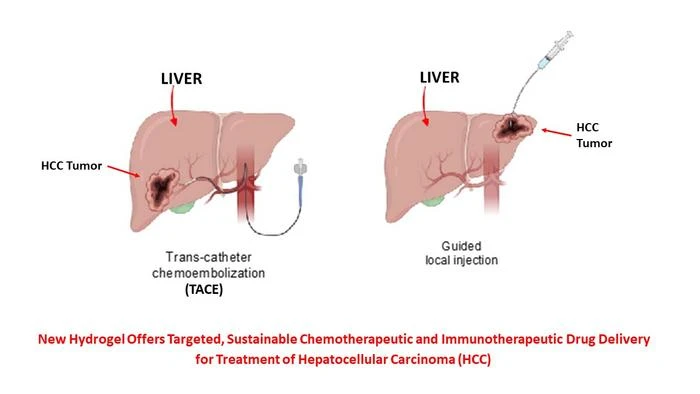
(LOS ANGELES) – November 29, 2023 - Scientists from the Terasaki Institute for Biomedical Innovation (TIBI) have developed an injectable or catheter-administered hydrogel with enhanced capabilities for treating hepatocellular carcinoma (HCC), a deadly form of liver cancer. As described in their recent publication in Advanced Functional Materials, this drug-eluting hydrogel can provide sustained, pH-dependent drug co-delivery and has capabilities for promoting anti-tumor immune responses. This reduces tumor cell proliferation and growth and offers a more efficient means of enabling tumor cell death.
Worldwide, HCC is a leading cause of cancer-related deaths, with an estimated one million new HCC cases to be diagnosed by 2025. Effective treatment options remain elusive. If diagnosed at an early stage, smaller liver tumors may be surgically removed, but tumor recurrence occurs in 70% of these patients. Liver transplantation also offers hope, but there is a huge shortage of suitable liver donors available, and successful outcomes are usually observed only in early diagnosis cases.
Another commonly used treatment method is trans-arterial chemoembolization, or TACE. In this technique, small microbead particles are delivered through a catheter into an artery that is supplying oxygen and nutrient-containing blood to a tumor. The particles block blood flow from the artery and thereby restrict tumor growth. Concurrently, the particles may serve as anti-cancer drug delivery vehicles which target the tumor cells; the restricted blood flow caused by the vessel blockage also serves to concentrate the drug around the tumor.
While offering a more targeted and safe approach than previous systemic chemotherapeutic approaches, the TACE method is not without inherent problems, with non-uniform bead dispersion occurring because the beads may break apart or aggregate; this limits their ability to penetrate deeply into tumors.
Also, the delivery of chemotherapeutic drugs to the tumor site may not be enough to destroy malignant tumor growth. These types of tumors exhibit unrestricted growth because they have found ways to suppress the body’s normal immune response system. Immunotherapeutic drugs can reverse this suppression and reinstate the body’s natural immune defenses to destroy tumor cells and inhibit their growth.
Given the known abilities of the chemotherapeutic agent, doxorubicin (DOX), to prime tumor cells for immunogenic cell death, the TIBI researchers sought to design a drug delivery system that could deliver both DOX and an immunotherapeutic drug, anti-PD-1, sequentially in a targeted, sustained and controllable manner. Using in vitro optimization experiments, the team formulated a Laponite®-containing gelatin hydrogel for this purpose. Laponite® nanoclay not only improves injectability but confers pH-controlled delivery as well.
In subsequent in vitro experiments, the team was able to identify the optimum formulation and pH conditions for both DOX and anti-PD-1 release by the hydrogel. They were also able to establish that DOX release by the hydrogel induced more effective priming of anti-tumor immune responses at the tumor site.
The efficacy of this drug delivery hydrogel platform was tested in in vivo experiments in which mouse liver tumor cells were injected into mouse models, followed by treatments with both dual (DOX+anti-PD1) and singly (DOX) loaded hydrogels. The mice were monitored for tumor size and survival time, and it was found that the subjects treated with combined DOX and anti-PD-1 loaded hydrogels had the longest survival times and smallest tumor size.
Other tests revealed that the combination drug loaded hydrogels also exhibited the greatest infiltration by anti-tumor immune cells, as well as the biggest reduction in tumor cell proliferation and the most increased level of tumor cell death.
“The one-two punch of combined chemotherapeutic and immunotherapeutic drug deliveries boosts the anti-tumor efficacy against hepatocellular carcinoma,” said TIBI’s Director and CEO, Ali Khademhosseini, PhD. “Our approach enhances current methods of treatment and offers renewed hope for patients with this deadly disease.”
Authors are Natashya Falcone, Menekse Ermis, Ankit Gangrade, Auveen Choroomi, Patric Young, Tess G. Mathes, Mahsa Monirizad, Fatemeh Zehtabi, Marvin Mecwan, Marco Rodriguez, Yangzhi Zhu, Youngjoo Byun, Ali Khademhosseini, Natan Roberto de Barros, and Han-Jun Kim.
The authors gratefully acknowledge funding from the National Institutes of Health (CA257558, DK130566). N.F. appreciates the postdoctoral fellowship (PDF) from the National Science and Engineering Research Council (NSERC). H-J.K. would like to acknowledge the Basic Science Research Program through the National Research Foundation of Korea (NRF), funded by the Ministry of Education (RS-2023-00240729). This research was supported by the MSIT (Ministry of Science and ICT), Korea, under the ITRC (Information Technology Research Center) support program (IITP-2023-RS-2023-00258971) supervised by the IITP (Institute for Information & Communications Technology Planning & Evaluation). This research was also supported by a Korea University Grant (KU S-FRG; K2319831). This work was supported by the National Research Foundation (NRF) of Korea (2019R1A6A1A03031807).
PRESS CONTACT
Stewart Han, shan@terasaki.org, +1 818-836-4393
Terasaki Institute for Biomedical Innovation
###
About the Terasaki Institute for Biomedical Innovation
The Terasaki Institute for Biomedical Innovation is accelerating the pace of translational research by supporting the world’s leading scientists with an open, entrepreneurial environment for bioengineering new materials, biological models, and advanced technologies to address critical challenges to the health of the planet and its people. The Institute’s worldwide collaborations with academic, clinical, and entrepreneurial partners provide a rich foundation for translating innovations to the real world.
Contact:
Stewart Han
President
Terasaki Institute for Biomedical Innovation
shan@terasaki.org
END
Worldwide, HCC is a leading cause of cancer-related deaths, with an estimated one million new HCC cases to be diagnosed by 2025. Effective treatment options remain elusive. If diagnosed at an early stage, smaller liver tumors may be surgically removed, but tumor recurrence occurs in 70% of these patients. Liver transplantation also offers hope, but there is a huge shortage of suitable liver donors available, and successful outcomes are usually observed only in early diagnosis cases.
Another commonly used treatment method is trans-arterial chemoembolization, or TACE. In this technique, small microbead particles are delivered through a catheter into an artery that is supplying oxygen and nutrient-containing blood to a tumor. The particles block blood flow from the artery and thereby restrict tumor growth. Concurrently, the particles may serve as anti-cancer drug delivery vehicles which target the tumor cells; the restricted blood flow caused by the vessel blockage also serves to concentrate the drug around the tumor.
While offering a more targeted and safe approach than previous systemic chemotherapeutic approaches, the TACE method is not without inherent problems, with non-uniform bead dispersion occurring because the beads may break apart or aggregate; this limits their ability to penetrate deeply into tumors.
Also, the delivery of chemotherapeutic drugs to the tumor site may not be enough to destroy malignant tumor growth. These types of tumors exhibit unrestricted growth because they have found ways to suppress the body’s normal immune response system. Immunotherapeutic drugs can reverse this suppression and reinstate the body’s natural immune defenses to destroy tumor cells and inhibit their growth.
Given the known abilities of the chemotherapeutic agent, doxorubicin (DOX), to prime tumor cells for immunogenic cell death, the TIBI researchers sought to design a drug delivery system that could deliver both DOX and an immunotherapeutic drug, anti-PD-1, sequentially in a targeted, sustained and controllable manner. Using in vitro optimization experiments, the team formulated a Laponite®-containing gelatin hydrogel for this purpose. Laponite® nanoclay not only improves injectability but confers pH-controlled delivery as well.
In subsequent in vitro experiments, the team was able to identify the optimum formulation and pH conditions for both DOX and anti-PD-1 release by the hydrogel. They were also able to establish that DOX release by the hydrogel induced more effective priming of anti-tumor immune responses at the tumor site.
The efficacy of this drug delivery hydrogel platform was tested in in vivo experiments in which mouse liver tumor cells were injected into mouse models, followed by treatments with both dual (DOX+anti-PD1) and singly (DOX) loaded hydrogels. The mice were monitored for tumor size and survival time, and it was found that the subjects treated with combined DOX and anti-PD-1 loaded hydrogels had the longest survival times and smallest tumor size.
Other tests revealed that the combination drug loaded hydrogels also exhibited the greatest infiltration by anti-tumor immune cells, as well as the biggest reduction in tumor cell proliferation and the most increased level of tumor cell death.
“The one-two punch of combined chemotherapeutic and immunotherapeutic drug deliveries boosts the anti-tumor efficacy against hepatocellular carcinoma,” said TIBI’s Director and CEO, Ali Khademhosseini, PhD. “Our approach enhances current methods of treatment and offers renewed hope for patients with this deadly disease.”
Authors are Natashya Falcone, Menekse Ermis, Ankit Gangrade, Auveen Choroomi, Patric Young, Tess G. Mathes, Mahsa Monirizad, Fatemeh Zehtabi, Marvin Mecwan, Marco Rodriguez, Yangzhi Zhu, Youngjoo Byun, Ali Khademhosseini, Natan Roberto de Barros, and Han-Jun Kim.
The authors gratefully acknowledge funding from the National Institutes of Health (CA257558, DK130566). N.F. appreciates the postdoctoral fellowship (PDF) from the National Science and Engineering Research Council (NSERC). H-J.K. would like to acknowledge the Basic Science Research Program through the National Research Foundation of Korea (NRF), funded by the Ministry of Education (RS-2023-00240729). This research was supported by the MSIT (Ministry of Science and ICT), Korea, under the ITRC (Information Technology Research Center) support program (IITP-2023-RS-2023-00258971) supervised by the IITP (Institute for Information & Communications Technology Planning & Evaluation). This research was also supported by a Korea University Grant (KU S-FRG; K2319831). This work was supported by the National Research Foundation (NRF) of Korea (2019R1A6A1A03031807).
PRESS CONTACT
Stewart Han, shan@terasaki.org, +1 818-836-4393
Terasaki Institute for Biomedical Innovation
###
About the Terasaki Institute for Biomedical Innovation
The Terasaki Institute for Biomedical Innovation is accelerating the pace of translational research by supporting the world’s leading scientists with an open, entrepreneurial environment for bioengineering new materials, biological models, and advanced technologies to address critical challenges to the health of the planet and its people. The Institute’s worldwide collaborations with academic, clinical, and entrepreneurial partners provide a rich foundation for translating innovations to the real world.
Contact:
Stewart Han
President
Terasaki Institute for Biomedical Innovation
shan@terasaki.org
END
Attachments