Developing nanocatalysts to overcome limitations of water electrolysis technology
Developing nanocatalysts that do not degrade at high temperatures above 600 degrees Celsius, more than doubling green hydrogen production with high-temperature water electrolysis cells
Published 2023-12-28 · Original archive entry · Explore research explainers
Green hydrogen can be produced through water electrolysis technology, which uses renewable energy to split water into hydrogen and oxygen without emitting carbon dioxide. However, the production cost of green hydrogen is currently around $5 per kilogram, which is two to three times higher than gray hydrogen obtained from natural gas. For the practical use of green hydroten, the innovation in water electrolysis technology is required for the realization of hydrogen economy, especially for Korea where the utilization of renewable energy is limited owing to geographical reasons.
Dr. Kyung Joong Yoon’s research team at the Energy Materials Research Center of the Korea Institute of Science and Technology (KIST) has developed a nanocatalyst for high-temperature water electrolysis that can retain a high current density of more than 1A/cm2 for a long time at temperatures above 600 degrees. While the degradation mechanisms of nanomaterials at high temperatures have been elusive thus far, the team identified the fundamental reasons of abnormal behavior of nanomateirals and successfully resolved issues, eventually improving performance and stability in realistic water electrolysis cells.
The electrolysis technology can be classified into low- and high-temperature electrolysis. While low-temperature electrolysis operating at temperatures below 100 degrees Celsius has long been developed and is technologically more mature, high-temperature electrolysis operating above 600 degrees Celsius offers higher efficiency and is considered as a next-generation technology with a strong potential for further cost-down. However, its commercialization has been hindered by the lack of thermal stability and insufficient lifetime owing to high-temperature degradation, such as corrosion and structural deformation. In particular, nanocatalysts, which are widely used to improve the performance of low-temperature water electrolyzers, quickly deteriorate at high operating temperatures, making it difficult to effectively use them for high-temperature water electrolysis.
To overcome this limitation, the team developed a new nanocatalyst synthetic techniques that suppresses the formation of harmful compounds causing high temperature degradation. By systematically analyzing the nanoscale phenomena using transmission electron microscopy, the researchers identified specific substances causing severe structural alterations, such as strontium carbonate and cobalt oxide and successfully removed them to achieve highly stable nanocatalysts in terms of chemical and physical properties.
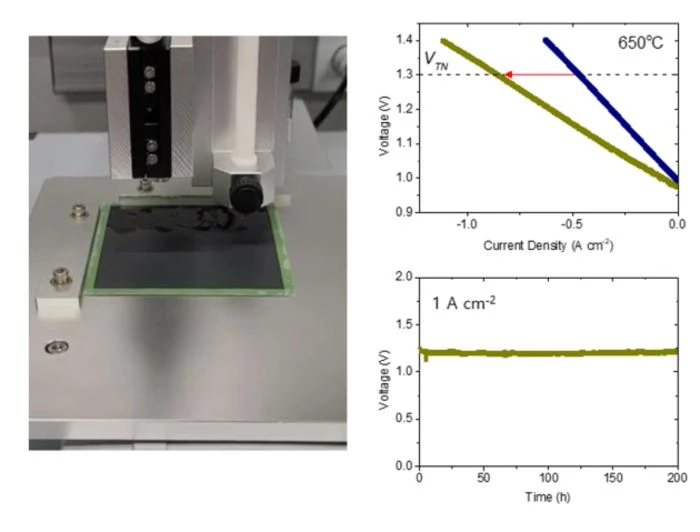
When the team applied the nanocatalyst to a high-temperature water electrolysis cell, it more than doubled hydrogen production rate and operated for more than 400 hours at 650 degrees without degradation. This technique was also sucessfully applied to a practical large-area water electrolysis cell, confirming its strong potential for scale-up and commercial use.
"Our newly developed nanomaterials achieved both high performance ans stability for high-temperature water electrolysis technology, and it can contribute to lower the production cost of green hydrogen, making it economically competitive with gray hydrogen in the future," said Dr. Kyungjoong Yoon of KIST. "For commercialization, we plan to develop automated processing techniques for mass production in cooperation with industry cell manufacturers."
###
KIST was established in 1966 as the first government-funded research institute in Korea. KIST now strives to solve national and social challenges and secure growth engines through leading and innovative research. For more information, please visit KIST’s website at https://eng.kist.re.kr/
This research was supported by the Ministry of Science and ICT (Minister Lee Jong-ho) through the KIST Major Project and Climate Change Response Technology Development Project (2020M1A2A2080862), and the results were published in the latest issue of the Chemical Engineering Journal (IF 15.1, top 3.2% in JCR), an international journal in the field of chemical engineering.
END
Dr. Kyung Joong Yoon’s research team at the Energy Materials Research Center of the Korea Institute of Science and Technology (KIST) has developed a nanocatalyst for high-temperature water electrolysis that can retain a high current density of more than 1A/cm2 for a long time at temperatures above 600 degrees. While the degradation mechanisms of nanomaterials at high temperatures have been elusive thus far, the team identified the fundamental reasons of abnormal behavior of nanomateirals and successfully resolved issues, eventually improving performance and stability in realistic water electrolysis cells.
The electrolysis technology can be classified into low- and high-temperature electrolysis. While low-temperature electrolysis operating at temperatures below 100 degrees Celsius has long been developed and is technologically more mature, high-temperature electrolysis operating above 600 degrees Celsius offers higher efficiency and is considered as a next-generation technology with a strong potential for further cost-down. However, its commercialization has been hindered by the lack of thermal stability and insufficient lifetime owing to high-temperature degradation, such as corrosion and structural deformation. In particular, nanocatalysts, which are widely used to improve the performance of low-temperature water electrolyzers, quickly deteriorate at high operating temperatures, making it difficult to effectively use them for high-temperature water electrolysis.
To overcome this limitation, the team developed a new nanocatalyst synthetic techniques that suppresses the formation of harmful compounds causing high temperature degradation. By systematically analyzing the nanoscale phenomena using transmission electron microscopy, the researchers identified specific substances causing severe structural alterations, such as strontium carbonate and cobalt oxide and successfully removed them to achieve highly stable nanocatalysts in terms of chemical and physical properties.
When the team applied the nanocatalyst to a high-temperature water electrolysis cell, it more than doubled hydrogen production rate and operated for more than 400 hours at 650 degrees without degradation. This technique was also sucessfully applied to a practical large-area water electrolysis cell, confirming its strong potential for scale-up and commercial use.
"Our newly developed nanomaterials achieved both high performance ans stability for high-temperature water electrolysis technology, and it can contribute to lower the production cost of green hydrogen, making it economically competitive with gray hydrogen in the future," said Dr. Kyungjoong Yoon of KIST. "For commercialization, we plan to develop automated processing techniques for mass production in cooperation with industry cell manufacturers."
###
KIST was established in 1966 as the first government-funded research institute in Korea. KIST now strives to solve national and social challenges and secure growth engines through leading and innovative research. For more information, please visit KIST’s website at https://eng.kist.re.kr/
This research was supported by the Ministry of Science and ICT (Minister Lee Jong-ho) through the KIST Major Project and Climate Change Response Technology Development Project (2020M1A2A2080862), and the results were published in the latest issue of the Chemical Engineering Journal (IF 15.1, top 3.2% in JCR), an international journal in the field of chemical engineering.
END