(Press-News.org) ROCKVILLE, MD – Many premature infants need mechanical ventilation to breathe. However, prolonged ventilation can lead to problems like respiratory diseases or ventilation-induced injury.
Jonas Naumann and Mareike Zink study the physics of mechanical stress from ventilation at Leipzig University, in Leipzig, Germany and discovered some of the mechanisms that explain why premature lungs are especially sensitive to stress. Naumann will present their research at the 68th Biophysical Society Annual Meeting, to be held February 10 - 14, 2024 in Philadelphia, Pennsylvania.
When you breathe normally, your diaphragm and the muscles between ribs create a negative pressure inside the lung. “But when you are undergoing mechanical ventilation, you are creating hydrostatic overpressure. And the forces which are acting during mechanical ventilation are completely different than during normal breathing. And this is probably causing some kind of damage to the cells,” Zink explained.
Using lung tissue from fetal and adult rats, the researchers together with collaborators from the Division of Neonatology, University Clinic Leipzig, used varying amounts of tension with rest phases in between, similar to the actions that occur within the lung during mechanical ventilation. Even with a little pressure, the premature rat lung tissue showed characteristics of being both elastic and viscous. This means the lung tissue changed its shape and responded to stress in a way that wasn't normal. Moreover, they found that “the fetal lung is much stiffer than the adult lung under deformation,” said Naumann.
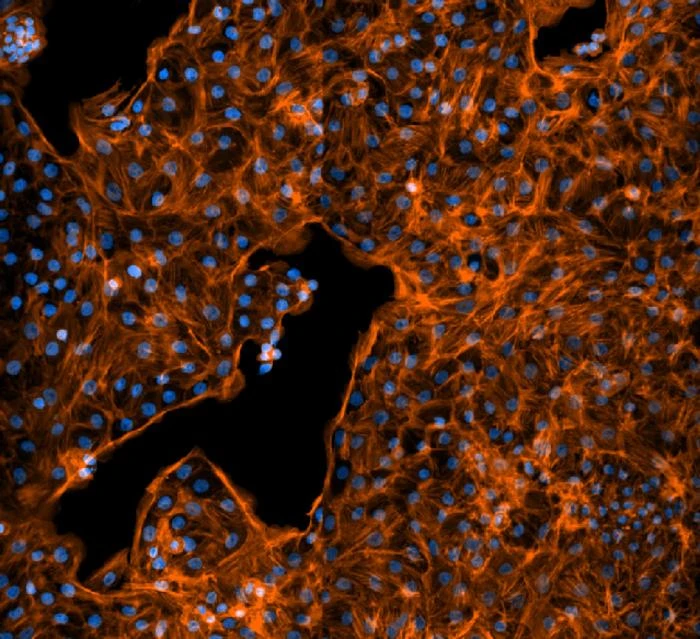
To determine whether these tension-related changes in the tissue led to alterations in sodium transport, which is important for removing the water from the lungs that is present at birth, the team used electrophysiology to measure the movement of ions across a layer of premature lung cells. They found that changes in pressure affected the activity of two channels involved in sodium transport—the epithelial sodium channel and the sodium-potassium ion pump in the cells of lung alveoli. This disruption in the normal function of these transporters could explain why mechanical ventilation has negative effects on the infant's lungs.
“This may be the reason why lung fluid cannot get absorbed that well into the circulation after the preterm births,” Naumann explained. He hopes that there will be more research about what ventilator settings might lead to the best outcomes for preemies. Naumann points out that “small pressure gradients can have such a big impact on the lung mechanics.”
The next phase of their research will be exploring how the lung tissue’s extracellular matrix, the scaffolding and the glue that holds cells together, plays a role in mechanical ventilation. By better understanding how the premature lung responds to pressure, they hope that future studies improve therapies for babies born early.
END
Why ventilators can be tough on preemie lungs
New research finds that premature lungs become stiffer than adult lungs under stress, this disrupts the function of transporters that are important for removing water from the lungs after birth
2024-02-10
ELSE PRESS RELEASES FROM THIS DATE:
Using ion beams to improve brain microscopy
2024-02-10
ROCKVILLE, MD – Improving the way scientists can see the microscopic structures of the brain can improve our understanding of a host of brain diseases, like Alzheimer’s or multiple sclerosis. Studying these diseases is challenging and has been limited by accuracy of available models.
To see the smallest parts of cells, scientists often use a technique called electron microscopy. Electron microscopy historically involves adding chemicals and physically cutting the tissue. However, this approach can change the way the cells and structures look, perturbing their natural state, and can limit resolution. ...
Faster monkeypox (mpox) testing through CRISPR
2024-02-10
ROCKVILLE, MD – Mpox, formerly known as monkeypox, is a rare viral disease that is spread through physical contact between people. Currently, testing for mpox requires lab equipment and can take a few hours to get test results. But new research suggests a way for faster testing that could be done in any clinic soon.
Md. Ahasan Ahamed, a graduate student mentored by Weihua Guan at Pennsylvania State University will present this research at the 68th Biophysical Society Annual Meeting, to be held February 10 - 14, 2024 in Philadelphia, Pennsylvania.
Though mpox symptoms are generally mild with fever, rash, and swollen lymph nodes, severe cases can occur and require medical attention. ...
New method could detect early ovarian cancer from urine samples
2024-02-10
New research by Joseph Reiner and colleagues at Virginia Commonwealth University shows promise for a urine-based test for ovarian cancer. Reiner will present their research at the 68th Biophysical Society Annual Meeting, to be held February 10 - 14, 2024 in Philadelphia, Pennsylvania.
Previous research showed that there are thousands of small molecules, called peptides, in the urine of people with ovarian cancer. While it is possible to detect those molecules using certain well-established techniques, ...
Scientists find new way to roll atomically thin nanosheets into scrolls
2024-02-10
Tokyo, Japan – Researchers from Tokyo Metropolitan University have come up with a new way of rolling atomically thin sheets of atoms into “nanoscrolls.” Their unique approach uses transition metal dichalcogenide sheets with a different composition on either side, realizing a tight roll that gives scrolls down to five nanometers in diameter at the center and micrometers in length. Control over nanostructure in these scrolls promises new developments in catalysis and photovoltaic devices.
Nanotechnology is giving us new tools to control the structure of materials at ...
New test for improving population-based colorectal cancer screening
2024-02-10
New test for improving population-based colorectal cancer screening
A new stool test appears to detect colorectal cancer precursors better than the current test. This could further reduce the number of new colorectal cancer cases as well as the number of people dying from the disease. A study led by the Netherlands Cancer Institute compared both tests. The results are published today in The Lancet Oncology.
Each year worldwide, approximately 1.9 million people are diagnosed with colorectal cancer, and 935,000 people ...
Quitting smoking at any age brings big health benefits, fast: study
2024-02-09
People who quit smoking see major gains in life expectancy after just a few years, according to a new study by University of Toronto researchers at Unity Health Toronto.
The study, published in NEJM Evidence, shows that smokers who quit smoking before age 40 can expect to live almost as long as those who never smoked. Those who quit at any age return close to never-smoker survival 10 years after quitting, and about half that benefit occurs within just three years.
“Quitting smoking is ridiculously effective in reducing ...
Discoveries can be used to optimize production of annatto powder
2024-02-09
Researchers at the University of São Paulo’s Luiz de Queiroz College of Agriculture (ESALQ-USP) and the Federal University of Viçosa (UFV) in Brazil have shown for the first time that bixin or annatto powder, a carotenoid pigment extracted from the seeds of the achiote or annatto tree (Bixa orellana), is not produced only in the seeds but also in other organs, and that the process intensifies in the plant’s adult phase.
An article on the study published in the Journal of Experimental Botany, also describes genetic modifications in the species that can optimize production of the pigment, which is widely used in the food ...
Harnessing human evolution to advance precision medicine
2024-02-09
Humans are still evolving, and Tatum Simonson, PhD, founder and co-director of the Center for Physiological Genomics of Low Oxygen at University of California School of Medicine, plans to use evolution to improve healthcare for all.
Her latest research, which was published February 9, 2024 in Science Advances, reveals that a gene variant in some Andean people is associated with reduced red blood cell count at high altitude, enabling them to safely live high in the mountains in low-oxygen conditions. Simonson’s UC San Diego lab is applying those findings toward understanding whether there may be a genetic component ...
For Black patients, 'representation matters' in evaluating prostate cancer websites
2024-02-09
Waltham — February 9, 2024 — For Black men with prostate cancer, racial representation is a key factor affecting trust in websites offering information on prostate cancer, reports a study in the March issue of The Journal of Urology®, an Official Journal of the American Urological Association (AUA). The journal is published in the Lippincott portfolio by Wolters Kluwer.
"Our study shows that representation matters to Black patients seeking prostate cancer information online," comments lead author Stacy Loeb, MD, MSc, PhD (Hon), of New York University Langone Health. "Not only does it impact trust in the information, but a lack ...
Having COVID-19 and Long COVID can impact women’s sex lives
2024-02-09
From work to school to socializing, COVID-19 has impacted just about every part of our lives—and now Boston University research has shown that also includes what happens in the bedroom. A study of more than 2,000 cisgender women found the coronavirus disease can impair sexual function, with long COVID having an especially detrimental effect.
“If you’re sick with COVID, you’re probably less interested in sex and maybe your body is less prepared to have sex,” says Amelia M. Stanton, a BU College of Arts & Sciences assistant ...
LAST 30 PRESS RELEASES:
Alkali cation effects in electrochemical carbon dioxide reduction
Test platforms for charging wireless cars now fit on a bench
$3 million NIH grant funds national study of Medicare Advantage’s benefit expansion into social supports
Amplified Sciences achieves CAP accreditation for cutting-edge diagnostic lab
Fred Hutch announces 12 recipients of the annual Harold M. Weintraub Graduate Student Award
Native forest litter helps rebuild soil life in post-mining landscapes
Mountain soils in arid regions may emit more greenhouse gas as climate shifts, new study finds
Pairing biochar with other soil amendments could unlock stronger gains in soil health
Why do we get a skip in our step when we’re happy? Thank dopamine
UC Irvine scientists uncover cellular mechanism behind muscle repair
Platform to map living brain noninvasively takes next big step
Stress-testing the Cascadia Subduction Zone reveals variability that could impact how earthquakes spread
We may be underestimating the true carbon cost of northern wildfires
Blood test predicts which bladder cancer patients may safely skip surgery
Kennesaw State's Vijay Anand honored as National Academy of Inventors Senior Member
Recovery from whaling reveals the role of age in Humpback reproduction
Can the canny tick help prevent disease like MS and cancer?
Newcomer children show lower rates of emergency department use for non‑urgent conditions, study finds
Cognitive and neuropsychiatric function in former American football players
From trash to climate tech: rubber gloves find new life as carbon capturers materials
A step towards needed treatments for hantaviruses in new molecular map
Boys are more motivated, while girls are more compassionate?
Study identifies opposing roles for IL6 and IL6R in long-term mortality
AI accurately spots medical disorder from privacy-conscious hand images
Transient Pauli blocking for broadband ultrafast optical switching
Political polarization can spur CO2 emissions, stymie climate action
Researchers develop new strategy for improving inverted perovskite solar cells
Yes! The role of YAP and CTGF as potential therapeutic targets for preventing severe liver disease
Pancreatic cancer may begin hiding from the immune system earlier than we thought
Robotic wing inspired by nature delivers leap in underwater stability
[Press-News.org] Why ventilators can be tough on preemie lungsNew research finds that premature lungs become stiffer than adult lungs under stress, this disrupts the function of transporters that are important for removing water from the lungs after birth