PRESS-NEWS.org - Press Release Distribution
PRESS RELEASES DISTRIBUTION

SwRI and UTSA developing helmet pads to reduce traumatic brain injury in military service members

Researchers plan to create multi-behavior padding that can withstand blunt and ballistic impacts

SwRI and UTSA developing helmet pads to reduce traumatic brain injury in military service members
2024-09-16
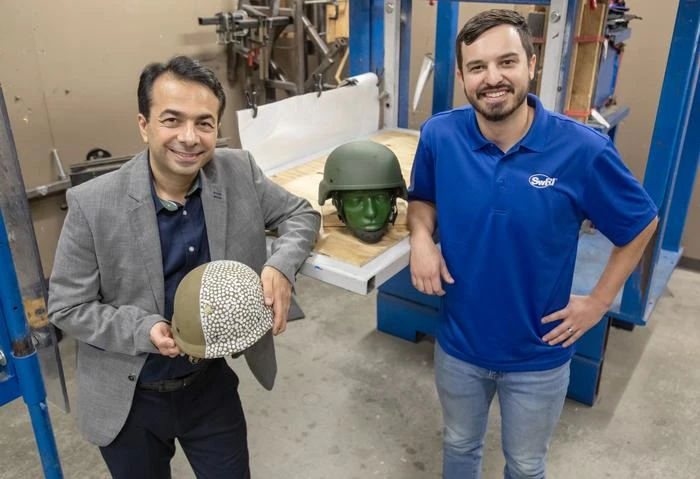
(Press-News.org) SAN ANTONIO — September 16, 2024 —Researchers from Southwest Research Institute (SwRI) and The University of Texas at San Antonio (UTSA) are creating innovative military helmet pads designed to prevent traumatic brain injury (TBI). The project, led by SwRI’s Dr. Daniel Portillo and UTSA’s Dr. Morteza Seidi, is supported by a $125,000 grant from the Connecting through Research Partnerships (Connect) program.

Traumatic brain injury can affect human performance and quality of life. It is a critical concern in military settings, where service members are regularly exposed to environments that pose significant risks for blast exposures, blunt trauma, and ballistic impacts.

“The increasing incidence of TBI among military service members shows a pressing need for enhanced protective equipment in combat and training environments,” Portillo said. “The widespread use of improvised explosive devices and firearms has made TBIs particularly prevalent, and helmets are the primary form of protection against skull and brain injuries.”

SwRI and UTSA will collaborate on a helmet that includes a multi-behavior padding that becomes soft or stiff depending on the type of impact the wearer experiences. During a blunt impact, such as a fall, the padding will soften to cushion against the blow. A ballistic impact from shrapnel or a bullet will make the padding stiffen to absorb the impact’s kinetic energy and prevent injury to the skull and brain.

“Ballistic impacts occur at extremely high speeds,” Seidi said. “They are very different from blunt impacts at relatively lower speeds, which is why it’s challenging to create a helmet that can protect against both.”

SwRI’s Dr. Dan Nicolella and UTSA’s Dr. Marzieh Memar will lead the computer analysis of human brain response to evaluate the overall performance of padding in reducing the likelihood of brain injury.

The researchers will use 3D printing technology to build the helmet pads, and then test their ability to mitigate injury under various levels of both types of impacts, simulating real-world conditions. Blunt impact testing will occur at UTSA, while SwRI will conduct ballistic impact testing.

“By leveraging the unique expertise at UTSA and SwRI, we can improve the safety and wellbeing of military service members,” Portillo said.

SwRI’s Executive Office and UTSA’s Office of Research sponsor the Connect program, which offers grant opportunities to enhance greater scientific collaboration between the two institutions.

For more information, visit https://www.swri.org/bone-biomechanics.

END

[Attachments] See images for this press release:
SwRI and UTSA developing helmet pads to reduce traumatic brain injury in military service members

ELSE PRESS RELEASES FROM THIS DATE:

Waiting is the hardest part: Medical field should address uncertainty for cancer patients under active surveillance

2024-09-16
Indianapolis – Patients with low-risk cancers undergoing active surveillance face a favorable long-term prognosis. David Haggstrom, M.D., MAS, makes the case that it’s time for the medical field to help manage the anxiety caused by waiting. Dr. Haggstrom, a physician-researcher with Regenstrief Institute, the Veterans Administration Medical Center in Indianapolis and the Indiana University School of Medicine, is lead author of a Viewpoint article, published in JAMA (Journal of the American Medical ...

New research reveals major gaps and new solutions in menopause care

2024-09-16
The Kinsey Institute at Indiana University, in partnership with leading sexual wellbeing company the Lovehoney Group and its Womanizer brand, has released early data from new nationally representative surveys exploring menopause knowledge, symptom management, medical care engagement, and health disparities among Americans.   Phase 1 surveyed of 1,500 American adults aged 18-88, to assess overall public knowledge and understanding of menopause. Phase 2 surveyed 1,500 women aged 40-65, to better understand women’s experiences with menopause. ...

Financial grants fuel well-being of K-12 students nationwide

2024-09-16
DALLAS, September 16, 2024 — As the new school year begins, the American Heart Association is supporting student health and well-being by awarding financial grants to nearly 80 elementary, middle and high schools nationwide. These grants, part of the Association’s commitment to improve cardiovascular health for all people everywhere, will allow local schools in communities across the country to invest in vital resources such as new fitness equipment, water filling stations and health education ...

New study reveals majority of pediatric long COVID patients develop a dizziness known as orthostatic intolerance

2024-09-16
BALTIMORE, September 16, 2024— A new study from Kennedy Krieger Institute shows that the majority of children diagnosed with long COVID are likely to experience orthostatic intolerance (OI), a condition that causes the body to struggle with regulating blood pressure and heart rate when standing up. As a result, children often feel dizzy, lightheaded, fatigued and may experience “brain fog” or cognitive difficulties. Orthostatic intolerance includes disorders such as postural orthostatic tachycardia syndrome (POTS) and orthostatic hypotension. Among the patients studied, dizziness (67%), fatigue (25%), ...

Urgent conservation efforts needed: Small population size and possible extirpation of the threatened malagasy poison frog Mantella cowanii

Urgent conservation efforts needed: Small population size and possible extirpation of the threatened malagasy poison frog Mantella cowanii
2024-09-16
New research highlights the precarious status of one of Madagascar's most threatened amphibians, the harlequin mantella (Mantella cowanii), revealing small population sizes and the possible extirpation of the species from several of its historic habitats. The findings underscore the urgent need for targeted conservation action to prevent the species from slipping further towards extinction. Research Findings: A Dire Situation  Amphibians around the world are facing unprecedented population declines, and Mantella cowanii is no exception. The study, which focused on confirming the frog’s presence at historic localities and estimating its population size ...

American Academy of Sleep Medicine Foundation and Restless Legs Syndrome Foundation co-fund RLS research

American Academy of Sleep Medicine Foundation and Restless Legs Syndrome Foundation co-fund RLS research
2024-09-16
The American Academy of Sleep Medicine Foundation has joined forces with the Restless Legs Syndrome Foundation to fund research leading to new treatments and a cure for RLS. Earlier this year, the AASM Foundation began an agreement with the RLS Foundation to co-fund basic and clinical RLS research. The partnership for 2024 includes the following research priorities: Neurobiological interaction: Elucidate the points of interaction between RLS-relevant neurotransmitters, neuronal pathways, and iron deficiency. Pharmacologic treatments: Elucidate effects of novel pharmacological approaches on RLS. Clinical practice: Research based on innovations in patient ...

Vital language sites in brain act like connectors in a social network

2024-09-16
Discovery expands understanding of how language is produced by the brain Current method of mapping brain language function for surgery using electrical stimulation hasn’t changed in 50 years Finding could make it easier on patients and doctors to identify critical language sites in the brain to preserve function after surgery CHICAGO --- When surgeons perform brain surgery on people with brain tumors or epilepsy, they need to remove the tumor or abnormal tissue while preserving parts of the brain that control language and movement. A new Northwestern Medicine study may better inform doctors’ ...

Astronomers detect black hole ‘starving’ its host galaxy to death

Astronomers detect black hole ‘starving’ its host galaxy to death
2024-09-16
Astronomers have used the NASA/ESA James Webb Space Telescope to confirm that supermassive black holes can starve their host galaxies of the fuel they need to form new stars. The international team, co-led by the University of Cambridge, used Webb to observe a galaxy roughly the size of the Milky Way in the early universe, about two billion years after the Big Bang. Like most large galaxies, it has a supermassive black hole at its centre. However, this galaxy is essentially ‘dead’: it has mostly stopped forming new stars. “Based ...

Is CREME AI’s answer to CRISPR?

2024-09-16
Imagine you’re looking at millions upon millions of mysterious genetic mutations. With CRISPR gene-editing technology, a select few of these mutations might have therapeutic potential. However, proving it would mean many thousands of hours of lab work. Just figuring out which ones are worth exploring further would take a lot of time and money. But what if you could do it in the virtual realm with artificial intelligence? CREME is a new AI-powered virtual laboratory invented by Cold Spring Harbor Laboratory (CSHL) Assistant Professor Peter Koo and his team. It allows geneticists to run thousands of virtual experiments ...

Interrelated social factors may affect cardiovascular health in Asian American subgroups

2024-09-16
Statement Highlights: There are a variety of interrelated social and structural factors that contribute to differences in cardiovascular health among Asian Americans, and these factors are likely different within individual Asian ethnic subgroups. Asian Americans and Asian immigrants are quite diverse and comprise many ethnic groups.  Social determinants, such as immigration-related factors, discrimination, socioeconomic status, English proficiency and cultural beliefs, may influence health behaviors, access to health care and the ability ...

LAST 30 PRESS RELEASES:

Eye for trouble: Automated counting for chromosome issues under the microscope

The vast majority of US rivers lack any protections from human activities, new research finds

Ultrasound-responsive in situ antigen "nanocatchers" open a new paradigm for personalized tumor immunotherapy

Environmental “superbugs” in our rivers and soils: new one health review warns of growing antimicrobial resistance crisis

Triple threat in greenhouse farming: how heavy metals, microplastics, and antibiotic resistance genes unite to challenge sustainable food production

Earthworms turn manure into a powerful tool against antibiotic resistance

AI turns water into an early warning network for hidden biological pollutants

Hidden hotspots on “green” plastics: biodegradable and conventional plastics shape very different antibiotic resistance risks in river microbiomes

Engineered biochar enzyme system clears toxic phenolic acids and restores pepper seed germination in continuous cropping soils

Retail therapy fail? Online shopping linked to stress, says study

How well-meaning allies can increase stress for marginalized people

Commercially viable biomanufacturing: designer yeast turns sugar into lucrative chemical 3-HP

Control valve discovered in gut’s plumbing system

George Mason University leads phase 2 clinical trial for pill to help maintain weight loss after GLP-1s

Hop to it: research from Shedd Aquarium tracks conch movement to set new conservation guidance

Weight loss drugs and bariatric surgery improve the body’s fat ‘balance:’ study

The Age of Fishes began with mass death

TB harnesses part of immune defense system to cause infection

Important new source of oxidation in the atmosphere found

A tug-of-war explains a decades-old question about how bacteria swim

Strengthened immune defense against cancer

Engineering the development of the pancreas

The Journal of Nuclear Medicine ahead-of-print tip sheet: Jan. 9, 2026

Mount Sinai researchers help create largest immune cell atlas of bone marrow in multiple myeloma patients

Why it is so hard to get started on an unpleasant task: Scientists identify a “motivation brake”

Body composition changes after bariatric surgery or treatment with GLP-1 receptor agonists

Targeted regulation of abortion providers laws and pregnancies conceived through fertility treatment

Press registration is now open for the 2026 ACMG Annual Clinical Genetics Meeting

Understanding sex-based differences and the role of bone morphogenetic protein signaling in Alzheimer’s disease

Breakthrough in thin-film electrolytes pushes solid oxide fuel cells forward

[Press-News.org] SwRI and UTSA developing helmet pads to reduce traumatic brain injury in military service members
Researchers plan to create multi-behavior padding that can withstand blunt and ballistic impacts