PRESS-NEWS.org - Press Release Distribution
PRESS RELEASES DISTRIBUTION

New biochar nanocomposite enhances detection of acetaminophen and uric acid in urine

New biochar nanocomposite enhances detection of acetaminophen and uric acid in urine
2024-10-16
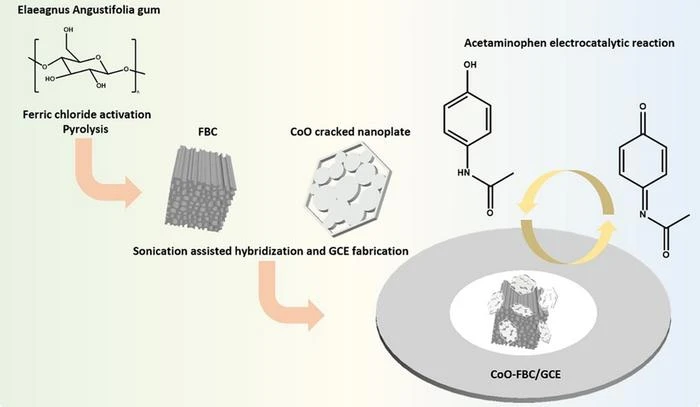
(Press-News.org) In recent years, the excessive use of acetaminophen (APAP) has become a significant human hazard and social burden. Rapid and automated electrochemical detection has emerged as a crucial method for measuring APAP concentration in human urine. This study explores a novel porous cobalt-derived biomass electrocatalyst material prepared from Elaeagnus angustifolia gum and investigates its electrochemical properties as well as its specific detection capability for APAP. Their work is published in the journal Industrial Chemistry & Materials on 18 July 2024.

Acetaminophen (APAP) is a commonly used analgesic and antipyretic drug. Due to misuse, there is an excessive presence of APAP in bodily fluids, leading to significant side effects such as acute liver injury and liver failure. Currently, the methods for detecting APAP in the human body are relatively expensive and complex.

Using natural Elaeagnus angustifolia gum as the base material, a series of treatments including high-temperature calcination are conducted. This material is then activated with ferric chloride to produce a porous natural carbon-based material with a significantly increased specific surface area, which is 2.6 times that of BC. Based on relevant research, cobalt oxide doping was chosen to enhance conductivity, enabling specific recognition of APAP molecules in urine during selective and sensitive testing for acetaminophen detection. The Ipa of FBC-CoO/GCE modified with cobalt oxide is nearly twice that of FBC/GCE. Compared to traditional liquid chromatography detection methods, it offers faster speed, higher sensitivity, miniaturization, and automation.

This study employed natural resources like Elaeagnus angustifolia gum to produce FBC via straightforward preparation steps. By modifying the preparation process, we adjusted the hollowness of cobalt oxide cracked nanosheets, thereby synthesizing APAP sensors with excellent sensitivity. In this study, the uric acid and APAP reaction peaks can be effectively separated and identified within a reasonable physiological concentration range.

Further enhancements can elevate the performance of CoO-FBC/GCE, setting the stage for in-depth research in upcoming projects. These enhancements encompass exploring the biomass activation process, tailoring the size and morphology of cobalt oxide cracked nanosheets, examining the ultrasonic steps and the ratio between biomass carbon and cobalt oxide, refining the alkaline co-precipitation method, and co-doping with other transition elements, all aimed at achieving high-performance sensors.

The research team includes Yihan Zhang, Zehong Gao, Xamxikamar Mamat and Longyi Chen from Xinjiang Technical Institute of Physics and Chemistry, Chinese Academy of Sciences; and Yiliyasi Baikeli from College of Chemistry and Chemical Engineering, Dezhou University.

This research was funded by the Biological Resources Programme, Chinese Academy of Sciences (KFJ-BRP-007-011). Y. Z., Z. G. and L. C. acknowledge support from the Xinjiang Uygur Autonomous Region's Tianchi Talent Program.

Industrial Chemistry & Materials is a peer-reviewed interdisciplinary academic journal published by Royal Society of Chemistry (RSC) with APCs currently waived. Icm publishes significant innovative research and major technological breakthroughs in all aspects of industrial chemistry and materials, especially the important innovation of the low-carbon chemical industry, energy, and functional materials.

END

[Attachments] See images for this press release:
New biochar nanocomposite enhances detection of acetaminophen and uric acid in urine

ELSE PRESS RELEASES FROM THIS DATE:

F. William Studier receives the 2024 Merkin Prize in ceremony at the Broad Institute for developing technology used to produce millions of doses of COVID-19 vaccines

F. William Studier receives the 2024 Merkin Prize in ceremony at the Broad Institute for developing technology used to produce millions of doses of COVID-19 vaccines
2024-10-16
The 2024 Richard N. Merkin Prize in Biomedical Technology was awarded to F. William Studier of Brookhaven National Laboratory in a ceremony and symposium at the Broad Institute on September 17, 2024. The prize, created by the Merkin Family Foundation and administered by the Broad, recognizes novel technologies that have significantly improved human health and carries a $400,000 award. [Event Video]  Studier was announced as the winner in May for his development, in 1986, of an efficient, scalable method of producing ...

Applications open for School of Advanced Science on Structural Safety

2024-10-16
The “São Paulo School of Advanced Science on Structural Safety and its role in reducing greenhouse gas emissions by the built environment” will be held May 3-16, 2025, in Brazil, at the São Carlos School of Engineering of the University of São Paulo in its São Carlos campus. Reporters are invited to register for the scientific sessions and short courses, which will present state-of-art science and results of new research. This advanced science school will address the main challenges related to Structural Safety ...

Scientists use Allen Telescope Array to search for radio signals in the TRAPPIST-1 star system

Scientists use Allen Telescope Array to search for radio signals in the TRAPPIST-1 star system
2024-10-16
October 16, 2024, Mountain View, CA - Scientists at the SETI Institute and partners from Penn State University used the Allen Telescope Array (ATA) to search for signs of alien technology in the TRAPPIST-1 star system. The team spent 28 hours scanning the system, looking for radio signals that could indicate extraterrestrial technology. This project marks the longest single-target search for radio signals from TRAPPIST-1. Although they didn’t find any evidence of extraterrestrial technology, their work provided valuable data ...

Zebrafish as a model for studying rare genetic disease

Zebrafish as a model for studying rare genetic disease
2024-10-16
Fukuoka, Japan—Nager syndrome, or NS, is a rare genetic disease that affects the development of the face and limbs, usually causing anomalies in the bone structures of the jaws, cheeks, and hands. With a prevalence of less than 100 cases ever reported, not much is known about the disease except the fact that mutations in the SF3B4 gene are its primary cause. Now, in a recent study made available online on September 15, 2024 and upcoming in the November issue of International Journal of Biological Macromolecules, researchers from Kyushu University have developed a convenient approach to explore the underlying mechanisms ...

A synthetic molecular switch lets you 'paint' with natural light

A synthetic molecular switch lets you paint with natural light
2024-10-16
Liquid crystals exist in a phase of their own. They can flow like liquids, but because their molecules are arranged in a somewhat orderly way, they can be easily manipulated to reflect light. This flexibility has made liquid crystals the go-to material for energy-efficient phone, TV, and computer display screens. In a new study in Nature Chemistry, researchers at Dartmouth and Southern Methodist University hint at other applications for liquid crystals that might one day be possible, all powered by natural light. They include liquid crystal ...

Honoring a career of outstanding achievement

Honoring a career of outstanding achievement
2024-10-16
NEWPORT NEWS, VA – This year, the U.S. Department of Energy's Thomas Jefferson National Accelerator Facility celebrates the 40th anniversary of its founding to probe the secrets of the subatomic universe. And for 39 of those years, esteemed physicist Volker D. Burkert has been an important part of its mission. Now, Burkert is being honored for his contributions to advancements in experimental physics with the prestigious Tom W. Bonner Prize in Nuclear Physics. The citation reads: “For exemplary leadership in the development of high-performance instrumentation for large acceptance spectrometers that have enabled breakthroughs in fundamental nuclear ...

MSK research highlights, October 15, 2024

MSK research highlights, October 15, 2024
2024-10-16
A new tactic for overcoming breast cancer drug resistance The most common type of breast cancer, estrogen receptor positive, has been effectively treated with hormone therapy combined with drugs that block cell division called CDK4/6 inhibitors. However, it has been impossible to predict how long people will respond to this drug combination. In some patients, the disease is controlled for years, but in others, the cancer starts progressing again after just a few months. This presents ...

Hot news flash: Menopause can impact a woman’s heart health

2024-10-16
DALLAS, Oct. 16, 2024 — The risk of heart disease increases with age for most people, however, for women that may be even more true. The menopause transition, those years leading up to and through menopause, is a time of increasing heart disease risk, according to an American Heart Association scientific statement published in the flagship journal Circulation in 2020. “While many people think that breast cancer is the leading killer of women in the U.S., in ...

Standing more may not reduce cardiovascular disease risk, could increase circulatory disease

2024-10-16
EMBARGO: SYDNEY: 17 October 2024, 00.01 | NEW YORK: 16 October 2024, 09:00 Standing more may not reduce cardiovascular disease risk, could increase circulatory disease Standing has gained popularity among people looking to offset the harms of a sedentary lifestyle often caused by spending long days sitting in front of the computer, television or driving wheel. Standing desks have become a popular option among office workers, and in other industries like retail, workers may opt to stand instead of sit.   However, their efforts may not produce the intended result. New University of Sydney research has shown that over ...

Video series aims at improving indoor air quality

2024-10-16
Improving indoor air quality is the goal of a new video series developed by experts at the University of California, Davis in collaboration with the California Department of Public Health. Aimed at building and facility managers, the videos distill the science of air quality into steps building and facility managers can take to remove pollutants, including viruses, from the place we spend most of our time -- indoors.  “The goal is to help people understand the issues around indoor air quality, how it is related to disease, and what managers can do to make it better,” said Professor Chris Cappa, chair of the Department of Civil and Environmental ...

LAST 30 PRESS RELEASES:

Researchers identify gene that calms the mind and improves attention in mice

Artificial metabolism turns waste CO2 into useful chemicals

Ancient sea anemone sheds light on animal cell type evolution

Begging gene leads to drone food

How climate policies that incentivize and penalize can drive the clean energy transition

Can community awareness campaigns in low-resource areas improve early diagnosis of colorectal cancer?

Stardust study resets how life’s atoms spread through space

Practical education: Clinical scenario-based program development

The impact of family dynamics on eating behaviour – how going home for Christmas can change how you eat

Tracing the quick synthesis of an industrially important catalyst

New software sheds light on cancer’s hidden genetic networks

UT Health San Antonio awarded $3 million in CPRIT grants to bolster cancer research and prevention efforts in South Texas

Third symposium spotlights global challenge of new contaminants in China’s fight against pollution

From straw to soil harmony: International team reveals how biochar supercharges carbon-smart farming

Myeloma: How AI is redrawing the map of cancer care

Manhattan E. Charurat, Ph.D., MHS invested as the Homer and Martha Gudelsky Distinguished Professor in Medicine at the University of Maryland School of Medicine

Insilico Medicine’s Pharma.AI Q4 Winter Launch Recap: Revolutionizing drug discovery with cutting-edge AI innovations, accelerating the path to pharmaceutical superintelligence

Nanoplastics have diet-dependent impacts on digestive system health

Brain neuron death occurs throughout life and increases with age, a natural human protein drug may halt neuron death in Alzheimer’s disease

SPIE and CLP announce the recipients of the 2025 Advanced Photonics Young Innovator Award

Lessons from the Caldor Fire’s Christmas Valley ‘Miracle’

Ant societies rose by trading individual protection for collective power

Research reveals how ancient viral DNA shapes early embryonic development

A molecular gatekeeper that controls protein synthesis

New ‘cloaking device’ concept to shield sensitive tech from magnetic fields

Researchers show impact of mountain building and climate change on alpine biodiversity

Study models the transition from Neanderthals to modern humans in Europe

University of Phoenix College of Doctoral Studies releases white paper on AI-driven skilling to reduce burnout and restore worker autonomy

AIs fail at the game of visual “telephone”

The levers for a sustainable food system

[Press-News.org] New biochar nanocomposite enhances detection of acetaminophen and uric acid in urine