Panorama of our nearest galactic neighbor unveils hundreds of millions of stars
Published 2025-01-17 · Original archive entry · Explore research explainers
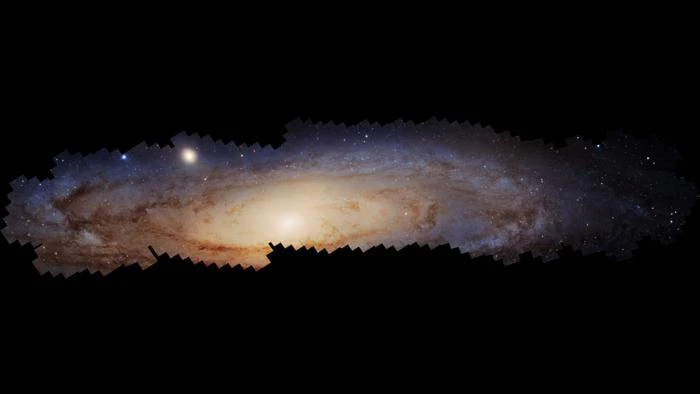
In the decades following the launch of NASA's Hubble Space Telescope, astronomers have tallied over 1 trillion galaxies in the universe. But only one galaxy stands out as the most important nearby stellar island to our Milky Way — the Andromeda Galaxy. It can be seen with the naked eye on clear autumn nights as a faint oval object roughly the size of the moon.
A century ago, astronomer Edwin Hubble first established that this so-called "spiral nebula" was approximately 2.5 million light years away from our own Milky Way galaxy.
Now, the space telescope named after Hubble has accomplished the most comprehensive survey of this galaxy. The work yields new clues to the evolutionary history of Andromeda — and it looks markedly different from the Milky Way's history.
University of Washington astronomers presented the findings Jan. 16 in Maryland at a meeting of the American Astronomical Society, and in an accompanying paper published the same date in The Astrophysical Journal.
Without Andromeda as an example of a spiral galaxy, astronomers would know much less about the structure and evolution of our own Milky Way. That's because Earth is embedded inside the Milky Way. This is like trying to understand the layout of New York City by standing in the middle of Central Park.
"With Hubble we can get into enormous detail about what's happening on a holistic scale across the entire disk of the galaxy. You can't do that with any other large galaxy," said principal investigator Benjamin Williams, a UW research associate professor of astronomy.
Hubble's sharp imaging capabilities can resolve more than 200 million stars in the Andromeda galaxy, detecting only stars brighter than our Sun. They look like grains of sand across the beach. But the telescope can’t capture everything. Andromeda's total population is estimated to be 1 trillion stars, with many less massive stars falling below Hubble's sensitivity limit.
Photographing Andromeda was a Herculean task because the galaxy is a much bigger target in the sky than the galaxies Hubble routinely observes, which are often billions of light years away. The full mosaic was carried out under two Hubble programs. In total it required over 1,000 Hubble orbits, spanning more than a decade.
This panorama started about a decade ago with the Panchromatic Hubble Andromeda Treasury program. Images were obtained at near-ultraviolet, visible and near-infrared wavelengths using instruments aboard Hubble to photograph the northern half of Andromeda.
This has now been followed by the newly published Panchromatic Hubble Andromeda Southern Treasury. This phase added images of approximately 100 million stars in the southern half of Andromeda. This region is structurally unique and more sensitive to the galaxy's merger history than the northern disk mapped earlier.
Combined, the two programs collectively cover the entire disk of Andromeda, which is seen almost edge on — tilted by 77 degrees relative to the view we see from Earth. The galaxy is so large that the mosaic is assembled from approximately 600 separate fields of view. The mosaic image is made up of at least 2.5 billion pixels.
“The asymmetry between the two halves — now visually evident in this image — is incredibly intriguing,” said Zhuo Chen, a UW postdoctoral researcher in astronomy and lead author of the accompanying paper. “It’s fascinating to see the detailed structures of an external spiral galaxy mapped over such a large, contiguous area.”
The complementary Hubble survey programs provide information about the age, heavy-element abundance and stellar masses inside Andromeda. This will allow astronomers to distinguish between competing scenarios where Andromeda merged with one or more galaxies. Hubble's detailed measurements constrain models of Andromeda's merger history and disk evolution.
“This ambitious photography of the Andromeda galaxy sets a new benchmark for precision studies of large spiral galaxies,” Chen said.
Though the Milky Way and Andromeda galaxies formed presumably around the same time many billions of years ago, observational evidence shows that they have very different evolutionary histories, despite growing up in the same cosmological neighborhood. Andromeda seems to be more highly populated with younger stars and unusual features like coherent streams of stars, researchers say. This implies it has a more active recent star formation and interaction history than the Milky Way.
"This detailed look at the resolved stars will help us to piece together the galaxy's past merger and interaction history," Williams said.
This research was funded by NASA and the Simons Foundation. A full list of co-authors is listed with the paper.
For more information, contact Williams at benw1@uw.edu or Chen at zczhuo@uw.edu.
END
A century ago, astronomer Edwin Hubble first established that this so-called "spiral nebula" was approximately 2.5 million light years away from our own Milky Way galaxy.
Now, the space telescope named after Hubble has accomplished the most comprehensive survey of this galaxy. The work yields new clues to the evolutionary history of Andromeda — and it looks markedly different from the Milky Way's history.
University of Washington astronomers presented the findings Jan. 16 in Maryland at a meeting of the American Astronomical Society, and in an accompanying paper published the same date in The Astrophysical Journal.
Without Andromeda as an example of a spiral galaxy, astronomers would know much less about the structure and evolution of our own Milky Way. That's because Earth is embedded inside the Milky Way. This is like trying to understand the layout of New York City by standing in the middle of Central Park.
"With Hubble we can get into enormous detail about what's happening on a holistic scale across the entire disk of the galaxy. You can't do that with any other large galaxy," said principal investigator Benjamin Williams, a UW research associate professor of astronomy.
Hubble's sharp imaging capabilities can resolve more than 200 million stars in the Andromeda galaxy, detecting only stars brighter than our Sun. They look like grains of sand across the beach. But the telescope can’t capture everything. Andromeda's total population is estimated to be 1 trillion stars, with many less massive stars falling below Hubble's sensitivity limit.
Photographing Andromeda was a Herculean task because the galaxy is a much bigger target in the sky than the galaxies Hubble routinely observes, which are often billions of light years away. The full mosaic was carried out under two Hubble programs. In total it required over 1,000 Hubble orbits, spanning more than a decade.
This panorama started about a decade ago with the Panchromatic Hubble Andromeda Treasury program. Images were obtained at near-ultraviolet, visible and near-infrared wavelengths using instruments aboard Hubble to photograph the northern half of Andromeda.
This has now been followed by the newly published Panchromatic Hubble Andromeda Southern Treasury. This phase added images of approximately 100 million stars in the southern half of Andromeda. This region is structurally unique and more sensitive to the galaxy's merger history than the northern disk mapped earlier.
Combined, the two programs collectively cover the entire disk of Andromeda, which is seen almost edge on — tilted by 77 degrees relative to the view we see from Earth. The galaxy is so large that the mosaic is assembled from approximately 600 separate fields of view. The mosaic image is made up of at least 2.5 billion pixels.
“The asymmetry between the two halves — now visually evident in this image — is incredibly intriguing,” said Zhuo Chen, a UW postdoctoral researcher in astronomy and lead author of the accompanying paper. “It’s fascinating to see the detailed structures of an external spiral galaxy mapped over such a large, contiguous area.”
The complementary Hubble survey programs provide information about the age, heavy-element abundance and stellar masses inside Andromeda. This will allow astronomers to distinguish between competing scenarios where Andromeda merged with one or more galaxies. Hubble's detailed measurements constrain models of Andromeda's merger history and disk evolution.
“This ambitious photography of the Andromeda galaxy sets a new benchmark for precision studies of large spiral galaxies,” Chen said.
Though the Milky Way and Andromeda galaxies formed presumably around the same time many billions of years ago, observational evidence shows that they have very different evolutionary histories, despite growing up in the same cosmological neighborhood. Andromeda seems to be more highly populated with younger stars and unusual features like coherent streams of stars, researchers say. This implies it has a more active recent star formation and interaction history than the Milky Way.
"This detailed look at the resolved stars will help us to piece together the galaxy's past merger and interaction history," Williams said.
This research was funded by NASA and the Simons Foundation. A full list of co-authors is listed with the paper.
For more information, contact Williams at benw1@uw.edu or Chen at zczhuo@uw.edu.
END
Attachments