Uncovering how developmental genes are held in a poised state
How intricate molecular interactions establish responsiveness to gene expression cues that shape development
Published 2025-02-06 · Original archive entry · Explore research explainers
Key points:
Researchers from the Voigt lab have extended our understanding of how developmental genes are held in a poised state to allow timely expression once they receive the correct ‘go’ signals. The next layer of regulation has been uncovered by the identification of proteins that interact with the epigenetic marks that poise developmental genes ready for expression. The research provides insight into the mechanisms through which the phenomenon of bivalency – where both activating and repressive marks are laid down at the same site on the genome – acts to ready developmental genes for activation. Importantly, the team identified specific interactor proteins that only recognise the bivalent state. Loss of one of these, KAT6B, blocks neuronal differentiation in embryonic stem cells. This research advances our understanding of the mechanisms that control developmental gene expression. Knowing more about these mechanisms contributes to our ability to maintain the health of cells in ageing and to the development of regenerative technologies such as cell and tissue regeneration and cellular reprogramming. As well as being essential in the precise packaging of DNA into the space of the nucleus, histone proteins are also the site of modifications, chemical additions referred to as epigenetic marks, that control whether a gene is silenced or expressed. A specialised version of this control is at sites where both activating and repressive marks are laid down, called bivalency. Research from the Voigt lab at the Babraham Institute has investigated the mechanism by which bivalency functions to poise genes for expression during cell differentiation. These findings provide insight into the intricate cellular processes that control development, how cell types are specified from stem cells, and how cell identity is established. Deciphering these mechanisms is not only key to understand fundamental biology but will also ultimately pave the way for the development of regenerative medicine approaches.
The combination of active and repressive marks is thought to hold the gene in a poised state in undifferentiated cells, ready for either full activation or full and permanent repression depending on differentiation cues.
Now the team’s research has shown in part how this balance is achieved and identified the protein interactors that read the bivalent state and influence gene expression.
Dr Devisree Valsakumar, a postdoctoral researcher in the Voigt lab, explained: “Bivalent marks are the gatekeeper of the poised status, which we can compare to the ‘Set’ command of ‘Ready, Set, Go!’. As the later findings of our research showed, this regulation, which holds genes in a ‘ready to go’ state, is critical for the proper specialism of cell types as cells differentiate from stem cells.”
Key to identifying the readers of bivalency was the team’s ability to create specifically modified histones and nucleosomes (where DNA is wound around histone proteins in a ‘beads on a string’ structure). Through painstakingly recreating the DNA and histone protein complexes to allow tailored protein interaction assays, the team have shown that at bivalent locations, proteins were recruited to the repressive mark (H3K27me3) and not to the activating mark (H3K4me3).
Importantly, they discovered that the bivalent combination of activating and repressive marks allows the binding of specific proteins that are not recruited by the repressive (H3K27me3) or activating (H3K4me3) marks individually.
One of these proteins is the histone acetyltransferase complex KAT6B (MORF), identifying this for the first time as a reader of bivalent nucleosomes and regulator of bivalent gene expression during embryonic stem cell (ESC) differentiation.
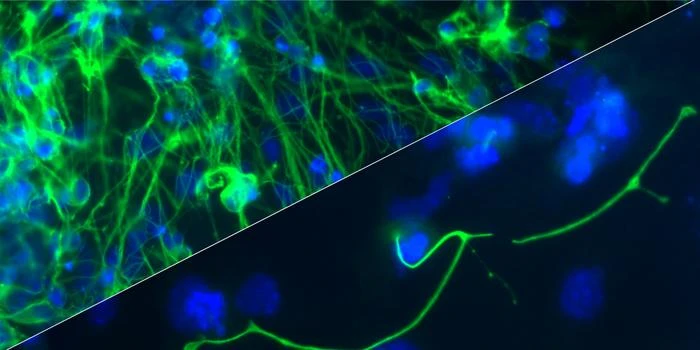
When KAT6B was knocked out in embryonic stem cells, the cells showed diminished differentiation potential to form neurons when compared to unaltered controls. The team showed that this was caused by a failure to properly regulate the expression of bivalent genes, indicating that KAT6B contributes to the poised state of bivalent genes, ensuring their proper activation during ESC differentiation.
Dr Philipp Voigt, a tenure-track group leader in the Institute’s Epigenetics research programme, commented: “Our research provides insight into a long-standing paradigm in the regulation of developmental gene expression, revealing a key mechanism that has so far eluded experimental scrutiny. It also uncovers a new layer of histone-based regulation, suggesting that bivalency is much more complex than originally thought. We are excited to now figure out what additional layers of regulation exist and how these contribute to poising and the control of developmental gene expression.
“I’d like to thank everyone involved in this work, including colleagues from my lab in Babraham and the Bioinformatics team, and my former lab in Edinburgh and the proteomics core at the University of Edinburgh.”
END
Researchers from the Voigt lab have extended our understanding of how developmental genes are held in a poised state to allow timely expression once they receive the correct ‘go’ signals. The next layer of regulation has been uncovered by the identification of proteins that interact with the epigenetic marks that poise developmental genes ready for expression. The research provides insight into the mechanisms through which the phenomenon of bivalency – where both activating and repressive marks are laid down at the same site on the genome – acts to ready developmental genes for activation. Importantly, the team identified specific interactor proteins that only recognise the bivalent state. Loss of one of these, KAT6B, blocks neuronal differentiation in embryonic stem cells. This research advances our understanding of the mechanisms that control developmental gene expression. Knowing more about these mechanisms contributes to our ability to maintain the health of cells in ageing and to the development of regenerative technologies such as cell and tissue regeneration and cellular reprogramming. As well as being essential in the precise packaging of DNA into the space of the nucleus, histone proteins are also the site of modifications, chemical additions referred to as epigenetic marks, that control whether a gene is silenced or expressed. A specialised version of this control is at sites where both activating and repressive marks are laid down, called bivalency. Research from the Voigt lab at the Babraham Institute has investigated the mechanism by which bivalency functions to poise genes for expression during cell differentiation. These findings provide insight into the intricate cellular processes that control development, how cell types are specified from stem cells, and how cell identity is established. Deciphering these mechanisms is not only key to understand fundamental biology but will also ultimately pave the way for the development of regenerative medicine approaches.
The combination of active and repressive marks is thought to hold the gene in a poised state in undifferentiated cells, ready for either full activation or full and permanent repression depending on differentiation cues.
Now the team’s research has shown in part how this balance is achieved and identified the protein interactors that read the bivalent state and influence gene expression.
Dr Devisree Valsakumar, a postdoctoral researcher in the Voigt lab, explained: “Bivalent marks are the gatekeeper of the poised status, which we can compare to the ‘Set’ command of ‘Ready, Set, Go!’. As the later findings of our research showed, this regulation, which holds genes in a ‘ready to go’ state, is critical for the proper specialism of cell types as cells differentiate from stem cells.”
Key to identifying the readers of bivalency was the team’s ability to create specifically modified histones and nucleosomes (where DNA is wound around histone proteins in a ‘beads on a string’ structure). Through painstakingly recreating the DNA and histone protein complexes to allow tailored protein interaction assays, the team have shown that at bivalent locations, proteins were recruited to the repressive mark (H3K27me3) and not to the activating mark (H3K4me3).
Importantly, they discovered that the bivalent combination of activating and repressive marks allows the binding of specific proteins that are not recruited by the repressive (H3K27me3) or activating (H3K4me3) marks individually.
One of these proteins is the histone acetyltransferase complex KAT6B (MORF), identifying this for the first time as a reader of bivalent nucleosomes and regulator of bivalent gene expression during embryonic stem cell (ESC) differentiation.
When KAT6B was knocked out in embryonic stem cells, the cells showed diminished differentiation potential to form neurons when compared to unaltered controls. The team showed that this was caused by a failure to properly regulate the expression of bivalent genes, indicating that KAT6B contributes to the poised state of bivalent genes, ensuring their proper activation during ESC differentiation.
Dr Philipp Voigt, a tenure-track group leader in the Institute’s Epigenetics research programme, commented: “Our research provides insight into a long-standing paradigm in the regulation of developmental gene expression, revealing a key mechanism that has so far eluded experimental scrutiny. It also uncovers a new layer of histone-based regulation, suggesting that bivalency is much more complex than originally thought. We are excited to now figure out what additional layers of regulation exist and how these contribute to poising and the control of developmental gene expression.
“I’d like to thank everyone involved in this work, including colleagues from my lab in Babraham and the Bioinformatics team, and my former lab in Edinburgh and the proteomics core at the University of Edinburgh.”
END
Attachments