PRESS-NEWS.org - Press Release Distribution
PRESS RELEASES DISTRIBUTION

Safeguarding intestinal stem cells during aging through balanced signaling
Safeguarding intestinal stem cells during aging through balanced signaling
2025-02-13
(Press-News.org)

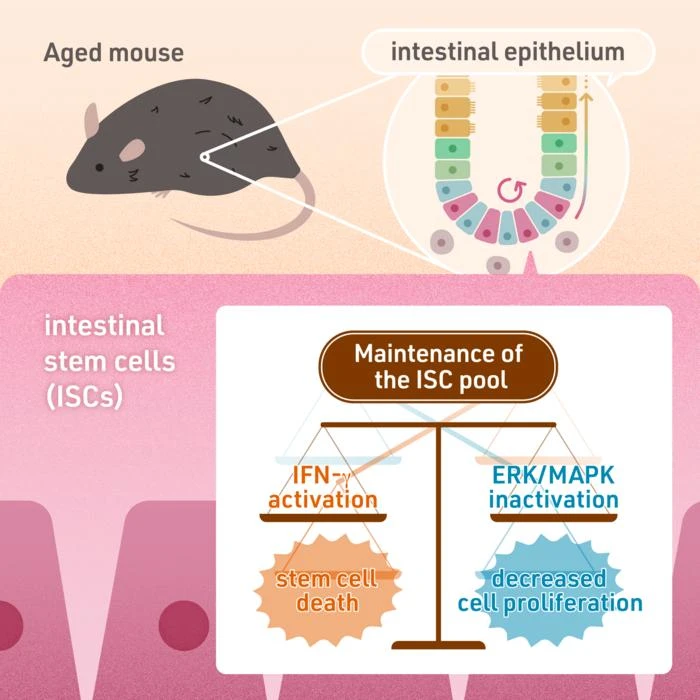
A recent study led by Associate Professor Takuya Yamamoto and Researcher May Nakajima-Koyama has revealed that maintaining a delicate balance between interferon-gamma (IFN-γ) and extracellular signal-regulated kinase (ERK)/mitogen-activated protein kinase (MAPK) signaling is essential for preserving the intestinal stem cell population during aging. By comparing young and aged mouse intestinal tissues, the researchers uncovered critical insights into the interplay between these signaling pathways in supporting stem cell maintenance over time.

The intestinal epithelium exhibits the highest cell turnover rate in the adult body, requiring constant and precise regulation of intestinal stem cells (ISCs) to sustain the production of new absorptive enterocytes and secretory cells, including Paneth, goblet, tuft, and enteroendocrine cells. Driven by growth factors and cytokines derived from the stem cell niche and surrounding immune cells, multiple signaling pathways tightly regulate ISC self-renewal and differentiation. Despite aging-related changes in the intestinal environment, ISCs continuously generate new cells to maintain this high turnover throughout life, suggesting the existence of protective mechanisms that shield ISCs from microenvironmental fluctuations. However, the underlying mechanisms remain largely unknown.

To understand how aging influences ISCs, the research team examined intestinal tissues from young (2–4 months old) and aged (22–27 months old) mice, which have an average lifespan of approximately two years. Using mice with an Lgr5 reporter, a marker gene for ISCs, the researchers found that the ISC pool is maintained even with aging. Histological analyses further revealed that while the proliferative capacity of ISCs remains unchanged, the proliferative capacity of progenitor cells declines with age. Additionally, they observed an enhanced differentiation of ISCs into enteroendocrine cells, which produce gut hormones and play a key role in regulating whole-body metabolism.

To gain deeper insights into aging-related changes, the researchers analyzed the gene expression profiles of over 10,000 individual cells from young and aged intestines to examine their gene expression patterns at the single-cell level. Their analysis identified cell-type-specific, age-related alterations in gene expression, with notable changes in enterocyte maturation. Additionally, they observed an age-dependent upregulation of metabolic genes, suggesting that aged enterocytes may undergo enhanced maturation and metabolic adaptations compared to their younger counterparts. These findings imply that differentiated cells may be more susceptible to the effects of aging than ISCs.

To uncover the regulatory mechanisms underlying age-dependent cellular and transcriptomic changes in the intestinal epithelium, the researchers first identified aging markers to pinpoint upstream factors by using their expression as indicators. By performing an integrative analysis with public datasets, they identified MHC class II genes, Ceacam10, and Ly6e as aging markers for ISCs upregulated prominently during aging. Although the expression of these genes was elevated in aged ISCs, they did not correlate at the single-cell level, thus suggesting the involvement of multiple independent regulatory mechanisms.

Next, the researchers conducted an in silico analysis to predict upstream regulatory factors and identified several candidate signaling pathways that may contribute to the induction of aging markers. To validate the involvement of these pathways, they treated intestinal organoids—mini-intestines in culture—with bioactive molecules known to influence the candidate pathways. Their findings revealed that IFN-γ signaling activation and ERK/MAPK signaling inactivation contribute to age-related changes in the intestinal epithelium. Using mouse models, the researchers further confirmed that these signaling alterations occur in the small intestine with aging. However, the combined effects of these signaling changes on intestinal homeostasis remain to be fully elucidated.

To examine how changes in these pathways affect ISCs, the researchers treated intestinal organoids with IFN-γ and iMEK (an inhibitor of MEK/ERK MAPK signaling). Notably, iMEK induced a quiescent state in ISCs, which was reversed by IFN-γ treatment. Moreover, they demonstrated that combined iMEK and IFN-γ treatment mitigates organoid damage caused by either molecule alone, suggesting that these two signaling pathways function in a compensatory manner to support organoid growth and survival. Mechanistically, transcriptome analysis revealed that IFN-γ reversed most iMEK-induced global transcriptomic changes, partly by regulating Wnt/β-catenin signaling and the transcription factor Myc. Conversely, iMEK or IFN-γ treatment independently triggered age-related changes in enteroendocrine cells and enterocytes. These findings suggest that while the balance between IFN-γ and ERK/MAPK signaling is crucial for ISC maintenance, it may simultaneously drive age-related changes and dysfunctions in differentiated cells.

This study revealed that the interplay between ERK/MAPK and IFN-γ signaling plays a key role in intestinal epithelial aging. The findings suggest that the mammalian intestinal epithelium has evolved a signaling mechanism that prioritizes the preservation of ISCs, potentially at the expense of differentiated cells, which may contribute to age-related metabolic changes in the body. Restoring ERK/MAPK and IFN-γ signaling activities simultaneously to a more youthful state could represent a promising anti-aging therapeutic strategy with minimum impacts on ISCs.

END


[Attachments] See images for this press release:
Safeguarding intestinal stem cells during aging through balanced signaling

ELSE PRESS RELEASES FROM THIS DATE:

How fruit flies flit between courtship and aggression to fight for mates

How fruit flies flit between courtship and aggression to fight for mates
2025-02-13
For fruit flies, finding the right mate is all about the right song. Now, research shows that male flies don’t just try to impress their valentine by serenading her with song—they also go to great lengths to drown out the competition. By jamming their rivals’ love songs with high-frequency wing flicks, male fruit flies boost the chances that they’ll win the female over. The new study, published in Cell, explains how the fruit fly brain coordinates courtship and aggressive competition—a framework which could ultimately help scientists understand how humans flexibly ...

Carbon emission drivers in the Belt and Road Initiative countries—An empirical analysis based on countries with different income levels

2025-02-13
With the promotion of the "the Belt and Road" initiative, the economy and society of BRI countries have developed rapidly, but they are also facing severe challenges of rising carbon emissions. Many countries rely on fossil fuels, and the process of energy transition is slow. Coupled with insufficient financial and technological support, especially low-income countries that have limited access to global climate funds, they face greater difficulties in the low-carbon transformation process.   To identify the carbon emission drivers at different development stages of BRI countries ...

Tracing diversity in earth tongues —— Phylogeny and species updates of Geoglossomycetes in China

Tracing diversity in earth tongues —— Phylogeny and species updates of Geoglossomycetes in China
2025-02-13
Geoglossomycetes is a class within the phylum Ascomycota that accommodates a single order and a single family, comprising nine genera. Geoglossomycetes is traditionally referred to as “earth tongues”. The class is characterized by tongue-shaped to clavate, stipitate, black ascomata covered with or without black setae, a swollen ascigerous portion, a cylindric stipe, filiform, septate paraphyses, cylindrical-clavate, 4–8-spored asci, and filiform or falciform, multi-septate, dark brown to hyaline ascospores. In collaboration with ...

The genus Thaxterogaster (Cortinariaceae): Phylogeny and species diversity in Western China

The genus Thaxterogaster (Cortinariaceae): Phylogeny and species diversity in Western China
2025-02-13
This study is led by Dr. Zhu L. Yang (Key Laboratory of Phytochemistry and Natural Medicines, Kunming Institute of Botany, Chinese Academy of Sciences). Specimens were collected by Song-Yan Zhou and Fei-Fei Liu; microscopic and phylogenetic analyses of Thaxterogaster species were conducted by Zi-Rui Wang at Kunming Institute of Botany, Chinese Academy of Sciences.   The team used 514 (236 newly generated + 278 downloaded) sequences from 243 collections representing 112 species building a five-locus phylogenetic tree which includes most currently known lineages and newly described ...

New journal Safety Emergency Science launches on the SciOpen platform: A leap forward for global safety and emergency research

New journal Safety Emergency Science launches on the SciOpen platform: A leap forward for global safety and emergency research
2025-02-13
In a significant endeavour to fortify international collaboration and drive innovation within the safety and emergency domain, Safety Emergency Science, a pioneering international academic journal, has been officially launched on the SciOpen platform. Jointly established by the China Association of Work Safety and Tsinghua University, this journal ushers in a new era in the global pursuit of excellence in safety and emergency research.   The journal made its debut at the 2nd Safety Technology Innovation Conference of the China Association of Work Safety, ...

Next translucent glass-ceramics: Amorphous alumina boosts strength and toughness

Next translucent glass-ceramics: Amorphous alumina boosts strength and toughness
2025-02-13
Zirconia-based ceramics, particularly 3Y-TZP, have transformed dental restorations, enabling the development of durable all-ceramic crowns and fixed prostheses. However, their inherent opacity necessitates the application of a porcelain layer, which is prone to chipping and debonding. To address this, translucent glass ceramics (GCs) have been developed and commercialized, including mica-based, leucite-based, and lithium disilicate GCs. These materials offer excellent aesthetics and bondability due to their controlled crystallization process, ...

Postpartum depression discovery opens door to blood test, earlier treatment

2025-02-13
New postpartum depression research from the University of Virginia School of Medicine and Weill Cornell Medicine could lead to a blood test to identify women at risk and possibly even to a preventive treatment. The research suggests that pregnant women may have characteristic levels of certain molecules in their blood that can warn that they are at risk of developing postpartum depression (PPD). These molecules, called neuroactive steroids, are derived from progesterone, a hormone that plays critical roles in pregnancy and menstruation. Measuring those molecules ...

Project Cure CRC ignites innovation in 2025 with $10.5 million in research, K-SPY debut & renewed RFP

Project Cure CRC ignites innovation in 2025 with $10.5 million in research, K-SPY debut & renewed RFP
2025-02-13
The leading nonprofit Colorectal Cancer Alliance (Alliance) is making bold strides in its mission to put an end to the disease. Its Project Cure CRC research initiative awarded new grants, convened top scientists to spark breakthrough advancements at its Cure CRC Summit, and unveiled K-SPY, a groundbreaking multi-center platform trial for high-risk colorectal cancer cases. Since its launch, Project Cure CRC has received 275 proposals, of which 22 have been approved totaling $10.5 million in awards. The latest awards reflect $2.8 million ...

Damon Runyon Cancer Research Foundation and St. Jude Children’s Research Hospital invest $1.8 million in childhood cancer research

Damon Runyon Cancer Research Foundation and St. Jude Children’s Research Hospital invest $1.8 million in childhood cancer research
2025-02-13
New York, New York, and Memphis, Tennessee, February 13, 2025 The Damon Runyon Cancer Research Foundation and St. Jude Children’s Research Hospital have announced their newest class of pediatric cancer research fellows, each of whom will receive funding for four years ($300,000 total) to support an innovative research project with the potential to significantly impact the diagnosis or treatment of one or more pediatric cancers. Launched in 2024, the Damon Runyon-St. Jude Pediatric Cancer Research Fellowship aims to address a funding gap that drives top talent to seek more prevalent opportunities in adult cancer research or the pharmaceutical sector. Fellows are selected by a distinguished ...

New ACS study finds menthol flavored cigarette smoking increases mortality risk vs. non-menthol cigarettes

New ACS study finds menthol flavored cigarette smoking increases mortality risk vs. non-menthol cigarettes
2025-02-13
In a large, nationwide study led by the American Cancer Society (ACS), researchers found mortality risks for smoking menthol cigarettes were higher than non-menthol cigarettes for death from any cause and cardiovascular diseases, especially heart diseases. Higher risks were evident in individuals who had quit smoking and at high smoking intensities. Black participants currently smoking menthol brands had high increases for some heart diseases with an 88% elevated mortality risk compared to non-menthol cigarettes. ...

LAST 30 PRESS RELEASES:

Eye for trouble: Automated counting for chromosome issues under the microscope

The vast majority of US rivers lack any protections from human activities, new research finds

Ultrasound-responsive in situ antigen "nanocatchers" open a new paradigm for personalized tumor immunotherapy

Environmental “superbugs” in our rivers and soils: new one health review warns of growing antimicrobial resistance crisis

Triple threat in greenhouse farming: how heavy metals, microplastics, and antibiotic resistance genes unite to challenge sustainable food production

Earthworms turn manure into a powerful tool against antibiotic resistance

AI turns water into an early warning network for hidden biological pollutants

Hidden hotspots on “green” plastics: biodegradable and conventional plastics shape very different antibiotic resistance risks in river microbiomes

Engineered biochar enzyme system clears toxic phenolic acids and restores pepper seed germination in continuous cropping soils

Retail therapy fail? Online shopping linked to stress, says study

How well-meaning allies can increase stress for marginalized people

Commercially viable biomanufacturing: designer yeast turns sugar into lucrative chemical 3-HP

Control valve discovered in gut’s plumbing system

George Mason University leads phase 2 clinical trial for pill to help maintain weight loss after GLP-1s

Hop to it: research from Shedd Aquarium tracks conch movement to set new conservation guidance

Weight loss drugs and bariatric surgery improve the body’s fat ‘balance:’ study

The Age of Fishes began with mass death

TB harnesses part of immune defense system to cause infection

Important new source of oxidation in the atmosphere found

A tug-of-war explains a decades-old question about how bacteria swim

Strengthened immune defense against cancer

Engineering the development of the pancreas

The Journal of Nuclear Medicine ahead-of-print tip sheet: Jan. 9, 2026

Mount Sinai researchers help create largest immune cell atlas of bone marrow in multiple myeloma patients

Why it is so hard to get started on an unpleasant task: Scientists identify a “motivation brake”

Body composition changes after bariatric surgery or treatment with GLP-1 receptor agonists

Targeted regulation of abortion providers laws and pregnancies conceived through fertility treatment

Press registration is now open for the 2026 ACMG Annual Clinical Genetics Meeting

Understanding sex-based differences and the role of bone morphogenetic protein signaling in Alzheimer’s disease

Breakthrough in thin-film electrolytes pushes solid oxide fuel cells forward

[Press-News.org] Safeguarding intestinal stem cells during aging through balanced signaling