SNU researchers develop world’s first technology to observe atomic structural changes of nanoparticles in 3D
Applied the 2017 Nobel Prize-winning ‘3D structural analysis method for protein particles’ to solve a long-standing challenge
Published 2025-03-04 · Original archive entry · Explore research explainers
Seoul National University College of Engineering announced that Professor Jungwon Park’s research team from the Department of Chemical and Biological Engineering has developed a groundbreaking technology to observe atomic structural changes of nanoparticles in three dimensions.
This study, recognized as a revolutionary achievement that resolves a long-standing challenge even past Nobel laureates could not solve, was published online in Nature Communications, one of the most prestigious international journals, on January 29.
Recently, nanoparticles have garnered significant attention as they are widely used in developing functional materials for cutting-edge industries such as energy, environment, and medicine. Due to their nanoscale size—measuring just a few nanometers (1 nm = one-billionth of a meter)—nanoparticles exhibit unique physical and chemical properties. Their reactivity varies significantly with size, making it crucial to observe structural changes. However, existing techniques for analyzing nanostructures have limitations. They are often restricted to fixed nanoparticles under vacuum conditions or provide only averaged information from multiple nanoparticles, limiting observations to simple structural identification. As a result, directly observing the three-dimensional atomic structure of individual nanoparticles over time in liquid environments remained a formidable technical challenge.
Unlike nanoparticles, the three-dimensional atomic structures of proteins had already been elucidated. This breakthrough was made possible by the revolutionary ‘cryo-transmission electron microscopy (cryo-TEM)’ technique developed by three scientists who won the 2017 Nobel Prize in Chemistry. Building on this innovation, Professor Park’s research team further advanced the field by developing a ‘liquid transmission electron microscopy (liquid TEM)’ technique using graphene, allowing three-dimensional visualization of nanostructures in solution. The research team’s previous study on this technique, called ‘Brownian tomography,’ was featured on the cover of Science in 2020.
Continuing this trajectory, Professor Park’s team has now developed the ‘time-resolved Brownian tomography’ technique, enabling real-time tracking of three-dimensional atomic structural changes in individual nanoparticles. This advancement opens new avenues for a deeper understanding of atomic-level changes in nanoparticles during complex chemical reactions. Particularly significant is that this research, supported by Samsung’s Future Technology Development Program—an initiative that funds pioneering research tackling scientific grand challenges—has successfully addressed a previously unsolvable problem.
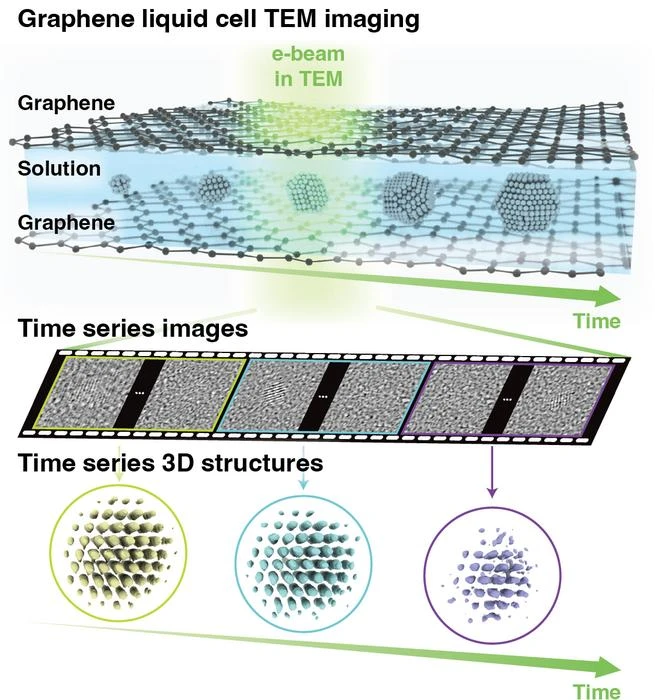
The research team developed a method to observe freely moving nanoparticles in solution by leveraging the ‘graphene liquid cell transmission electron microscopy (Graphene Liquid Cell TEM)’ technique. This method involves capturing nanoparticles undergoing Brownian motion (random movement of microscopic particles in fluid) from multiple angles over time and reconstructing the collected data into a three-dimensional visualization. (See Figure 1) Unlike conventional TEM, which typically examines fixed nanoparticles in vacuum conditions, or spectroscopic methods that only provide averaged information from numerous nanoparticles, this breakthrough represents a significant leap forward. It is the first-ever technology capable of directly measuring the three-dimensional atomic arrangement of a ‘single’ nanoparticle as it dynamically changes in a ‘liquid environment.’
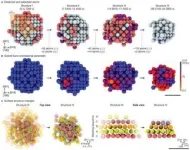
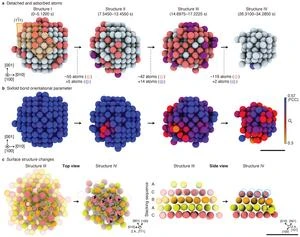
Furthermore, using the newly developed technique, the research team conducted an in-depth study on the structural changes of platinum (Pt) nanoparticles at the atomic level during the etching (chemical corrosion) process. They successfully captured the precise moments when surface atoms detached (desorbed), rearranged, or reattached (re-adsorbed) in three dimensions. Additionally, they discovered that when the nanocrystals shrank to around 1 nm in size, a highly disordered phase emerged—an unexpected finding since platinum generally exhibits a highly ordered atomic structure. (See Figure 2.) This study suggests that extremely small nanoparticles may exhibit unique structural characteristics distinct from their larger counterparts, even when composed of the same elemental material.
Additionally, the ‘time-resolved Brownian tomography’ technique is regarded as a transformative advancement in atomic structure observation, surpassing conventional ‘transmission electron microscopy’ (TEM) and ‘cryo-TEM,’ the latter of which was crucial in winning the 2017 Nobel Prize in Chemistry. This innovation allows researchers to analyze how nanomaterials’ three-dimensional structures evolve over time under various chemical conditions such as applied voltage or reactive solution composition. The study’s findings are expected to provide a more precise understanding of structural changes affecting the performance of next-generation nanomaterials, including metals, semiconductors, and oxides. Moreover, this research, supported by the National Hydrogen Priority Research Center project, successfully observed structural changes in platinum nanoparticles—critical catalysts for eco-friendly hydrogen energy applications—laying the groundwork for future high-performance catalyst development.
Professor Jungwon Park, who led the research, emphasized, “The development of ‘time-resolved Brownian tomography’ continues the legacy of the 2017 Nobel Prize-winning ‘cryo-TEM’ and our 2020 Science cover-featured ‘liquid TEM’ innovation. This new technique will significantly contribute to unraveling complex reaction mechanisms in hydrogen fuel cells, CO₂ conversion catalysts, lithium-ion batteries, and other advanced energy materials, facilitating the design of superior materials.”
The paper’s lead author, Researcher Sungsu Kang, remarked, “Our research directly captured real-time atomic-level structural changes of nanocrystals in liquid environments. This achievement is particularly significant because it successfully visualized surface atomic movements and the emergence of new phases unique to nanomaterials—phenomena that were challenging to detect using conventional spectroscopic or electrochemical methods.”
Sungsu Kang earned his Ph.D. from the School of Chemical and Biological Engineering at SNU and is currently conducting postdoctoral research at the University of Chicago. He continues to refine the ‘time-resolved Brownian tomography’ technique while expanding its applications to various nanomaterials and exploring their potential real-world use in chemical environments.
□ Introduction to the SNU College of Engineering
Seoul National University (SNU) founded in 1946 is the first national university in South Korea. The College of Engineering at SNU has worked tirelessly to achieve its goal of ‘fostering leaders for global industry and society.’ In 12 departments, 323 internationally recognized full-time professors lead the development of cutting-edge technology in South Korea and serving as a driving force for international development.
END
This study, recognized as a revolutionary achievement that resolves a long-standing challenge even past Nobel laureates could not solve, was published online in Nature Communications, one of the most prestigious international journals, on January 29.
Recently, nanoparticles have garnered significant attention as they are widely used in developing functional materials for cutting-edge industries such as energy, environment, and medicine. Due to their nanoscale size—measuring just a few nanometers (1 nm = one-billionth of a meter)—nanoparticles exhibit unique physical and chemical properties. Their reactivity varies significantly with size, making it crucial to observe structural changes. However, existing techniques for analyzing nanostructures have limitations. They are often restricted to fixed nanoparticles under vacuum conditions or provide only averaged information from multiple nanoparticles, limiting observations to simple structural identification. As a result, directly observing the three-dimensional atomic structure of individual nanoparticles over time in liquid environments remained a formidable technical challenge.
Unlike nanoparticles, the three-dimensional atomic structures of proteins had already been elucidated. This breakthrough was made possible by the revolutionary ‘cryo-transmission electron microscopy (cryo-TEM)’ technique developed by three scientists who won the 2017 Nobel Prize in Chemistry. Building on this innovation, Professor Park’s research team further advanced the field by developing a ‘liquid transmission electron microscopy (liquid TEM)’ technique using graphene, allowing three-dimensional visualization of nanostructures in solution. The research team’s previous study on this technique, called ‘Brownian tomography,’ was featured on the cover of Science in 2020.
Continuing this trajectory, Professor Park’s team has now developed the ‘time-resolved Brownian tomography’ technique, enabling real-time tracking of three-dimensional atomic structural changes in individual nanoparticles. This advancement opens new avenues for a deeper understanding of atomic-level changes in nanoparticles during complex chemical reactions. Particularly significant is that this research, supported by Samsung’s Future Technology Development Program—an initiative that funds pioneering research tackling scientific grand challenges—has successfully addressed a previously unsolvable problem.
The research team developed a method to observe freely moving nanoparticles in solution by leveraging the ‘graphene liquid cell transmission electron microscopy (Graphene Liquid Cell TEM)’ technique. This method involves capturing nanoparticles undergoing Brownian motion (random movement of microscopic particles in fluid) from multiple angles over time and reconstructing the collected data into a three-dimensional visualization. (See Figure 1) Unlike conventional TEM, which typically examines fixed nanoparticles in vacuum conditions, or spectroscopic methods that only provide averaged information from numerous nanoparticles, this breakthrough represents a significant leap forward. It is the first-ever technology capable of directly measuring the three-dimensional atomic arrangement of a ‘single’ nanoparticle as it dynamically changes in a ‘liquid environment.’
Furthermore, using the newly developed technique, the research team conducted an in-depth study on the structural changes of platinum (Pt) nanoparticles at the atomic level during the etching (chemical corrosion) process. They successfully captured the precise moments when surface atoms detached (desorbed), rearranged, or reattached (re-adsorbed) in three dimensions. Additionally, they discovered that when the nanocrystals shrank to around 1 nm in size, a highly disordered phase emerged—an unexpected finding since platinum generally exhibits a highly ordered atomic structure. (See Figure 2.) This study suggests that extremely small nanoparticles may exhibit unique structural characteristics distinct from their larger counterparts, even when composed of the same elemental material.
Additionally, the ‘time-resolved Brownian tomography’ technique is regarded as a transformative advancement in atomic structure observation, surpassing conventional ‘transmission electron microscopy’ (TEM) and ‘cryo-TEM,’ the latter of which was crucial in winning the 2017 Nobel Prize in Chemistry. This innovation allows researchers to analyze how nanomaterials’ three-dimensional structures evolve over time under various chemical conditions such as applied voltage or reactive solution composition. The study’s findings are expected to provide a more precise understanding of structural changes affecting the performance of next-generation nanomaterials, including metals, semiconductors, and oxides. Moreover, this research, supported by the National Hydrogen Priority Research Center project, successfully observed structural changes in platinum nanoparticles—critical catalysts for eco-friendly hydrogen energy applications—laying the groundwork for future high-performance catalyst development.
Professor Jungwon Park, who led the research, emphasized, “The development of ‘time-resolved Brownian tomography’ continues the legacy of the 2017 Nobel Prize-winning ‘cryo-TEM’ and our 2020 Science cover-featured ‘liquid TEM’ innovation. This new technique will significantly contribute to unraveling complex reaction mechanisms in hydrogen fuel cells, CO₂ conversion catalysts, lithium-ion batteries, and other advanced energy materials, facilitating the design of superior materials.”
The paper’s lead author, Researcher Sungsu Kang, remarked, “Our research directly captured real-time atomic-level structural changes of nanocrystals in liquid environments. This achievement is particularly significant because it successfully visualized surface atomic movements and the emergence of new phases unique to nanomaterials—phenomena that were challenging to detect using conventional spectroscopic or electrochemical methods.”
Sungsu Kang earned his Ph.D. from the School of Chemical and Biological Engineering at SNU and is currently conducting postdoctoral research at the University of Chicago. He continues to refine the ‘time-resolved Brownian tomography’ technique while expanding its applications to various nanomaterials and exploring their potential real-world use in chemical environments.
□ Introduction to the SNU College of Engineering
Seoul National University (SNU) founded in 1946 is the first national university in South Korea. The College of Engineering at SNU has worked tirelessly to achieve its goal of ‘fostering leaders for global industry and society.’ In 12 departments, 323 internationally recognized full-time professors lead the development of cutting-edge technology in South Korea and serving as a driving force for international development.
END
Attachments