Over 1 in 3 adults in households with guns do not store all in locked locations
Published 2025-03-11 · Original archive entry · Explore research explainers
PHILADELPHIA – Since 2017, firearm-related injuries in the United States have been the most common cause of death from injury among children through young adults, ages 1 to 24, surpassing motor vehicle accidents, according to a 2022 study. Access to firearms in one’s home increases the risk of suicide and accidental death.
But over a third of Americans with guns in their homes say they do not store all of them in a locked location (37%), according to the latest health survey from the Annenberg Public Policy Center (APPC) of the University of Pennsylvania. (Download the topline.)
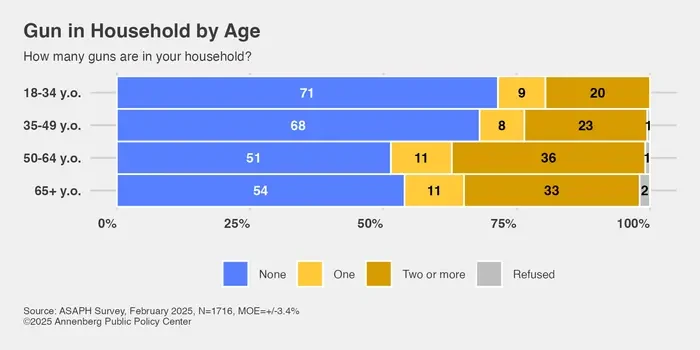
In the survey, conducted Jan. 30-Feb. 10, 2025, among more than 1,700 U.S. adults, over a third of respondents (37%) report having one or more guns in their household. Of them, nearly 3 in 4 (74%) report having more than one gun in their household. Respondents aged 50 and older are more likely to be in a household with guns than those who are 18 to 49 years old.
There are party differences among those who report living in gun households: 50% of self-described Republicans and Republican-leaning independents report being in a household with one or more guns. Just 28% of self-described Democrats and Democrat-leaners report living in a household with guns, as do 31% of those who are non-leaning independents or in neither the Democratic nor Republican parties. Importantly, among households with guns, there are no significant differences in reported gun storage by political affiliation or the lack thereof. (See Q57A (a) in the topline.)
Among the people who report having one or more guns in their household, just 61% say “all of them” are stored in a locked place and 20% say “none of them” are in a locked place. Another 17% report that “a few” or “most of them” are in a locked place.
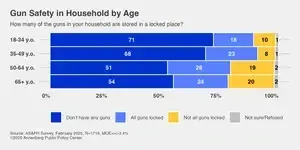
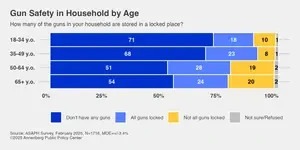
Respondents who are 18 to 49 years old – the ages of individuals who are more likely to have children or teens at home – are more likely than those in the older groups to report either having no guns or that all guns in their household are stored in a locked place (89-91% vs. 78-79%). Also, individuals under 50 who live in households with guns are less likely than the older groups to report that not all of them are stored in a locked place (8-10% vs. 19-20%).
“One can disagree about the advisability of having guns at home,” said Kathleen Hall Jamieson, director of the Annenberg Public Policy Center. “But since secure storage minimizes inadvertent use, child access, and gun theft, we all should consider it part of responsible gun ownership.”
APPC’s Annenberg Science and Public Health knowledge survey The survey data come from the 23rd wave of a nationally representative panel of 1,716 U.S. adults conducted for the Annenberg Public Policy Center by SSRS, an independent market research company. Most have been empaneled since April 2021. To account for attrition, small replenishment samples have been added over time using a random probability sampling design. The most recent replenishment, in September 2024, added 360 respondents to the sample. This wave of the Annenberg Science and Public Health Knowledge (ASAPH) survey was fielded Jan. 30-Feb. 10, 2025. The margin of sampling error (MOE) is ± 3.4 percentage points at the 95% confidence level. All figures are rounded to the nearest whole number and may not add to 100%. Combined subcategories may not add to totals in the topline and text due to rounding.
Download the topline and the methods report.
The policy center has been tracking the American public’s knowledge, beliefs, and behaviors regarding vaccination, Covid-19, flu, RSV, and other consequential health issues through this survey panel for nearly four years. In addition to Jamieson, APPC’s team on the survey includes research analysts Laura A. Gibson and Shawn Patterson Jr., Patrick E. Jamieson, director of the Annenberg Health and Risk Communication Institute, and Ken Winneg, managing director of survey research
See other recent Annenberg health knowledge surveys:
Low-dose aspirin: Nearly half of adults mistakenly think benefits of daily aspirin outweigh risks (Feb. 3, 2025) Vaccination mandates: Most Americans favor school vaccination requirements, but support is rising for opt-out options (Jan. 28, 2025) The RSV vaccine & vaccine hesitancy: Greater acceptance of RSV vaccine seen as vaccine hesitancy appears to have plateaued (Dec. 23, 2024) Whooping cough: Cases of whooping cough growing, but knowledge about it is lacking (Dec. 17, 2024) Alcohol and cancer: Most don’t know that alcohol raises cancer risk (Nov. 22, 2024) The Annenberg Public Policy Center was established in 1993 to educate the public and policy makers about communication’s role in advancing public understanding of political, science, and health issues at the local, state, and federal levels.
END
But over a third of Americans with guns in their homes say they do not store all of them in a locked location (37%), according to the latest health survey from the Annenberg Public Policy Center (APPC) of the University of Pennsylvania. (Download the topline.)
In the survey, conducted Jan. 30-Feb. 10, 2025, among more than 1,700 U.S. adults, over a third of respondents (37%) report having one or more guns in their household. Of them, nearly 3 in 4 (74%) report having more than one gun in their household. Respondents aged 50 and older are more likely to be in a household with guns than those who are 18 to 49 years old.
There are party differences among those who report living in gun households: 50% of self-described Republicans and Republican-leaning independents report being in a household with one or more guns. Just 28% of self-described Democrats and Democrat-leaners report living in a household with guns, as do 31% of those who are non-leaning independents or in neither the Democratic nor Republican parties. Importantly, among households with guns, there are no significant differences in reported gun storage by political affiliation or the lack thereof. (See Q57A (a) in the topline.)
Among the people who report having one or more guns in their household, just 61% say “all of them” are stored in a locked place and 20% say “none of them” are in a locked place. Another 17% report that “a few” or “most of them” are in a locked place.
Respondents who are 18 to 49 years old – the ages of individuals who are more likely to have children or teens at home – are more likely than those in the older groups to report either having no guns or that all guns in their household are stored in a locked place (89-91% vs. 78-79%). Also, individuals under 50 who live in households with guns are less likely than the older groups to report that not all of them are stored in a locked place (8-10% vs. 19-20%).
“One can disagree about the advisability of having guns at home,” said Kathleen Hall Jamieson, director of the Annenberg Public Policy Center. “But since secure storage minimizes inadvertent use, child access, and gun theft, we all should consider it part of responsible gun ownership.”
APPC’s Annenberg Science and Public Health knowledge survey The survey data come from the 23rd wave of a nationally representative panel of 1,716 U.S. adults conducted for the Annenberg Public Policy Center by SSRS, an independent market research company. Most have been empaneled since April 2021. To account for attrition, small replenishment samples have been added over time using a random probability sampling design. The most recent replenishment, in September 2024, added 360 respondents to the sample. This wave of the Annenberg Science and Public Health Knowledge (ASAPH) survey was fielded Jan. 30-Feb. 10, 2025. The margin of sampling error (MOE) is ± 3.4 percentage points at the 95% confidence level. All figures are rounded to the nearest whole number and may not add to 100%. Combined subcategories may not add to totals in the topline and text due to rounding.
Download the topline and the methods report.
The policy center has been tracking the American public’s knowledge, beliefs, and behaviors regarding vaccination, Covid-19, flu, RSV, and other consequential health issues through this survey panel for nearly four years. In addition to Jamieson, APPC’s team on the survey includes research analysts Laura A. Gibson and Shawn Patterson Jr., Patrick E. Jamieson, director of the Annenberg Health and Risk Communication Institute, and Ken Winneg, managing director of survey research
See other recent Annenberg health knowledge surveys:
Low-dose aspirin: Nearly half of adults mistakenly think benefits of daily aspirin outweigh risks (Feb. 3, 2025) Vaccination mandates: Most Americans favor school vaccination requirements, but support is rising for opt-out options (Jan. 28, 2025) The RSV vaccine & vaccine hesitancy: Greater acceptance of RSV vaccine seen as vaccine hesitancy appears to have plateaued (Dec. 23, 2024) Whooping cough: Cases of whooping cough growing, but knowledge about it is lacking (Dec. 17, 2024) Alcohol and cancer: Most don’t know that alcohol raises cancer risk (Nov. 22, 2024) The Annenberg Public Policy Center was established in 1993 to educate the public and policy makers about communication’s role in advancing public understanding of political, science, and health issues at the local, state, and federal levels.
END
Attachments