PRESS-NEWS.org - Press Release Distribution
PRESS RELEASES DISTRIBUTION

Advancements in organ preservation: paving the way for better transplantation outcomes
Advancements in organ preservation: paving the way for better transplantation outcomes
2025-03-14
(Press-News.org)

A review article published in Engineering delves into the crucial field of organ preservation, exploring its history, current techniques, and future prospects. The shortage of donor organs remains a significant global challenge, with only about 10% of the global demand for organ transplantation being met, as stated by the World Health Organization. This shortage is further exacerbated by the limitations of current organ preservation methods.

Currently, the main clinical methods for organ preservation are static cold storage (SCS) and machine perfusion (MP). SCS, which involves storing organs in a preservation solution at low temperatures (usually 4 °C), is simple and cost-effective. It has been widely used, for example, in Japan for kidney preservation. However, it can only maintain the function of organs for a limited time. For kidneys, the preservation time is 12–24 hours; for lungs, 6–8 hours; and for hearts, 4–6 hours. Prolonged SCS can lead to issues such as adenosine triphosphate (ATP) depletion, metabolite accumulation, and subsequent ischemia-reperfusion injury (IRI), which can cause organ damage and transplant failure.

MP, on the other hand, can extend the preservation time. Hypothermic machine perfusion (HMP) can maintain organ function for several days by providing a continuous supply of oxygen and nutrients. Normothermic machine perfusion (NMP), which simulates normal body temperature, has shown superior transplant survival rates in some cases, like in liver transplantation. But it also has its own problems, such as non-anastomotic biliary strictures in liver transplants.

In recent years, cryopreservation techniques have emerged as promising alternatives. Vitrification, in particular, is regarded as a potentially effective long-term organ preservation method. It involves replacing a portion of the water in organs with solutes to form a glass-like state, avoiding ice crystal formation. However, high concentrations of cryoprotective agents (CPAs) are required for vitrification, which can cause toxicity issues in cells. To address this, researchers are exploring various strategies, such as using isochoric preservation to reduce the required concentration of CPAs and developing new rewarming techniques.

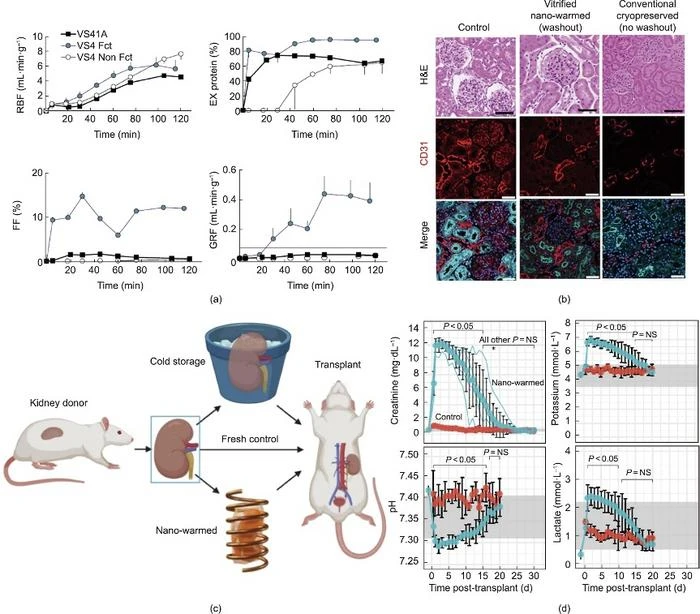
The paper also discusses the preservation of different major organs. For kidneys, in addition to SCS and MP, vitrification cryopreservation has shown potential, with successful transplantation of cryopreserved rat kidneys after 100 days. For livers, MP techniques are being developed to address the high discard rate due to IRI. Hearts face challenges in preservation due to high ATP consumption, but MP and vitrification-based methods are being explored. Lungs, currently preserved mainly by SCS for a short time, may benefit from ex vivo lung perfusion (EVLP) and cryopreservation in the future. Intestine preservation is crucial but challenging due to its large bacterial reservoir, and MP techniques are being investigated to improve outcomes.

Significant progress has been made in organ preservation, yet there remains a long journey ahead. Going forward, future research ought to center on devising more efficient preservation strategies, minimizing the toxicity of CPAs, and enhancing rewarming techniques. By doing so, it will be possible to achieve long-term, high-quality organ preservation, thus ultimately resolving the organ shortage issue.

The paper “Organ Preservation: History, Advancements, and Perspectives,” authored by Xinmeng Liu, Zhiquan Shu, Liming Zhang, Haoyue Li, Jing Yang, Lei Zhang. Full text of the open access paper: https://doi.org/10.1016/j.eng.2024.12.020. For more information about the Engineering, follow us on X (https://twitter.com/EngineeringJrnl) & like us on Facebook (https://www.facebook.com/EngineeringJrnl).

END


[Attachments] See images for this press release:
Advancements in organ preservation: paving the way for better transplantation outcomes Advancements in organ preservation: paving the way for better transplantation outcomes 2

ELSE PRESS RELEASES FROM THIS DATE:

Pitt study makes new insights into the origins of ovarian cancer

Pitt study makes new insights into the origins of ovarian cancer
2025-03-14
Researchers at the University of Pittsburgh have identified a novel trigger of a deadly form of ovarian cancer: a subset of progenitor cells that reside in fallopian tube supportive tissue, or stroma. The discovery of these high-risk cells, described in a new study published today in Cancer Discovery, a journal of the American Association for Cancer Research, could pave the way for better approaches to prevent and detect high-grade serous ovarian cancer (HGSOC), the most common form of ovarian cancer, which kills more than 12,000 women in the U.S. each year. “Ovarian cancer is the leading cause of death from gynecologic cancer in the Western world, but we currently ...

Topical steroid withdrawal diagnostic criteria defined by NIH researchers

Topical steroid withdrawal diagnostic criteria defined by NIH researchers
2025-03-14
WHAT: Researchers at the National Institutes of Health (NIH) have determined that dermatitis resulting from topical steroid withdrawal (TSW) is distinct from eczema and is caused by an excess of an essential chemical compound in the body. Scientists from NIH’s National Institute of Allergy and Infectious Diseases (NIAID) identified treatments that could be studied in clinical trials for the condition based on their potential to lower levels of the chemical compound—called nicotinamide adenine dinucleotide (NAD+), a form of ...

CeSPIACE: A broad-spectrum peptide inhibitor against variable SARS-CoV-2 spikes

CeSPIACE: A broad-spectrum peptide inhibitor against variable SARS-CoV-2 spikes
2025-03-14
SARS-CoV-2, the virus responsible for COVID-19, infects cells by binding its spike protein to angiotensin-converting enzyme 2 (ACE2) receptors. Blocking this interaction with inhibitors could prevent infection. Since these inhibitors act directly on the virus without affecting human cells, they may be safer than some existing treatments. However, mutations in the spike protein can alter its structure, reducing the effectiveness of these inhibitors. In a significant breakthrough, a research team led by Professor Yoshinori Fujiyoshi ...

Understanding the origin of magnetic moment enhancement in novel alloys

Understanding the origin of magnetic moment enhancement in novel alloys
2025-03-14
Magnetic materials have become indispensable to various technologies that support our modern society, such as data storage devices, electric motors, and magnetic sensors. High-magnetization ferromagnets are especially important for the development of next-generation spintronics, sensors, and high-density data storage technologies. Among these materials, the iron-cobalt (Fe-Co) alloy is widely used due to its strong magnetic properties. However, there is a limit to how much their performance can be improved, necessitating a new approach. Some of the earlier studies have shown that epitaxially grown films made up of Fe-Co alloys doped with heavier elements exhibit remarkably high ...

BU researchers develop computational tools to safeguard privacy without degrading voice-based cognitive markers

2025-03-14
(Boston)—Digital voice recordings contain valuable information that can indicate an individual’s cognitive health, offering a non-invasive and efficient method for assessment. Research has demonstrated that digital voice measures can detect early signs of cognitive decline by analyzing features such as speech rate, articulation, pitch variation and pauses, which may signal cognitive impairment when deviating from normative patterns.   However, voice data introduces privacy challenges due to the personally identifiable information embedded in recordings, ...

Breakthrough in rapid polymer nanostructure production

2025-03-14
Researchers at the University of Birmingham have developed a new method for the rapid scalable preparation of uniform nanostructures directly from block polymers.   This novel approach, led by the Dove and O'Reilly groups, significantly reduces processing time from a week to just minutes, enabling high-throughput production of precision polymer nanomaterials.  Publishing their findings today (14 Mar) in Nature Chemistry, the teams outline a rapid seed preparation technique that supersaturates polymer solutions in a flow system.  The process facilitates uniform seed micelle formation and allows ...

Artificial photosynthesis: Researchers mimic plants

Artificial photosynthesis: Researchers mimic plants
2025-03-14
Photosynthesis is a marvellous process: plants use it to produce sugar molecules and oxygen from the simple starting materials carbon dioxide and water. They draw the energy they need for this complex process from sunlight. If humans could imitate photosynthesis, it would have many advantages. The free energy from the sun could be used to remove carbon dioxide from the atmosphere and use it to build carbohydrates and other useful substances. It would also be possible to produce hydrogen, as photosynthesis splits water into its components oxygen and hydrogen. Photosynthesis: a Complex Process ...

Social disadvantage can accelerate ageing and increase disease risk

2025-03-14
People with favourable socioeconomic conditions, such as high incomes or education levels, face a reduced risk of age-related diseases and show fewer signs of biological ageing than peers of the same age, finds a new study led by University College London (UCL) researchers. Social inequalities appear to have a direct impact on the biological ageing process, according to the authors of the Nature Medicine paper. The scientists found that people with more social advantages had fewer proteins in their blood that are linked to the ...

Breaking free from dependence on rare resources! A domestic high-performance permanent magnet emerges!

Breaking free from dependence on rare resources! A domestic high-performance permanent magnet emerges!
2025-03-14
The Nano Materials Research Division at the Korea Institute of Materials Science (KIMS), led by Dr. Tae-Hoon Kim and Dr. Jung-Goo Lee, has successfully developed a groundbreaking grain boundary diffusion process that enables the fabrication of high-performance permanent magnets without the use of expensive heavy rare earth elements. This pioneering technology, marks the world’s first achievement in this field. Permanent magnets are key components in various high-value-added products, including electric vehicle (EV) motors and robots. However, conventional permanent magnet manufacturing processes have been heavily dependent on ...

Symptoms of long-COVID can last up to two years after infection with COVID-19

2025-03-14
23% of people infected with SARS-CoV-2 between 2021 and 2023 developed long-COVID, and in more than half of them the symptoms persisted for two years. These are the main conclusions of a study conducted by ISGlobal, a centre supported by the ”la Caixa” Foundation, and in collaboration with the Germans Trias i Pujol Research Institute (IGTP), as part of the European END-VOC project. The risk of developing long-COVID depends on several factors, according to the results published in BMC Medicine. After overcoming an initial ...

LAST 30 PRESS RELEASES:

Study finds Alzheimer's disease can be evaluated with brain stimulation

Cells that are not our own may unlock secrets about our health

Caring Cross and Boston Children’s Hospital collaborate to expand access to gene therapy for sickle cell disease and beta thalassemia

Mount Sinai review maps the path forward for cancer vaccines, highlighting promise of personalized and combination approaches

Illinois study: How a potential antibiotics ban could affect apple growers

UC Irvine and Jefferson Health researchers find differences between two causes of heart valve narrowing

Ancien DNA pushes back record of treponemal disease-causing bacteria by 3,000 years

Human penis size influences female attraction and male assessment of rivals

Scientists devise way to track space junk as it falls to earth

AI is already writing almost one-third of new software code

A 5,500-year-old genome rewrites the origins of syphilis

Tracking uncontrolled space debris reentry using sonic booms

Endogenous retroviruses promote early human zygotic development

Malicious AI swarms pose emergent threats to democracy

Progenitor cells in the brain constantly attempt to produce new myelin-producing brain cells

Quantum measurements with entangled atomic clouds

Mayo Clinic researchers use AI to predict patient falls based on core density in middle age

Moffitt study develops new tool to predict how cancer evolves

National Multiple Sclerosis Society awards Dr. Manuel A. Friese the 2025 Barancik Prize for Innovation in MS Research

PBM profits obscured by mergers and accounting practices, USC Schaeffer white paper shows

Breath carries clues to gut microbiome health

New study links altered cellular states to brain structure

Palaeontology: Ancient giant kangaroos could hop to it when they needed to

Decoded: How cancer cells protect themselves from the immune system

ISSCR develops roadmap to accelerate pluripotent stem cell-derived therapies to patients

New study shows gut microbiota directly regulates intestinal stem cell aging

Leading cancer deaths in people younger than 50 years

Rural hospital bypass by patients with commercial health insurance

Jumping giants: Fossils show giant prehistoric kangaroos could still hop

Missing Medicare data alters hospital penalties, study finds

[Press-News.org] Advancements in organ preservation: paving the way for better transplantation outcomes