Scientists use cellular programming to mimic first days of embryonic development
Published 2025-03-20 · Original archive entry · Explore research explainers
The earliest days after fertilization, once a sperm cell meets an egg, are shrouded in scientific mystery.
The process of how a humble single cell becomes an organism fascinates scientists across disciplines. For some animals, the entire process of cellular multiplication, generation of specialized cells, and their organization into an ordered multicellular embryo takes place in the protective environment of the uterus, making direct observation and studies challenging. This makes it difficult for scientists to understand what can go wrong during that process, and how specific risk factors and the surrounding environment may prevent embryo formation.
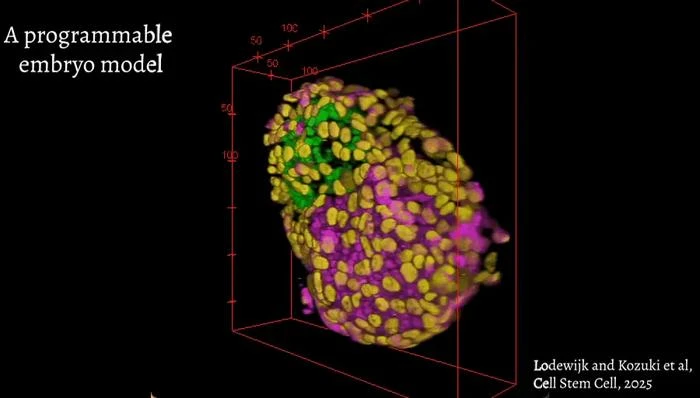
Scientists at UC Santa Cruz were able to engineer cellular models of embryos without ever experimenting with any actual embryos, allowing them to mimic the first few days after two sexually reproductive cells meet. They use CRISPR-based engineering methods to prompt stem cells to organize into “programmable” embryo-like structures, also known as embryoids, which can be used to study the role of certain genes in early development. These structures are not actual embryos but assemblies of lab-grown cells that self-organize in ways that mimic some aspects of early developmental stages. Their results are published in the leading stem cell journal Cell Stem Cell.
“We as scientists are interested in recreating and repurposing natural phenomena, such as formation of an embryo, in the dish to enable studies that are otherwise challenging to do with natural systems,” said Ali Shariati, assistant professor of biomolecular engineering and the study’s senior author. “We want to know how cells organize themselves into an embryo-like model, and what could go wrong when there are pathological conditions that prevent an animal from successfully developing.”
Cell co-development
Shariati is an expert in stem cell engineering, a field that uses stem cells — unspecialized cells that can form any type of cell such as gut or brain cells — to study and solve biological and health problems.
This project, led by UCSC postdoctoral scholar Gerrald Lodewijk and biomolecular engineering alumna and current Caltech graduate student Sayaka Kozuki, used mouse stem cells that are commonly grown in the lab to guide them to form basic building blocks of the embryo.
The team used a version of CRISPR technology known as an epigenome editor, which does not cut DNA but instead modifies how it is expressed. They targeted regions of the genome known to be involved in the development of an early embryo. This allowed them to control which genes were activated, and induce the creation of main types of cells needed for early development.
“We use the stem cells, which are like a blank canvas, and use them to induce different cell types using our CRISPR tools,” Lodewijik said.
This method had the advantage of allowing different cell types to “co-develop,” which more closely resembles the natural embryo formation than the chemical approaches other scientists have used to develop different cell types.
“These cells co-develop together, just like they would in an actual embryo, and establish that history of being neighbors,” Shariati said. “We do not change their genome or expose them to specific signaling molecules, but rather activate the existing genes.”
The team found that 80% of the stem cells organize themselves into a structure that mimics the most basic form of an embryo after a few days, and most undergo gene activation that reflects the development process that occurs in living organisms.
“The similarity is remarkable in the way the cells organize themselves, as well as the molecular composition,” Shariati said. “[The cells require] very little input from us — it’s as if the cells already know what to do, and we just give them a little bit of guidance.”
The researchers observed that the cells showed a collective behavior in moving and organizing together.
“Some of them start doing this rotational migration, almost like the collective behavior of birds or other species,” Shariati said. “Through this collective behavior and migration they can form these fascinating embryonic patterns.”
“Programmable” models
Having an accurate baseline model that reflects a living organisms’ early embryo could allow scientists to better study and learn how to treat developmental disorders or mutations.
“These models have a more complete representation of what’s going on in early stages of development, and can capture the background,” Lodewijik said.
The CRISPR programming not only allows the scientists to activate the genes at the beginning of the experimentation process, but also enables them to activate or modify genes important for other parts of development. This allows the embryo models to be “programmable,” meaning they can be relatively easily influenced with a high level of control to target and test the impact of multiple genes as the embryo model develops, illuminating which have deleterious effects when turned on or off.
As an example, the researchers demonstrated how certain tissues form or are hindered during early development, but their methods could be used to study a wide range of genes and their cascading effects on the cell types.
“I think this is the pioneering work of this study — the programmability and that we don’t rely on extrinsic factors to do this, but rather have a lot of control inside the cell,” Shariati said.
The researchers are interested in how this approach might be used to study other species, allowing for a look into their embryo formation without ever using their actual embryos.
This research could allow for the study of the bottlenecks that lead reproduction to fail in early stages. Among mammals, humans have more reproduction challenges in that human embryos often fail to implant or establish the correct early organizational form. Understanding why this is the case could help make progress toward improving human fertility.
END
The process of how a humble single cell becomes an organism fascinates scientists across disciplines. For some animals, the entire process of cellular multiplication, generation of specialized cells, and their organization into an ordered multicellular embryo takes place in the protective environment of the uterus, making direct observation and studies challenging. This makes it difficult for scientists to understand what can go wrong during that process, and how specific risk factors and the surrounding environment may prevent embryo formation.
Scientists at UC Santa Cruz were able to engineer cellular models of embryos without ever experimenting with any actual embryos, allowing them to mimic the first few days after two sexually reproductive cells meet. They use CRISPR-based engineering methods to prompt stem cells to organize into “programmable” embryo-like structures, also known as embryoids, which can be used to study the role of certain genes in early development. These structures are not actual embryos but assemblies of lab-grown cells that self-organize in ways that mimic some aspects of early developmental stages. Their results are published in the leading stem cell journal Cell Stem Cell.
“We as scientists are interested in recreating and repurposing natural phenomena, such as formation of an embryo, in the dish to enable studies that are otherwise challenging to do with natural systems,” said Ali Shariati, assistant professor of biomolecular engineering and the study’s senior author. “We want to know how cells organize themselves into an embryo-like model, and what could go wrong when there are pathological conditions that prevent an animal from successfully developing.”
Cell co-development
Shariati is an expert in stem cell engineering, a field that uses stem cells — unspecialized cells that can form any type of cell such as gut or brain cells — to study and solve biological and health problems.
This project, led by UCSC postdoctoral scholar Gerrald Lodewijk and biomolecular engineering alumna and current Caltech graduate student Sayaka Kozuki, used mouse stem cells that are commonly grown in the lab to guide them to form basic building blocks of the embryo.
The team used a version of CRISPR technology known as an epigenome editor, which does not cut DNA but instead modifies how it is expressed. They targeted regions of the genome known to be involved in the development of an early embryo. This allowed them to control which genes were activated, and induce the creation of main types of cells needed for early development.
“We use the stem cells, which are like a blank canvas, and use them to induce different cell types using our CRISPR tools,” Lodewijik said.
This method had the advantage of allowing different cell types to “co-develop,” which more closely resembles the natural embryo formation than the chemical approaches other scientists have used to develop different cell types.
“These cells co-develop together, just like they would in an actual embryo, and establish that history of being neighbors,” Shariati said. “We do not change their genome or expose them to specific signaling molecules, but rather activate the existing genes.”
The team found that 80% of the stem cells organize themselves into a structure that mimics the most basic form of an embryo after a few days, and most undergo gene activation that reflects the development process that occurs in living organisms.
“The similarity is remarkable in the way the cells organize themselves, as well as the molecular composition,” Shariati said. “[The cells require] very little input from us — it’s as if the cells already know what to do, and we just give them a little bit of guidance.”
The researchers observed that the cells showed a collective behavior in moving and organizing together.
“Some of them start doing this rotational migration, almost like the collective behavior of birds or other species,” Shariati said. “Through this collective behavior and migration they can form these fascinating embryonic patterns.”
“Programmable” models
Having an accurate baseline model that reflects a living organisms’ early embryo could allow scientists to better study and learn how to treat developmental disorders or mutations.
“These models have a more complete representation of what’s going on in early stages of development, and can capture the background,” Lodewijik said.
The CRISPR programming not only allows the scientists to activate the genes at the beginning of the experimentation process, but also enables them to activate or modify genes important for other parts of development. This allows the embryo models to be “programmable,” meaning they can be relatively easily influenced with a high level of control to target and test the impact of multiple genes as the embryo model develops, illuminating which have deleterious effects when turned on or off.
As an example, the researchers demonstrated how certain tissues form or are hindered during early development, but their methods could be used to study a wide range of genes and their cascading effects on the cell types.
“I think this is the pioneering work of this study — the programmability and that we don’t rely on extrinsic factors to do this, but rather have a lot of control inside the cell,” Shariati said.
The researchers are interested in how this approach might be used to study other species, allowing for a look into their embryo formation without ever using their actual embryos.
This research could allow for the study of the bottlenecks that lead reproduction to fail in early stages. Among mammals, humans have more reproduction challenges in that human embryos often fail to implant or establish the correct early organizational form. Understanding why this is the case could help make progress toward improving human fertility.
END