PRESS-NEWS.org - Press Release Distribution
PRESS RELEASES DISTRIBUTION

ISU research raises hope for solving Parkinson's disease puzzle

ISU research raises hope for solving Parkinson's disease puzzle
2011-03-01
(Press-News.org) AMES, Iowa - A protein pathway that may hold the secret to understanding Parkinson's disease has been discovered and explained by Iowa State University researchers.

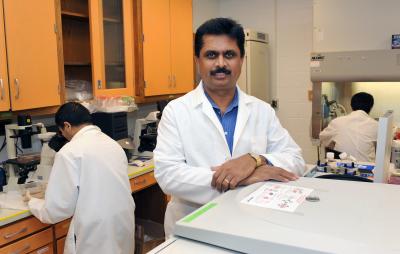
Anumantha Kanthasamy, a distinguished professor of biomedical sciences and the W. Eugene and Linda R. Lloyd Endowed Chair in Neurotoxicology at the ISU College of Veterinary Medicine, has been working to understand the complex mechanisms of the disease for more than a decade. He believes this recent discovery offers hope for the cure.

The research was funded by the National Institutes of Health and is published in the Journal of Neuroscience.

Parkinson's disease sufferers lack a sufficient amount of a brain chemical called dopamine. In previous research, Kanthasamy has shown that a novel protein -- known as protein kinase-C (specifically PKCδ) - kills essential dopamine-producing cells in the brain.

Now, Kanthasamy has shown how to modify the production of the kinase-C, and, more important, how to inhibit it.

The process begins with a protein called alpha-synuclein (ά-synuclein) that - after interacting with other proteins in cells - becomes part of the protein complex that modifies kinase-C level in the cells.

One of the proteins that alpha-synuclein interacts with inside the cell is known as p300.

By changing the activity of p300 protein, Kanthasamy believes that production of the destructive kinase-C will be inhibited.

"We have identified an essential pathway that regulates the survival of dopamine-producing nerve cells," he said.

"This p300 is an intermediate protein that is implicit in the Parkinson's disease," he said. "By modifying this protein, we can potentially reduce the expression of kinase-C and the associated destructive effects on dopamine-producing cells."

"We found the mechanism," said Kanthasamy of the pathway. "Now we can focus on finding chemicals that may be able to control the mechanism."

Parkinson's disease strikes around 50,000 people each year, and approximately 1 million people have the disease. Parkinson's sufferers include actor Michael J. Fox and former boxing champion Muhammad Ali.

Currently, there is no cure for Parkinson's and available therapies only treat the symptoms.

Symptoms of Parkinson's disease include trembling in hands, arms, legs, jaw, and face; rigidity or stiffness of the limbs and trunk; slowness of movement; and impaired balance and coordination. As these symptoms become more pronounced, patients may have difficulty walking, talking, or completing other simple tasks.

Because the disease typically affects people over the age of 50, the National Institutes of Health anticipates the incidence of Parkinson's will increase as the nation's population ages.


INFORMATION:


[Attachments] See images for this press release:
ISU research raises hope for solving Parkinson's disease puzzle

ELSE PRESS RELEASES FROM THIS DATE:

Study finds close linkage between a rare, deadly lung condition and blood cell abnormalities

2011-03-01
WASHINGTON, February 28, 2011) – Results from a study published in Blood, the Journal of the American Society of Hematology reveal a close relationship between pulmonary arterial hypertension (PAH)—exceedingly high blood pressure in the arteries carrying blood from the heart to the lungs—and abnormalities of the blood-forming cells in the bone marrow (known as myeloid abnormalities). The study, which was conducted by a team of researchers at the Cleveland Clinic, showed that blood progenitor cells (cells that are capable of forming white blood cells, red blood cells, ...

U. of Colorado study shows acupressure effective in helping to treat traumatic brain injury

U. of Colorado study shows acupressure effective in helping to treat traumatic brain injury
2011-03-01
A new University of Colorado Boulder study indicates an ancient form of complementary medicine may be effective in helping to treat people with mild traumatic brain injury, a finding that may have implications for some U.S. war veterans returning home. The study involved a treatment known as acupressure in which one's fingertips are used to stimulate particular points on a person's body -- points similar to those stimulated with needles in standard acupuncture treatments, said CU-Boulder Professor Theresa Hernandez, lead study author. The results indicate a link between ...

Study finds breast cancer incidence rates no longer declining in US women

2011-03-01
ATLANTA –February 28, 2011– A sharp decline in breast cancer incidence rates among non-Hispanic white women in the U.S. after a dramatic drop in the use of postmenopausal hormone therapy did not continue through 2007, according to a new study from the American Cancer Society and the National Cancer Institute. While there are several possible explanations for the recent stabilization, it may indicate that the decrease in breast cancers thought to be related to postmenopausal hormone use has bottomed out. The study appears online in Cancer Epidemiology Biomarkers and Prevention ...

Student innovation at Rensselaer holds key to safer remote detection of dangerous materials

Student innovation at Rensselaer holds key to safer remote detection of dangerous materials
2011-03-01
Troy, N.Y. – Benjamin Clough has developed a novel method for eavesdropping on terahertz information hidden in invisible plasma acoustic bursts. The doctoral student at Rensselaer Polytechnic Institute has demonstrated a promising technique that employs sound waves to boost the distance from which researchers can use powerful terahertz technology to remotely detect hidden explosives, chemicals, and other dangerous materials. Clough, a student in the Department of Electrical, Computer, and Systems Engineering at Rensselaer, is one of three finalists for the 2011 $30,000 ...

NYU physicists develop potent packing process

2011-03-01
New York University physicists have developed a method for packing microscopic spheres that could lead to improvements in commercial products ranging from pharmaceutical lotions to ice cream. Their work, which relies on an innovative application of statistical mechanics, appears in the Proceedings of the National Academy of Sciences. The study aimed to manipulate the properties of emulsions, which are a mixture of two or more immiscible liquids. The NYU researchers examined droplets of oil in water, which form the basis of a range of consumer products, including butter, ...

NYU researchers identify neural circuits used in processing basic linguistic phrases

2011-03-01
New York University researchers have isolated neural activity that reflects basic mechanisms used by the brain to combine elementary pieces of language in order to construct complex ideas. The study, which appears in the Journal of Neuroscience, was conducted by Douglas Bemis, a graduate student in NYU's Department of Psychology, and Liina Pylkkänen, an associate professor in NYU's Department of Psychology and Department of Linguistics. Researchers have long studied the neural regions that underlie the processing of complete sentences and other complex linguistic ...

Share of black S&E degrees from HBCUs declines in 2008

2011-03-01
More than 45 years after the Civil Rights Act of 1964, National Science Foundation (NSF) statistics show minority academic institutions still enroll a substantial number of minority students, but the percentage of minorities earning bachelor's degrees in science and engineering (S&E) from minority-serving institutions has declined over time. Statistics published today in a report titled "Women, Minorities, and Persons with Disabilities in Science and Engineering: 2011" show that 26 percent of blacks earned S&E bachelor's degrees from historically black colleges and universities ...

Lead contamination in Philadelphia's Chinatown discovered by Jefferson Emergency Medicine team

2011-03-01
PHILADELPHIA – Recently, a research team from the Department of Emergency Medicine at Jefferson Medical College of Thomas Jefferson University discovered an alarming amount of lead contamination in ceramic cooking and eating utensils sold in Philadelphia's Chinatown. The team, led be Gerald O'Malley, D.O., director of Clinical Research; and Thomas Gilmore, M.D., resident, purchased and tested a sampling of Chinese ceramics. Using a LeadCheck®, one area on each item was rubbed with a lead-detecting solution. In almost 30 percent of the items, the area turned pink or red, ...

Team delivers development aid via cell phone animations

Team delivers development aid via cell phone animations
2011-03-01
CHAMPAIGN, lll. — A farmer in Niger learns how to protect his crops from insects. A resident of Port-au-Prince or a rural Haitian village learns how to avoid exposure to cholera. An entrepreneur in Mali gets step-by-step instructions on extracting the oil from shea seeds to make shea butter she can sell at a local market. These people are benefiting from a new approach to sustainable development education that reaches a much larger audience than traditional methods – and at a fraction of the cost. The initiative, led by a team of extension educators and faculty at the ...

A grudge match between humanity and death -- who wins?

2011-03-01
FAIRFAX, Va., February 28, 2011—Death can be terrifying. Recognizing that death is inescapable and unpredictable makes us incredibly vulnerable, and can invoke feelings of anxiety, hatred and fear. But new research by George Mason University psychology professor Todd Kashdan shows that being a mindful person not only makes you generally more tolerant and less defensive, but it can also actually neutralize fears of dying and death. "Mindfulness is being open, receptive, and attentive to whatever is unfolding in the present moment," says Kashdan. In his latest research, ...

LAST 30 PRESS RELEASES:

Making lighter work of calculating fluid and heat flow

Normalizing blood sugar can halve heart attack risk

Lowering blood sugar cuts heart attack risk in people with prediabetes

Study links genetic variants to risk of blinding eye disease in premature infants

Non-opioid ‘pain sponge’ therapy halts cartilage degeneration and relieves chronic pain

AI can pick up cultural values by mimicking how kids learn

China’s ecological redlines offer fast track to 30 x 30 global conservation goal

Invisible indoor threats: emerging household contaminants and their growing risks to human health

Adding antibody treatment to chemo boosts outcomes for children with rare cancer

Germline pathogenic variants among women without a history of breast cancer

Tanning beds triple melanoma risk, potentially causing broad DNA damage

Unique bond identified as key to viral infection speed

Indoor tanning makes youthful skin much older on a genetic level

Mouse model sheds new light on the causes and potential solutions to human GI problems linked to muscular dystrophy

The Journal of Nuclear Medicine ahead-of-print tip sheet: December 12, 2025

Smarter tools for peering into the microscopic world

Applications open for funding to conduct research in the Kinsey Institute archives

Global measure underestimates the severity of food insecurity

Child survivors of critical illness are missing out on timely follow up care

Risk-based vs annual breast cancer screening / the WISDOM randomized clinical trial

University of Toronto launches Electric Vehicle Innovation Ontario to accelerate advanced EV technologies and build Canada’s innovation advantage

Early relapse predicts poor outcomes in aggressive blood cancer

American College of Lifestyle Medicine applauds two CMS models aligned with lifestyle medicine practice and reimbursement

Clinical trial finds cannabis use not a barrier to quitting nicotine vaping

Supplemental nutrition assistance program policies and food insecurity

Switching immune cells to “night mode” could limit damage after a heart attack, study suggests

URI-based Global RIghts Project report spotlights continued troubling trends in worldwide inhumane treatment

Neutrophils are less aggressive at night, explaining why nighttime heart attacks cause less damage than daytime events

Menopausal hormone therapy may not pose breast cancer risk for women with BRCA mutations

Mobile health tool may improve quality of life for adolescent and young adult breast cancer survivors

[Press-News.org] ISU research raises hope for solving Parkinson's disease puzzle