PRESS-NEWS.org - Press Release Distribution
PRESS RELEASES DISTRIBUTION

Getting the point: Real-time monitoring of atomic-microscope probes adjusts for wear

Getting the point: Real-time monitoring of atomic-microscope probes adjusts for wear
2011-04-02
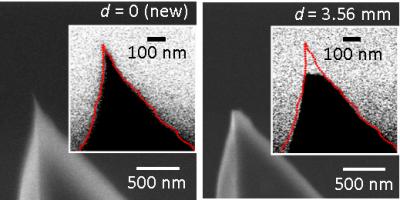
(Press-News.org) Scientists at the National Institute of Standards and Technology (NIST) have developed a way to measure the wear and degradation of the microscopic probes used to study nanoscale structures in situ and as it's happening. Their technique can both dramatically speed up and improve the accuracy of the most precise and delicate nanoscale measurements done with atomic force microscopy (AFM).

If you're trying to measure the contours of a surface with a ruler that's crumbling away as you work, then you at least need to know how fast and to what extent it is being worn away during the measurement.

This has been the challenge for researchers and manufacturers trying to create images of the surfaces of nanomaterials and nanostructures. Taking a photo is impossible at such small scales, so researchers use atomic force microscopes. Think of a device like a phonograph needle being used, on a nanoscale, to measure the peaks and valleys as it's dragged back and forth across a surface. These devices are used extensively in nanoscale imaging to measure the contours of nanostructures, but the AFM tips are so small that they tend to wear down as they traverse the surface being measured.

Today, most researchers stop the measurement to "take a picture" of the tip with an electron microscope, a time-consuming method prone to inaccuracies.

NIST materials engineer Jason Killgore has developed a method for measuring in real time the extent to which AFM tips wear down. Killgore measures the resonant frequency of the AFM sensor tip, a natural vibration rate like that of a tuning fork, while the instrument is in use. Because changes to the size and shape of the tip affect its resonant frequency, he is able to measure the size of the AFM's tip as it works—in increments of a tenth of a nanometer, essentially atomic scale resolution. The technique, called contact resonance force microscopy, is described in a paper recently published in the journal Small.*

The potential impact of this development is considerable. Thousands of AFMs are in use at universities, manufacturing plants and research and development facilities around the world. Improving their ability to measure and image nanosized devices will improve the quality and effectiveness of those devices. Another benefit is that developing new measurement tips—and studying the properties of new materials used in those tips—will be much easier and faster, given the immediate feedback about wear rates.


INFORMATION:


* J. P. Killgore, R. H. Geiss and D. C. Hurley. Continuous measurement of AFM tip wear by contact resonance force microscopy. Small. Published March 15, 2011.


[Attachments] See images for this press release:
Getting the point: Real-time monitoring of atomic-microscope probes adjusts for wear

ELSE PRESS RELEASES FROM THIS DATE:

Online Casino JackpotCity.com is Handing Out Daily Easter Treats to its UK Players During the Month of April

2011-04-02
JackpotCity.com UK Online Casino http://www.jackpotcity.com/uk/ has announced that it will be treating their players to a host of daily Easter promotions in their Microgaming powered online casino software. To access the promotion players will need to log into their software anytime between the 4th and the 24th of April 2011, wager 50 credits and enter the Easter Calendar promotion. The daily Easter giveaways will consist of the following casino promotional prizes: Week One: (4 - 10 April, 2011) The daily rewards consist of 425 Free Spins, 100 Credits, 90,000 Loyalty ...

U.S. Federal Business Continuity/Disaster Recovery IT Market to Reach $5 Bln in 2015

2011-04-02
Market Research Media Ltd announces new report on business continuity/disaster recovery market. From the ever eminent threats of terror attacks, electricity blackouts and hurricanes to recent waves of cyber attacks, the U.S government networks are facing a wide variety of threats to operational stability. As technology solutions became more vital to sustain operational stability of the government's critical infrastructure, the Federal business continuity/disaster recovery spending grows to meet old and new challenges. A sense of uncertainty about cyber security among ...

Pilot study examines stress, anxiety and needs of young women with a unique breast cancer

2011-04-02
VIDEO: Unlike older breast cancer survivors, young women 40 and under with breast cancer face different psychological and social burdens: Newer careers, newer couple relationships, younger families, and a peer group... Click here for more information. When an aggressive form of breast cancer strikes a young woman, what kind of stress, anxiety and other psychological and social challenges does she face? That question hasn't been answered in the published psychological cancer ...

Celebrating superconductivity: NIST debuts online museum of quantum voltage standards

2011-04-02
On April 8, 2011, the scientific community will celebrate the centennial of the discovery of superconductivity—the ability of certain materials to conduct electricity without resistance when cooled below a specific temperature. Quantum voltage standards are among the successful practical applications of superconductivity, so to mark the anniversary, the National Institute of Standards and Technology (NIST) has created an online museum highlighting important accomplishments and historical images from the voltage standards program. Superconductivity was first discovered ...

Charge it: Neutral atoms made to act like electrically charged particles

2011-04-02
Completing the story they started by creating synthetic magnetic fields,* scientists from the Joint Quantum Institute (JQI), a collaboration of the National Institute of Standards and Technology (NIST) and the University of Maryland, have now made atoms act as if they were charged particles accelerated by electric fields. Reported in the journal Nature Physics,** these synthetic electric fields make each atom in a gas act, individually, as if it were a charged particle, but collectively they remain neutral, uncharged particles. This dual personality will help researchers ...

McMaster vaccine has pet owners feline groovy

2011-04-02
Hamilton, ON (March 31, 2011) - Good-bye itching, watering eyes and sneezing. McMaster University researchers have developed a vaccine which successfully treats people with an allergy to cats. Traditionally, frequent allergy shots have been considered the most effective way to bring relief – other than getting rid of the family pet -- for the eight to 10% of the population allergic to cats. Both options – one difficult and costly, the other troubling - may now be tossed aside thanks to the work of immunologist Mark Larché, professor in the Department of Medicine in ...

Older and stronger: Progressive resistance training can build muscle, increase strength as we age

2011-04-02
VIDEO: It's often thought that older adults must tolerate the strength and muscle loss that come with age. But analyses of current research by University of Michigan scientists reveal that not... Click here for more information. ANN ARBOR, Mich.—Getting older doesn't mean giving up muscle strength. Not only can adults fight the battle of strength and muscle loss that comes with age, but the Golden Years can be a time to get stronger, say experts at the University of Michigan ...

Archaeologists investigate Iraqi marshes for origins of Mesopotamian cities

2011-04-02
Three National Science Foundation-supported researchers recently undertook the first non-Iraqi archaeological investigation of the Tigris-Euphrates delta in nearly 20 years. Archeologists Jennifer Pournelle and Carrie Hritz, with geologist Jennifer Smith, carried out the study late last year to look for links between wetland resources and the emergence of Mesopotamian cities. "Mesopotamia"--Greek for "the land between the rivers"--is an area about 300 miles long and 150 miles wide straddling the Tigris and Euphrates rivers, which now run through Iraq, northeastern Syria, ...

It's good to have a shady side: sun and shade leaves play different roles in tree canopies

2011-04-02
Durham, NC —'Outer' tree canopy leaves influence the sunlight reaching inner canopy leaves by changing their shape, says a new study. The shape and physiology of leaves within the tree canopy is not constant, and can vary depending on their position within the tree crown. This phenomenon is expected to have important consequences for how trees cope with stress and use resources. A new study describes how the leaves in the outer canopy of olive trees can influence the light environment within the canopy by changing their shape, as more elongated leaves resulted in higher ...

NJIT professor uses math analytics to project 2011 Major League Baseball winners

2011-04-02
Philadelphia Phillies, St. Louis Cardinals and San Francisco Giants should win their divisions, while the Atlanta Braves will take the wild card slot in the National League (NL), according to NJIT's baseball guru Bruce Bukiet. http://www.njit.edu/news/experts/bukiet.php For over a decade, Bukiet, an associate professor and associate dean, has applied mathematical analysis to compute winning games for each Major League Baseball Team. This year, he said that in the American League (AL), the New York Yankees and Boston Red Sox should tie for first place in the East, with ...

LAST 30 PRESS RELEASES:

Researchers identify cleaner ways to burn biomass using new environmental impact metric

Avian malaria widespread across Hawaiʻi bird communities, new UH study finds

New study improves accuracy in tracking ammonia pollution sources

Scientists turn agricultural waste into powerful material that removes excess nutrients from water

Tracking whether California’s criminal courts deliver racial justice

Aerobic exercise may be most effective for relieving depression/anxiety symptoms

School restrictive smartphone policies may save a small amount of money by reducing staff costs

UCLA report reveals a significant global palliative care gap among children

The psychology of self-driving cars: Why the technology doesn’t suit human brains

Scientists discover new DNA-binding proteins from extreme environments that could improve disease diagnosis

Rapid response launched to tackle new yellow rust strains threatening UK wheat

How many times will we fall passionately in love? New Kinsey Institute study offers first-ever answer

Bridging eye disease care with addiction services

Study finds declining perception of safety of COVID-19, flu, and MMR vaccines

The genetics of anxiety: Landmark study highlights risk and resilience

How UCLA scientists helped reimagine a forgotten battery design from Thomas Edison

Dementia Care Aware collaborates with the Institute for Healthcare Improvement to advance age-friendly health systems

Growth of spreading pancreatic cancer fueled by 'under-appreciated' epigenetic changes

Lehigh University professor Israel E. Wachs elected to National Academy of Engineering

Brain stimulation can nudge people to behave less selfishly

Shorter treatment regimens are safe options for preventing active tuberculosis

How food shortages reprogram the immune system’s response to infection

The wild physics that keeps your body’s electrical system flowing smoothly

From lab bench to bedside – research in mice leads to answers for undiagnosed human neurodevelopmental conditions

More banks mean higher costs for borrowers

Mohebbi, Manic, & Aslani receive funding for study of scalable AI-driven cybersecurity for small & medium critical manufacturing

Media coverage of Asian American Olympians functioned as 'loyalty test'

University of South Alabama Research named Top 10 Scientific Breakthroughs of 2025

Genotype-specific response to 144-week entecavir therapy for HBeAg-positive chronic hepatitis B with a particular focus on histological improvement

‘Stiff’ cells provide new explanation for differing symptoms in sickle cell patients

[Press-News.org] Getting the point: Real-time monitoring of atomic-microscope probes adjusts for wear