Productonica: Robot speeds up glass development
Published 2011-11-15 · Original archive entry · Explore research explainers
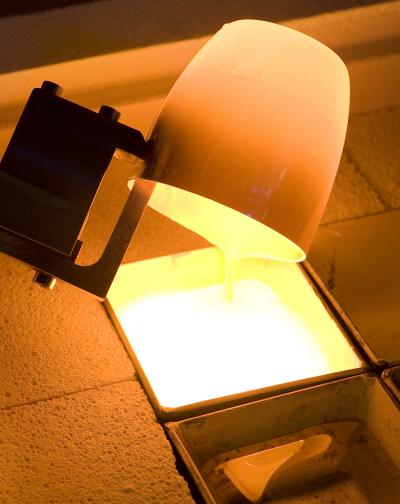
In order to develop glass with new characteristics, experts select about ten compounds from potential elements, mix them and then heat the powder. They heat it in a furnace until it is soft, then they pour it into a mould and let it cool slowly and in a controlled fashion, down to room temperature. During that process small samples from the viscous glass are taken to test it: how viscous is it? How well does it wet metals? How does it crystallize out? To produce the glass samples by hand and to test them requires a lot of time: one employee needs approximately two weeks to process 16 samples.
Researchers of the Fraunhofer Institute for Silicate Research ISC in Würzburg have developed a unit that carries out all these steps automatically. "It needs only 24 hours to process 16 samples", says Dr. Martin Kilo, manager of the expert group for glass and high-temperature materials at the ISC. "For this reason we are able to develop glass elements more cost-effectively than previously, by up to 50 percent." The core piece of the unit is a robot: it puts a mixing cup on a scale and moves it under 14 storage vessels, from which a certain amount of powder is filled into the cup. Then the robot mixes the individual ingredients by closing the cup and shaking it, just like a bartender does with a cocktail shaker. The robot arm then grabs a crucible, puts it onto the scale, fills it with a certain amount of the mixed powder and puts the crucible into one of the five furnaces available in total. The robot repeats this steps several times, since gases build up when the powder is heated and foam could form otherwise. In addition, the powder shrinks during the melting process. Finally the furnace heats the fully filled crucible to a higher temperature, causing the gas bubbles in the glass to rise to the surface. Once the glass is viscous, the robot arm removes the crucible, pours the glass into a new mould and places it in a stress-relieving furnace. Here, the glass cools slowly and in a controlled manner, from 600 to 800 degrees Celsius down to room temperature.
An additional central element of the unit is the analysis unit. It works according to the thermo-optical measurement principle. Looking through two measurement windows, the shade the sample projects in a backlight test system is recorded by a CCD camera. The changes in the contour make it possible to determine characteristics such as sample volume, hemisphere point and wetting angle. This test unit measures how viscous the melt is, and if and how it crystallizes and wets metals. The test unit can also be used independently of the glass screening unit. The unit also determines and records the ability of the glass to conduct heat. Researchers will introduce this robot at the "productronica" trade fair that takes place in Munich, Germany, from November 15 -18, 2011 (Hall B2, Booth 135).
INFORMATION:
Researchers will introduce this robot at the "productronica" trade fair to be held in Munich, Germany, from November 15 - 18, 2011 (Hall B2, Booth 135).
Researchers of the Fraunhofer Institute for Silicate Research ISC in Würzburg have developed a unit that carries out all these steps automatically. "It needs only 24 hours to process 16 samples", says Dr. Martin Kilo, manager of the expert group for glass and high-temperature materials at the ISC. "For this reason we are able to develop glass elements more cost-effectively than previously, by up to 50 percent." The core piece of the unit is a robot: it puts a mixing cup on a scale and moves it under 14 storage vessels, from which a certain amount of powder is filled into the cup. Then the robot mixes the individual ingredients by closing the cup and shaking it, just like a bartender does with a cocktail shaker. The robot arm then grabs a crucible, puts it onto the scale, fills it with a certain amount of the mixed powder and puts the crucible into one of the five furnaces available in total. The robot repeats this steps several times, since gases build up when the powder is heated and foam could form otherwise. In addition, the powder shrinks during the melting process. Finally the furnace heats the fully filled crucible to a higher temperature, causing the gas bubbles in the glass to rise to the surface. Once the glass is viscous, the robot arm removes the crucible, pours the glass into a new mould and places it in a stress-relieving furnace. Here, the glass cools slowly and in a controlled manner, from 600 to 800 degrees Celsius down to room temperature.
An additional central element of the unit is the analysis unit. It works according to the thermo-optical measurement principle. Looking through two measurement windows, the shade the sample projects in a backlight test system is recorded by a CCD camera. The changes in the contour make it possible to determine characteristics such as sample volume, hemisphere point and wetting angle. This test unit measures how viscous the melt is, and if and how it crystallizes and wets metals. The test unit can also be used independently of the glass screening unit. The unit also determines and records the ability of the glass to conduct heat. Researchers will introduce this robot at the "productronica" trade fair that takes place in Munich, Germany, from November 15 -18, 2011 (Hall B2, Booth 135).
INFORMATION:
Researchers will introduce this robot at the "productronica" trade fair to be held in Munich, Germany, from November 15 - 18, 2011 (Hall B2, Booth 135).