How the fly flies
Max Planck scientists discover gene switch responsible for flight muscle formation
Published 2011-11-21 · Original archive entry · Explore research explainers
This press release is available in German.
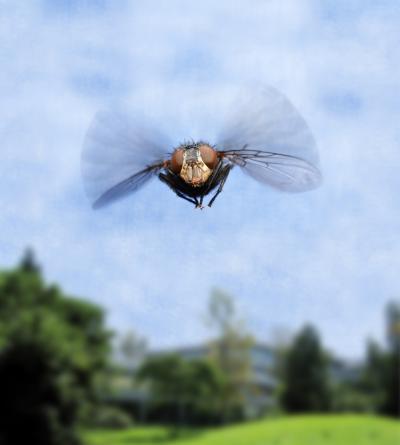
Flies are real flight artists, although they only have small wings compared to their body size. Scientists at the Max Planck Institute of Biochemistry in Martinsried near Munich, Germany, recently identified the genetic switch that regulates the formation of flight muscles. "The gene spalt is essential for the generation of the ultrafast super muscles," emphasizes Frank Schnorrer, head of the research group 'Muscle Dynamics'. "Without spalt, the fly builds only normal leg muscles instead of flight muscles." The scientists' results have now been published in Nature.
In order to fly efficiently, flies have to flap their small wings very fast. This causes the familiar buzzing and humming of the small beasts. The fruit fly Drosophila melanogaster moves her wings at a frequency of 200 hertz – that means its flight muscles contract and relax 200 times per second. "In contrast, a hundred meters sprinter who moves his legs only a few times per second moves like a snail," Frank Schnorrer describes. How can the fruit fly flap its wings at such a high frequency?
Muscles control all body movements, including the wing oscillations. However, flight muscles are unique. Their contractions are not only regulated by nerve impulses as usual, but additionally triggered by tension. Every fly has two categories of flight muscles which enable the wing oscillations: One type moves the wings down and, at the same time, stretches the other type which induces its contraction. Such, the wings are pulled up again and stable wing oscillations begin.
No spalt, you are flightless
By means of targeted gene silencing in the fruit fly, scientists in the research group "Muscle Dynamics" at the MPI of Biochemistry have now identified the switch essential for the formation of flight muscles: "Spalt". Transcription factors like Spalt play an important role for the correct transcription of the genetic information into RNA and proteins necessary in the respective cell type. Spalt only exists in flight muscles and is responsible for the specific architecture of their myofibrils. These components of muscle fibres alone enable the contraction of a muscle in response to the applied tension during the oscillations. Without Spalt, the flies survive, but are flightless. The flight muscles no longer react to tension and behave like normal leg muscles. Vice versa, the scientists succeeded in creating flight muscle-like muscles in the fly's legs by only inserting Spalt.
These results could be medically important. "Human body muscles do not have Spalt and are hardly regulated by tension," Frank Schnorrer explains. "But the human cardiac muscle builds Spalt and the tension inside the ventricle influences the heartbeat intensity. Whether Spalt plays a role in heartbeat regulation, is not yet known and remains to be investigated."
INFORMATION:
Original publication:
Cornelia Schönbauer, Jutta Distler, Nina Jährling, Martin Radolf, Hans-Ulrich Dodt, Manfred Frasch & Frank Schnorrer (2011)
Spalt mediates an evolutionarily conserved switch to fibrillar muscle fate in insects
Optionaler Link
Nature, 17 November 2011
Flies are real flight artists, although they only have small wings compared to their body size. Scientists at the Max Planck Institute of Biochemistry in Martinsried near Munich, Germany, recently identified the genetic switch that regulates the formation of flight muscles. "The gene spalt is essential for the generation of the ultrafast super muscles," emphasizes Frank Schnorrer, head of the research group 'Muscle Dynamics'. "Without spalt, the fly builds only normal leg muscles instead of flight muscles." The scientists' results have now been published in Nature.
In order to fly efficiently, flies have to flap their small wings very fast. This causes the familiar buzzing and humming of the small beasts. The fruit fly Drosophila melanogaster moves her wings at a frequency of 200 hertz – that means its flight muscles contract and relax 200 times per second. "In contrast, a hundred meters sprinter who moves his legs only a few times per second moves like a snail," Frank Schnorrer describes. How can the fruit fly flap its wings at such a high frequency?
Muscles control all body movements, including the wing oscillations. However, flight muscles are unique. Their contractions are not only regulated by nerve impulses as usual, but additionally triggered by tension. Every fly has two categories of flight muscles which enable the wing oscillations: One type moves the wings down and, at the same time, stretches the other type which induces its contraction. Such, the wings are pulled up again and stable wing oscillations begin.
No spalt, you are flightless
By means of targeted gene silencing in the fruit fly, scientists in the research group "Muscle Dynamics" at the MPI of Biochemistry have now identified the switch essential for the formation of flight muscles: "Spalt". Transcription factors like Spalt play an important role for the correct transcription of the genetic information into RNA and proteins necessary in the respective cell type. Spalt only exists in flight muscles and is responsible for the specific architecture of their myofibrils. These components of muscle fibres alone enable the contraction of a muscle in response to the applied tension during the oscillations. Without Spalt, the flies survive, but are flightless. The flight muscles no longer react to tension and behave like normal leg muscles. Vice versa, the scientists succeeded in creating flight muscle-like muscles in the fly's legs by only inserting Spalt.
These results could be medically important. "Human body muscles do not have Spalt and are hardly regulated by tension," Frank Schnorrer explains. "But the human cardiac muscle builds Spalt and the tension inside the ventricle influences the heartbeat intensity. Whether Spalt plays a role in heartbeat regulation, is not yet known and remains to be investigated."
INFORMATION:
Original publication:
Cornelia Schönbauer, Jutta Distler, Nina Jährling, Martin Radolf, Hans-Ulrich Dodt, Manfred Frasch & Frank Schnorrer (2011)
Spalt mediates an evolutionarily conserved switch to fibrillar muscle fate in insects
Optionaler Link
Nature, 17 November 2011