An inside look at face transplantation
In a new research article, Brigham and Women's surgeons describe 3 successful full face transplants
Published 2011-12-29 · Original archive entry · Explore research explainers
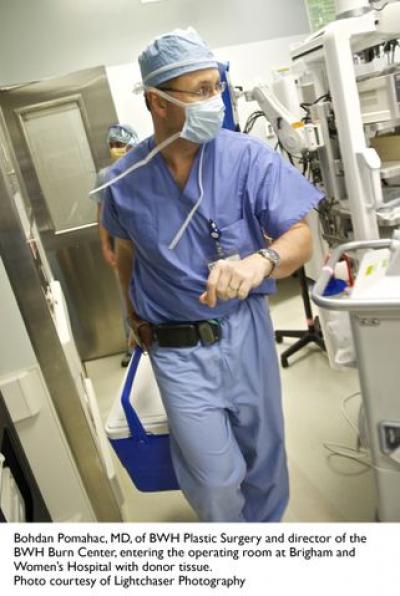
Boston, MA - In March 2011, a surgical team at Brigham and Women's Hospital (BWH) performed the first full face transplantation (FFT) in the United States and went on to complete a total of three FFTs this year. Now, in the first research publication to evaluate FFT in the US, and largest series worldwide, the researchers describe details of patient preparation, novel design and execution of the operation as well as unique immunosuppression protocol allowing for lowest long-term maintenance drug regimen. They also share details of the early functional outcomes and demonstrate FFT as a viable option in the treatment of severe facial deformities and injuries. This research is published in the New England Journal of Medicine in the December 27, 2011 issue.
"Unlike conventional reconstruction, facial transplantation seeks to transform severely deformed features to a near-normal appearance and function that conventional reconstructive plastic surgical techniques cannot match," said lead author Dr. Bohdan Pomahac, Director of the Plastic Surgery Transplantation Program at BWH and lead surgeon in all three FFT procedures. "It truly is a life-giving procedure for these patients."
In an effort to advance the field of face transplantation, Pomahac and colleagues document the novel processes involved in a successful face transplant program from screening candidates to the transplant procedure itself and the follow up management of the recipients.
Researchers describe the rigorous screening and consent process that each patient must pass, which includes evaluation by a team of physicians who determine whether the patient is physically and mentally prepared for the procedure through numerous clinical and psychological evaulations. Once a candidate is approved by the face transplant team and the Institutional Review Board at BWH, BWH physicians work closely with the New England Organ Bank (NEOB) to identify the criteria for suitable donors and the process for obtaining consent for this unique transplantation.
Next, researchers outline the details of the surgeries with a focus on the multi-disciplinary collaborative efforts of an entire team of clinicians. Surgeons and staff coordinate their tasks while preparing the recipient and simultaneously retrieving the donor tissue within a limited time frame. The researchers describe the similarities and difference between each procedure, noting the various differences that occurred in the one FFT recipient who also concurrently received a bilateral hand transplant.
Lastly, researchers explain the care of the recipient post-transplant. Following the surgery, physicians monitor and adjust immunosuppressants (anti-rejection medications) while methodically screening for any signs of organ rejection. The researchers discuss occurrences of single episodes of rejection in two patients, as well as describe other complications following surgery, like occurrence of infection. Pomahac and colleagues discuss how the transplanted tissue transformed and adapted to match the features of the recipient in each case.
"Our focus moving forward continues to be on monitoring and documenting the progress of patients who have undergone FFT, and refining the use of immunosuppressants, with the hope that one day patients will eventually need to take little or none," said Pomahac. We are also learning how brain reintegrates the new parts, and follow closely motor and sensory return. Important part of the study is also calculation of cost-effectiveness.
INFORMATION:
The Plastic Surgery Transplantation Program continues the rich history in transplantation at BWH, with the first successful human organ transplant occurring at the hospital in 1954, and this tradition continues with a current concentration on FFT, hand transplantation and many other innovations and research in the field of transplantation.
The study was funded by a research contract between the United States Department of Defense and Brigham and Women's Hospital under the Biomedical Translational Initiative Program.
Brigham and Women's Hospital (BWH) is a 793-bed nonprofit teaching affiliate of Harvard Medical School and a founding member of Partners HealthCare, an integrated health care delivery network. BWH is the home of the Carl J. and Ruth Shapiro Cardiovascular Center, the most advanced center of its kind. BWH is committed to excellence in patient care with expertise in virtually every specialty of medicine and surgery. The BWH medical preeminence dates back to 1832, and today that rich history in clinical care is coupled with its national leadership in quality improvement and patient safety initiatives and its dedication to educating and training the next generation of health care professionals. Through investigation and discovery conducted at its Biomedical Research Institute (BRI), www.brighamandwomens.org/research , BWH is an international leader in basic, clinical and translational research on human diseases, involving more than 900 physician-investigators and renowned biomedical scientists and faculty supported by more than $537 M in funding. BWH is also home to major landmark epidemiologic population studies, including the Nurses' and Physicians' Health Studies and the Women's Health Initiative. For more information about BWH, please visit www.brighamandwomens.org
Photos and Video available: http://tiny.cc/BWHFFT
"Unlike conventional reconstruction, facial transplantation seeks to transform severely deformed features to a near-normal appearance and function that conventional reconstructive plastic surgical techniques cannot match," said lead author Dr. Bohdan Pomahac, Director of the Plastic Surgery Transplantation Program at BWH and lead surgeon in all three FFT procedures. "It truly is a life-giving procedure for these patients."
In an effort to advance the field of face transplantation, Pomahac and colleagues document the novel processes involved in a successful face transplant program from screening candidates to the transplant procedure itself and the follow up management of the recipients.
Researchers describe the rigorous screening and consent process that each patient must pass, which includes evaluation by a team of physicians who determine whether the patient is physically and mentally prepared for the procedure through numerous clinical and psychological evaulations. Once a candidate is approved by the face transplant team and the Institutional Review Board at BWH, BWH physicians work closely with the New England Organ Bank (NEOB) to identify the criteria for suitable donors and the process for obtaining consent for this unique transplantation.
Next, researchers outline the details of the surgeries with a focus on the multi-disciplinary collaborative efforts of an entire team of clinicians. Surgeons and staff coordinate their tasks while preparing the recipient and simultaneously retrieving the donor tissue within a limited time frame. The researchers describe the similarities and difference between each procedure, noting the various differences that occurred in the one FFT recipient who also concurrently received a bilateral hand transplant.
Lastly, researchers explain the care of the recipient post-transplant. Following the surgery, physicians monitor and adjust immunosuppressants (anti-rejection medications) while methodically screening for any signs of organ rejection. The researchers discuss occurrences of single episodes of rejection in two patients, as well as describe other complications following surgery, like occurrence of infection. Pomahac and colleagues discuss how the transplanted tissue transformed and adapted to match the features of the recipient in each case.
"Our focus moving forward continues to be on monitoring and documenting the progress of patients who have undergone FFT, and refining the use of immunosuppressants, with the hope that one day patients will eventually need to take little or none," said Pomahac. We are also learning how brain reintegrates the new parts, and follow closely motor and sensory return. Important part of the study is also calculation of cost-effectiveness.
INFORMATION:
The Plastic Surgery Transplantation Program continues the rich history in transplantation at BWH, with the first successful human organ transplant occurring at the hospital in 1954, and this tradition continues with a current concentration on FFT, hand transplantation and many other innovations and research in the field of transplantation.
The study was funded by a research contract between the United States Department of Defense and Brigham and Women's Hospital under the Biomedical Translational Initiative Program.
Brigham and Women's Hospital (BWH) is a 793-bed nonprofit teaching affiliate of Harvard Medical School and a founding member of Partners HealthCare, an integrated health care delivery network. BWH is the home of the Carl J. and Ruth Shapiro Cardiovascular Center, the most advanced center of its kind. BWH is committed to excellence in patient care with expertise in virtually every specialty of medicine and surgery. The BWH medical preeminence dates back to 1832, and today that rich history in clinical care is coupled with its national leadership in quality improvement and patient safety initiatives and its dedication to educating and training the next generation of health care professionals. Through investigation and discovery conducted at its Biomedical Research Institute (BRI), www.brighamandwomens.org/research , BWH is an international leader in basic, clinical and translational research on human diseases, involving more than 900 physician-investigators and renowned biomedical scientists and faculty supported by more than $537 M in funding. BWH is also home to major landmark epidemiologic population studies, including the Nurses' and Physicians' Health Studies and the Women's Health Initiative. For more information about BWH, please visit www.brighamandwomens.org
Photos and Video available: http://tiny.cc/BWHFFT