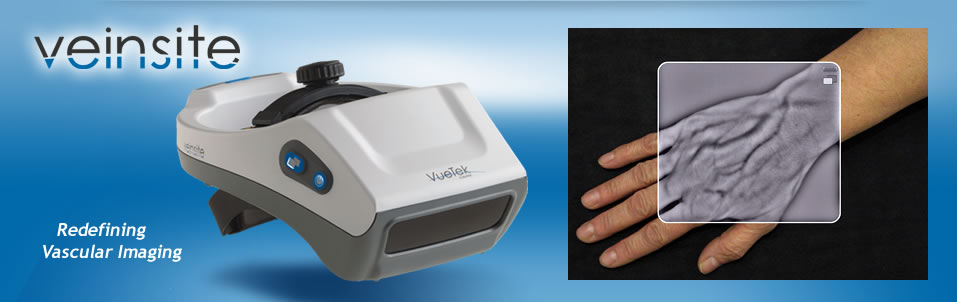
GRAY, MAINE, March 27, 2012 (Press-News.org) VueTek Scientific announced today that it has launched Veinsite, which is the only hands free and portable peripheral vascular imaging device. Veinsite is head worn, allowing clinicians' to be hands free in order to place IVs without changing standard clinical practice. In a recent clinical study, clinicians saw on average two additional veins with Veinsite than with the naked eye. The study included subjects who can present challenges to vascular access, including infants, children, elderly, obese and those with dark skin.
Veinsite allows clinicians to simply look at the anatomy where they want to see veins and find the ideal location to place an IV. Seeing more veins and making better access choices can reduce the number of attempts to place IVs, which minimizes infiltration, infection and central lines. These results improve pain initiative outcomes, patient satisfaction scores, save valuable time and reduce cost.
Veinsite's proprietary technology utilizes a headset display to provide a crisp, clear video image without compromise from ambient light, skin contours and imperfections. This ideal configuration provides the best image on the market. Veinsite is proudly made in the U.S.A.
Veinsite is being distributed in the United States to Hospitals and Oncology Centers by Alliance Medical, 800-862-4446. All other clinicians or institutions and those outside the United States should contact VueTek Scientific directly at www.vuetekscientific.com or call 207-657-6565.
VueTek Scientific, located in Gray Maine was founded in 2007 to develop and commercialize advanced imaging systems that address unmet clinical needs relating to vascular access. Clinicians or institutions not using Alliance Medical and those outside the United States should contact VueTek Scientific directly at www.vuetekscientific.com or call 207-657-6565.
VueTek Scientific Redefines Vascular Imaging with the Launch of Veinsite
VueTek Scientific announced today that it has launched Veinsite, which is the only hands free and portable peripheral vascular imaging device. Veinsite is head worn, allowing clinicians' to be hands free in order to place IVs.
2012-03-27
ELSE PRESS RELEASES FROM THIS DATE:
UGA researchers use nanoparticles, magnetic current to damage cancerous cells in mice
2012-03-27
Athens, Ga. – Using nanoparticles and alternating magnetic fields, University of Georgia scientists have found that head and neck cancerous tumor cells in mice can be killed in half an hour without harming healthy cells.
The findings, published recently in the journal Theranostics, mark the first time to the researchers' knowledge this cancer type has been treated using magnetic iron oxide nanoparticle-induced hyperthermia, or above-normal body temperatures, in laboratory mice.
"We show that we can use a small concentration of nanoparticles to kill the cancer cells," ...
Elder abuse remains hidden problem as baby boomers reach old age
2012-03-27
Despite the 2010 passage of the Elder Justice Act, policy experts have found that combating widespread abuse of seniors is still not a top priority for care providers and governments alike. As many as one in 10 people age 60 and over are affected by this problem, according to the newest Public Policy & Aging Report (PPAR) from the National Academy on an Aging Society, the policy institute of The Gerontological Society of America. U.S. Senator Herb Kohl (D-WI) and U.S. Representative Peter King (R-NY), who have been heavily involved in legislation to address elder abuse, ...
Wind turbines that learn like humans
2012-03-27
Depending on the weather, wind turbines can face whispering breezes or gale-force gusts. Such variable conditions make extracting the maximum power from the turbines a tricky control problem, but a collaboration of Chinese researchers may have found a novel solution in human-inspired learning models.
Most turbines are designed to produce maximum allowable power once winds reach a certain speed, called the rated speed. In winds above or below the rated speed, control systems can make changes to the turbine system, such as modifying the angle of the blades or the electromagnetic ...
ORNL process converts polyethylene into carbon fiber
2012-03-27
Common material such as polyethylene used in plastic bags could be turned into something far more valuable through a process being developed at the Department of Energy's Oak Ridge National Laboratory.
In a paper published in Advanced Materials, a team led by Amit Naskar of the Materials Science and Technology Division outlined a method that allows not only for production of carbon fiber but also the ability to tailor the final product to specific applications.
"Our results represent what we believe will one day provide industry with a flexible technique for producing ...
Writing graphene circuitry with ion 'pens'
2012-03-27
The unique electrical properties of graphene have enticed researchers to envision a future of fast integrated circuits made with the one-carbon-atom-thick sheets, but many challenges remain on the path to commercialization. Scientists from the University of Florida have recently tackled one of these challenges – how to reliably manufacture graphene on a large scale.
The team has developed a promising new technique for creating graphene patterns on top of silicon carbide (SiC). SiC comprises both silicon and carbon, but at high temperatures (around 1300 degrees Celcius) ...
Researchers create cellular automation model to study complex tumor-host role in cancer
2012-03-27
Cancer remains a medical mystery – despite all of the research efforts devoted to understanding and controlling it. The most sought-after tumor model is one that would be able to formulate theoretical and computational tools to predict cancer progression and propose individual treatment strategies.
To better understand the role complex tumor-host interactions play in tumor growth, Princeton University researchers developed a cellular automation model for tumor growth in heterogeneous microenvironments. They then used this same model to investigate the effects of pressure ...
Photoacoustics technique detects small number of cancer cells
2012-03-27
Researchers have developed multiple techniques and procedures to detect cancer cells during the earliest stages of the disease or after treatment. But one of the major limitations of these technologies is their inability to detect the presence of only a few cancer cells.
Now, a research collaboration between the University of Missouri-Columbia and Mexico's Universidad de Guanajuato shows that pulsed photoacoustic techniques, which combine the high optical contrast of optical tomography with the high resolution of ultrasound, can do just that, in vitro. Most cancer cells ...
Using game theory to understand the physics of cancer propagation
2012-03-27
In search of a different perspective on the physics of cancer, Princeton University and University of California, San Francisco researchers teamed up to use game theory to look for simplicity within the complexity of the dynamics of cooperator and cheater cells under metabolic stress conditions and high spatial heterogeneity. In the context of cancer, cooperator cells obey the general rules of communal survival, while cheater cells do not.
The ultimate goal of this research was to gain an understanding of the dynamics of cancer tumor evolution under stress. Since cancer ...
Bald Head Design Announces Social Media Service for Dentist. Social Media Marketing Could Save Your Practice Up to 90% In Advertising Costs
2012-03-27
Bald Head Design, Ohio based web design firm is helping dentist improve their communication between patients and their practices through the creation of social media outlets - Facebook and Twitter. By offering a comprehensive social media strategy, which includes not only the creation of these social media tools, but by also providing training and resources providing for a successful social media marketing campaign. Social media allows patients to connect and engage with both the dentists and their staff.
With over 500 million users, and growing, Facebook is becoming ...
Androgen suppression
2012-03-27
Androgen suppression – the inhibition of testosterone and other male hormones – is a routine therapy for prostate cancer. Unfortunately, it can dramatically reduce the quality of patients' sex lives and, more importantly, lead to cancer recurrence in a more deadly androgen-independent form. A new paper combining mathematical modeling with clinical data validates a different approach: cycling patients on and off treatment. Such intermittent androgen suppression alleviates most unwanted side effects and postpones the development of resistance to treatment. With the model, ...
LAST 30 PRESS RELEASES:
High‑performance all‑solid‑state magnesium-air rechargeable battery enabled by metal-free nanoporous graphene
Improving data science education using interest‑matched examples and hands‑on data exercises
Sparkling water helps keep minds sharp during long esports sessions
Drone LiDAR surveys of abandoned roads reveal long-term debris supply driving debris-flow hazards
UGA Bioinformatics doctoral student selected for AIBS and SURA public policy fellowship
Gut microbiome connected with heart disease precursor
Nitrous oxide, a product of fertilizer use, may harm some soil bacteria
FAU lands $4.5M US Air Force T-1A Jayhawk flight simulator
SimTac: A physics-based simulator for vision-based tactile sensing with biomorphic structures
Preparing students to deal with ‘reality shock’ in the workplace
Researchers develop beating, 3D-printed heart model for surgical practice
Black soldier fly larvae show promise for safe organic waste removal
People with COPD commonly misuse medications
How periodontitis-linked bacteria accelerate osteoporosis-like bone loss through the gut
Understanding how cells take up and use isolated ‘powerhouses’ to restore energy function
Ten-point plan to deliver climate education unveiled by experts
Team led by UC San Diego researchers selected for prestigious global cancer prize
Study: Reported crop yield gains from breeding may be overstated
Stem cells from human baby teeth show promise for treating cerebral palsy
Chimps’ love for crystals could help us understand our own ancestors’ fascination with these stones
Vaginal estrogen therapy not linked to cancer recurrence in survivors of endometrial cancer
How estrogen helps protect women from high blood pressure
Breaking the efficiency barrier: Researchers propose multi-stage solar system to harness the full spectrum
A new name, a new beginning: Building a green energy future together
From algorithms to atoms: How artificial intelligence is accelerating the discovery of next-generation energy materials
Loneliness linked to fear of embarrassment: teen research
New MOH–NUS Fellowship launched to strengthen everyday ethics in Singapore’s healthcare sector
Sungkyunkwan University researchers develop next-generation transparent electrode without rare metal indium
What's going on inside quantum computers?: New method simplifies process tomography
This ancient plant-eater had a twisted jaw and sideways-facing teeth
[Press-News.org] VueTek Scientific Redefines Vascular Imaging with the Launch of VeinsiteVueTek Scientific announced today that it has launched Veinsite, which is the only hands free and portable peripheral vascular imaging device. Veinsite is head worn, allowing clinicians' to be hands free in order to place IVs.