PRESS-NEWS.org - Press Release Distribution
PRESS RELEASES DISTRIBUTION

NASA sees Nadine weaken to a tropical storm again

NASA sees Nadine weaken to a tropical storm again
2012-10-02
(Press-News.org) NASA satellites continue to watch the long-lived Nadine in the eastern Atlantic. Today, Oct. 1, NASA satellite data revealed that Nadine has weakened from a hurricane and is now a tropical storm.

Over the weekend of Sept. 29 and 30, Hurricane Nadine dramatically rebounded. On September 19, 2012 Nadine appeared to be dissipating quickly and was expected to become post-tropical but after over a week of meandering near the Azores, Nadine sprang to life again as a hurricane on Friday September 28, 2012.

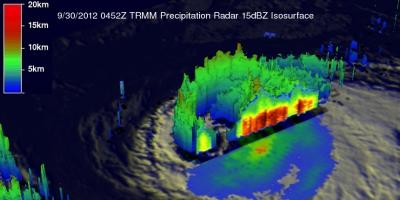
NASA's Tropical Rainfall Measuring Mission (TRMM) satellite's path took it almost directly above hurricane Nadine on Sept. 30 at 0452 UTC (12:52 a.m. EDT) when it was still a hurricane.

At NASA's Goddard Space Flight Center in Greenbelt, Md. an enhanced infrared image from TRMM's Visible and InfraRed Scanner (VIRS) was overlaid with a rainfall analysis derived from TRMM's TRMM Microwave Imager (TMI) and Precipitation Radar (PR). The final image revealed that Nadine had a well-defined but ragged eye with the heaviest rainfall of about 50mm/hour (~2 inches) located on the western side of the hurricane.

TRMM PR data were used to also create a 3-D view from the northeast that showed convective thunderstorms in the northwestern part of the hurricane were reaching to heights of about 12km (~7.5 miles).

On Oct. 1 at 11 a.m. EDT, the center of Tropical Storm Nadine was 690 miles (1,110 km) west of the Azores near latitude 35.8 north and longitude 39.2 west. Maximum sustained winds have decreased to near 70 mph (110 kph). Nadine is moving toward the south-southeast near 5 mph (7 kph) and expected to do a counter-clockwise loop over the next day, turning southeast and east.

A Tropical Storm Watch is again in effect for the Azores.

Satellite data reveals that the strongest thunderstorms within Nadine are in the northern and eastern quadrants. Wind shear is increasing and sea surface temperatures are below the 80 degree Fahrenheit (26.6 Celsius) threshold needed to keep a tropical storm going, so weakening is expected.

Infrared imagery from NASA's Atmospheric Infrared Sounder (AIRS) instrument aboard the Aqua satellite show that sea surface temperatures near Nadine are around 23 Celsius (73.4 Fahrenheit), too cold to maintain a tropical storm.

According to the National Hurricane Center, tropical storm conditions are possible in the Azores by late Wednesday, Oct. 3.


INFORMATION:


[Attachments] See images for this press release:
NASA sees Nadine weaken to a tropical storm again

ELSE PRESS RELEASES FROM THIS DATE:

NASA observes another tropical depression birth in northwestern Pacific

NASA observes another tropical depression birth in northwestern Pacific
2012-10-02
The twenty-first tropical depression of the northwestern Pacific Ocean was born as a NASA satellite flew overhead on Oct. 1, capturing its "baby picture" in infrared light. On Monday, Oct. 1 at 1500 UTC (11 a.m. EDT), Tropical Depression 21W (TD21W) had maximum sustained winds near 25 knots. It was centered about300 nautical miles south of Hong Kong, near 17.4 North latitude and 114.8 East longitude. TD21W has tracked northward at 5 knots and is expected to curve to the northwest and west. On Oct. 1, 2012, infrared imagery from the Atmospheric Infrared Sounder (AIRS) ...

Tropical Storm Maliksi forms, Iwo To on guard

Tropical Storm Maliksi forms, Iwo To on guard
2012-10-02
The western North Pacific is in full swing, tropically speaking and NASA observed the birth of Tropical Storm Maliksi on Sept. 30. NASA's Aqua satellite captured an infrared image of the storm when it was a depression and revealed a large area of powerful thunderstorms around its center that hinted at its strengthening. Tropical Storm Maliksi formed from the twentieth tropical depression of the western North Pacific typhoon season. Tropical Depression 20W formed on Sept. 20 about 305 nautical miles from Guam near 16.3 North and 149.0 East. It is moving to the north-northwest ...

Digital mammography improves population-based breast cancer screening

2012-10-02
OAK BROOK, Ill. – New research from the Netherlands shows that the switch from screen film mammography (SFM) to digital mammography (DM) in large, population-based breast cancer screening programs improves the detection of life-threatening cancer without significantly increasing detection of clinically insignificant disease. Results of the study are published online in the journal Radiology. DM's higher sensitivity at detecting breast cancer raised concerns that its introduction into screening programs would increase the diagnosis of clinically unimportant cancers—cancers ...

Novel MRI technique could reduce breast biopsies

2012-10-02
OAK BROOK, Ill. – Water diffusion measurements with MRI could decrease false-positive breast cancer results and reduce preventable biopsies, according to a new study published online in the journal Radiology. Researchers said the technique also could improve patient management by differentiating high-risk lesions requiring additional workup from other non-malignant subtypes. Dynamic contrast-enhanced MRI (DCE-MRI) has emerged in recent years as a useful tool in breast cancer detection and staging. One of its primary limitations is a substantial number of false-positive ...

PETA scientists analyze animal use in HPV chemicals challenge program

2012-10-02
Washington — In an article published today (October 2, 2012) in the peer-reviewed journal Environmental Health Perspectives (EHP), People for the Ethical Treatment of Animals reports that the U.S. Environmental Protection Agency (EPA) High Production Volume (HPV) Chemicals Challenge Program had the potential to use 3.5 million animals in new testing, but after the application of animal-saving measures, approximately 127,000 were actually used. Although this toll in animal lives is high, it would have been many times worse had PETA not obtained major concessions from the ...

Provincial effort to improve stroke care in Alberta is 'paying off'

2012-10-02
Stroke care has improved considerably in Alberta following the implementation of the Alberta Provincial Stroke Strategy (APSS), leading to more targeted patient care and fewer health complications, according to a study presented today at the Canadian Stroke Congress. Nearly 97 per cent of stroke patients received a brain-imaging scan during their admission to hospital in 2011, compared to 88 per cent before the APSS was implemented in 2006. "The faster a patient has access to brain imaging, the faster they get the right diagnosis and the right treatment," says lead ...

Sleep apnea plays dual role in stroke

2012-10-02
Improvements to the diagnosis and screening of sleep apnea are critical to stroke prevention, according to new stroke care guidelines released today at the Canadian Stroke Congress. Obstructive sleep apnea, a disorder where the flow of air to the brain pauses or decreases during sleep, is both a risk factor for stroke and a complication following stroke, according to the Canadian Best Practice Recommendations for Stroke Care. Among the general population sleep apnea increases the likelihood of having a stroke, even after controlling for other stroke risk factors, such ...

Smoking clouds the brain after stroke

2012-10-02
A study of stroke patients from Southern Ontario found those who smoke have more difficulty with problem-solving and decision-making than non-smokers. The study, presented today at the Canadian Stroke Congress, tested mental abilities of 76 patients, including 12 smokers, with an average age of 67.5 years, using the Montreal Cognitive Assessment (MoCA) tool. The MoCA exam tests patients with memory and problem solving questions and gives them a score out of 30. Smokers had a median MoCA score two points lower than non-smokers -- 22 out of 30 compared to 24 out of 30. ...

Expand telestroke in all provinces to save lives, reduce disability

2012-10-02
Widespread use of telestroke -- two-way audiovisual linkups between neurologists in stroke centres and emergency rooms in underserved and rural areas -- would save lives, reduce disability and cut health-care costs in all parts of Canada, according to a major national report released today at the Canadian Stroke Congress. However, despite repeated research that shows telestroke delivers quality stroke care to underserviced areas, few stroke patients in Canada are benefiting from this lifesaving service. "The case for telestroke is compelling and the need is urgent," ...

Alzheimer's disease in men linked to low levels of hormone, IGF-1

2012-10-02
Chevy Chase, MD— Low serum levels of insulin-like growth factor-1 (IGF-1) and insulin-like growth factor binding protein-3 (IGFBP-3) are associated with Alzheimer's Disease in men, but not women, according to a recent study accepted for publication in The Endocrine Society's Journal of Clinical Endocrinology & Metabolism (JCEM). IGF-1 and IGFBP-3 are involved in longevity and could be beneficial to cognition, especially in Alzheimer's disease where experimental studies have shown that IGF-1 opposes the main pathological processes of Alzheimer's disease. The current study ...

LAST 30 PRESS RELEASES:

Electrodes created using light

Second-hand gift-giving is a well-deliberated decision

How human interaction drove evolution to make bears less aggressive

National Poll: Few parents offer teens guidance on healthy eating during holiday season

Cannabis derivatives could provide new ovarian cancer treatments

Raising strong yeast as a petroleum substitute

Clues to the origin of hot Jupiters hidden in their orbits

Canada’s reduced pledge to Global Fund will impact domestic health

1 in 4 children with major traumatic injuries not cared for in pediatric trauma centres

Duke and Duke-NUS’ joint cross-population research to uncover "East-West" differences in disease and care

Scientists to ‘spy’ on cancer- immune cell interactions using quantum technology breakthrough

Tech savvy users have most digital concerns

Making lighter work of calculating fluid and heat flow

Normalizing blood sugar can halve heart attack risk

Lowering blood sugar cuts heart attack risk in people with prediabetes

Study links genetic variants to risk of blinding eye disease in premature infants

Non-opioid ‘pain sponge’ therapy halts cartilage degeneration and relieves chronic pain

AI can pick up cultural values by mimicking how kids learn

China’s ecological redlines offer fast track to 30 x 30 global conservation goal

Invisible indoor threats: emerging household contaminants and their growing risks to human health

Adding antibody treatment to chemo boosts outcomes for children with rare cancer

Germline pathogenic variants among women without a history of breast cancer

Tanning beds triple melanoma risk, potentially causing broad DNA damage

Unique bond identified as key to viral infection speed

Indoor tanning makes youthful skin much older on a genetic level

Mouse model sheds new light on the causes and potential solutions to human GI problems linked to muscular dystrophy

The Journal of Nuclear Medicine ahead-of-print tip sheet: December 12, 2025

Smarter tools for peering into the microscopic world

Applications open for funding to conduct research in the Kinsey Institute archives

Global measure underestimates the severity of food insecurity

[Press-News.org] NASA sees Nadine weaken to a tropical storm again