PRESS-NEWS.org - Press Release Distribution
PRESS RELEASES DISTRIBUTION

Swimming microorganisms stir things up, and the LHC takes over

Tiny creatures may play a crucial role in mixing ocean nutrients

Swimming microorganisms stir things up, and the LHC takes over
2010-10-11
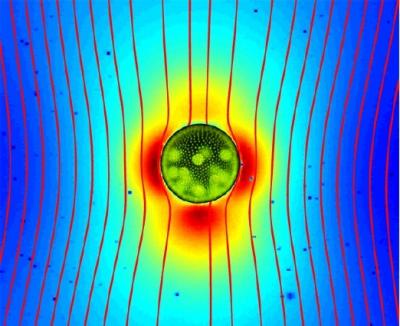
(Press-News.org) Two separate research groups are reporting groundbreaking measurements of the fluid flow that surrounds freely swimming microorganisms. Experiments involving two common types of microbes reveal the ways that one creature's motion can affect its neighbors, which in turn can lead to collective motions of microorganism swarms. In addition, the research is helping to clarify how the motions of microscopic swimmers produces large scale stirring that distributes nutrients, oxygen and chemicals in lakes and oceans. A pair of papers describing the experiments will appear in the October 11 issue of the APS journal Physical Review Letters.

In order to observe the flow that microorganisms produce, researchers at the University of Cambridge tracked the motion of tiny tracer beads suspended in the fluid surrounding the tiny swimmers. They used the technique to study the fluid around two very different types of creatures: a small, blue-green form of algae called Chlamydomonas reinhardtii that swims by paddling with a pair of whip-like flagella, and the larger, spherical alga Volvox carterii that propels itself with thousands of flagella covering its surface. The tracer beads showed that the two types of organisms generate distinctly different flow patterns, both of which are much more complex than previously assumed. In a related study performed at Haverford College in Pennsylvania, researchers used a high speed camera to track the flow of tracer particles around Chlamydomonas in a thin, two-dimension film of fluid over the course of a single stroke of its flagella.

The studies should help scientists develop new models to predict the fluid motions associated with aquatic microorganisms. The models will provide clearer pictures of the ways microbes mix bodies of water, and potentially offer insights into the role plankton plays in the carbon cycle as it stirs the world's oceans. David Saintillan (University of Illinois at Urbana Champagne) gives an overview of the microorganism swimming research in a Viewpoint article in the October 11 edition of APS Physics (physics.aps.org). Advance copies of the Physical Review Letters articles and the related Physics Viewpoint are available to journalists on request.

Also in Physics: LHC takes the reins of high energy particle physics

The Large Hadron Collider (LHC) has just begun collecting data from colliding bunches of protons, and is still running at only half its design limits, but after a few months of operation it has already surpassed some of the major accomplishments of its predecessor – the Fermilab particle accelerator laboratory in Batavia Illinois. The LHC's first achievements put tighter limits on extensions of the highly successful Standard Model of physics, which describes the currently known subatomic particles. A Synopsis describing the landmark publication of the LHC's early results will appear in the October 11 edition of Physics. Advance copies of the Physical Review Letters article describing the research, and the associated Physics Synopsis, are available on request.


INFORMATION:


About Physics:

Physics (http://physics.aps.org) is a production of the American Physical Society that provides expert written commentaries and highlights of papers appearing in the Society's journals.


[Attachments] See images for this press release:
Swimming microorganisms stir things up, and the LHC takes over

ELSE PRESS RELEASES FROM THIS DATE:

Novocure reports data showing TTF therapy in combination with chemotherapy has the potential to increase overall survival for patients with advanced non-small cell lung cancer

2010-10-11
### ABOUT NOVOCURE Novocure is a subsidiary of Jersey Isle based Standen Ltd., an oncology company pioneering tumor treating fields (TTF) therapy, a new modality for treating solid tumors. Novocure’s US operations are based in Portsmouth, NH and the company’s research center is located in Haifa, Israel. For additional information about Novocure, please visit www.novocuretrial.com. EDITORS NOTE: High resolution device photos available by request. 1Nasser Hanna et al; "Randomized Phase III Trial of Pemetrexed versus Docetaxel in Patients with Non-Small-Cell Lung Cancer ...

Research discovers how the deaf have super vision

Research discovers how the deaf have super vision
2010-10-11
Deaf or blind people often report enhanced abilities in their remaining senses, but up until now, no one has explained how and why that could be. Researchers at The University of Western Ontario, led by Stephen Lomber of The Centre for Brain and Mind have discovered there is a causal link between enhanced visual abilities and reorganization of the part of the brain that usually handles auditory input in congenitally deaf cats. The findings, published online in Nature Neuroscience, provide insight into the plasticity that may occur in the brains of deaf people. Cats ...

Scripps Research study challenges conventional theory of modern drug design

2010-10-11
JUPITER, Fl, October 7, 2010 – Scientists from The Scripps Research Institute have uncovered new evidence that challenges the current theory about a process key to the way modern drugs are designed and how they work in the human body. The new study was published October 10, 2010 in an advance, online edition of the journal Nature Chemical Biology. Currently, the theory about ligands – compounds that bind to proteins and trigger a specific biological action – and how they bind to proteins runs along the lines of a one person-one vote paradigm. Ligands are considered ...

Gladstone scientists link hepatitis C virus infection to fat enzyme in liver cells

2010-10-11
SAN FRANCISCO, CA—October 10, 2010—Scientists at the Gladstone Institute of Virology and Immunology (GIVI) have found that an enzyme associated with the storage of fat in the liver is required for the infectious activity of the hepatitis C virus (HCV). This discovery may offer a new strategy for treating the infection. More than 160 million people are infected throughout the world, and no vaccine is available to prevent further spread of the disease. Current treatments are not effective against the most common strains in the US and Europe. The study, published in the ...

Scientists watch cell-shape process for first time

2010-10-11
Palo Alto, CA—Researchers at the Carnegie Institution for Science, with colleagues at the Nara Institute of Science and Technology, observed for the first time a fundamental process of cellular organization in living plant cells: the birth of microtubules by studying recruitment and activity of individual protein complexes that create the cellular protein network known as the microtubule cytoskeleton—the scaffolding that provides structure and ultimately form and shape to the cell. These fundamental results could be important to agricultural research and are published in ...

Virtual research institute needed to unlock RNA's promise

2010-10-11
Strasbourg, 11 October 2010 - A Europe-wide network of labs focusing on RNA research is needed to make the most of RNA's high potential for treating a wide range of diseases. The recommendation for this virtual research institute comes from a panel of biologists at the European Science Foundation in a report published today, 'RNA World: a new frontier in biomedical research'. Ten years on from the human genome project, RNA (ribonucleic acid) has stolen some of DNA's limelight. The basic ingredient of our genes, DNA long outshone the other form of genetic material in our ...

Studies provide new insights into the genetics of obesity and fat distribution

2010-10-11
An international consortium has made significant inroads into uncovering the genetic basis of obesity by identifying 18 new gene sites associated with overall obesity and 13 that affect fat distribution. The studies include data from nearly a quarter of a million participants, the largest genetic investigation of human traits to date. The papers, both from the GIANT (Genetic Investigation of ANthropometric Traits) consortium – which consists of more than 400 scientists from 280 research institutions worldwide – will appear in Nature Genetics and are receiving early online ...

Tsunami risk higher in Los Angeles, other major cities

2010-10-11
Geologists studying the Jan. 12 Haiti earthquake say the risk of destructive tsunamis is higher than expected in places such as Kingston, Istanbul, and Los Angeles. Like Haiti's capital, these cities all lie near the coast and near an active geologic feature called a strike-slip fault where two tectonic plates slide past each other like two hands rubbing against each other. Until now, geologists did not consider the tsunami risk to be very high in these places because when these faults rupture, they usually do not vertically displace the seafloor much, which is how ...

Rutgers discovery paves way for development of efficient, inexpensive plastic solar cells

2010-10-11
NEW BRUNSWICK, N.J. – Physicists at Rutgers University have discovered new properties in a material that could result in efficient and inexpensive plastic solar cells for pollution-free electricity production. The discovery, posted online and slated for publication in an upcoming issue of the journal Nature Materials, reveals that energy-carrying particles generated by packets of light can travel on the order of a thousand times farther in organic (carbon-based) semiconductors than scientists previously observed. This boosts scientists' hopes that solar cells based on ...

Land 'evapotranspiration' taking unexpected turn: huge parts of world are drying up

2010-10-11
CORVALLIS, Ore. – The soils in large areas of the Southern Hemisphere, including major portions of Australia, Africa and South America, have been drying up in the past decade, a group of researchers conclude in the first major study to ever examine "evapotranspiration" on a global basis. Most climate models have suggested that evapotranspiration, which is the movement of water from the land to the atmosphere, would increase with global warming. The new research, published online this week in the journal Nature, found that's exactly what was happening from 1982 to the ...

LAST 30 PRESS RELEASES:

Korea University, Stanford University, and IESGA launch Water Sustainability Index to combat ESG greenwashing

Molecular glue discovery: large scale instead of lucky strike

Insulin resistance predictor highlights cancer connection

Explaining next-generation solar cells

Slippery ions create a smoother path to blue energy

Magnetic resonance imaging opens the door to better treatments for underdiagnosed atypical Parkinsonisms

National poll finds gaps in community preparedness for teen cardiac emergencies

One strategy to block both drug-resistant bacteria and influenza: new broad-spectrum infection prevention approach validated

Survey: 3 in 4 skip physical therapy homework, stunting progress

College students who spend hours on social media are more likely to be lonely – national US study

Evidence behind intermittent fasting for weight loss fails to match hype

How AI tools like DeepSeek are transforming emotional and mental health care of Chinese youth

Study finds link between sugary drinks and anxiety in young people

Scientists show how to predict world’s deadly scorpion hotspots

ASU researchers to lead AAAS panel on water insecurity in the United States

ASU professor Anne Stone to present at AAAS Conference in Phoenix on ancient origins of modern disease

Proposals for exploring viruses and skin as the next experimental quantum frontiers share US$30,000 science award

ASU researchers showcase scalable tech solutions for older adults living alone with cognitive decline at AAAS 2026

Scientists identify smooth regional trends in fruit fly survival strategies

Antipathy toward snakes? Your parents likely talked you into that at an early age

Sylvester Cancer Tip Sheet for Feb. 2026

Online exposure to medical misinformation concentrated among older adults

Telehealth improves access to genetic services for adult survivors of childhood cancers

Outdated mortality benchmarks risk missing early signs of famine and delay recognizing mass starvation

Newly discovered bacterium converts carbon dioxide into chemicals using electricity

Flipping and reversing mini-proteins could improve disease treatment

Scientists reveal major hidden source of atmospheric nitrogen pollution in fragile lake basin

Biochar emerges as a powerful tool for soil carbon neutrality and climate mitigation

Tiny cell messengers show big promise for safer protein and gene delivery

AMS releases statement regarding the decision to rescind EPA’s 2009 Endangerment Finding

[Press-News.org] Swimming microorganisms stir things up, and the LHC takes over
Tiny creatures may play a crucial role in mixing ocean nutrients