PRESS-NEWS.org - Press Release Distribution
PRESS RELEASES DISTRIBUTION

New strategy for fingerprint visualization developed at Hebrew University

New strategy for fingerprint visualization developed at Hebrew University
2012-11-06
(Press-News.org) Jerusalem, Nov. 6, 2012 -- Identifying fingerprints on paper is a commonly used method in police forensic work, but unfortunately it is not easy to make those fingerprints visible. Now, scientists at the Hebrew University of Jerusalem have developed a new approach for making such fingerprints more readily readable.

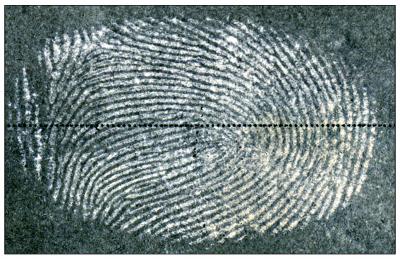
The new method, created by a team headed by Prof. Yossi Almog and Prof. Daniel Mandler of the Institute of Chemistry at the Hebrew University, uses an innovative chemical process to produce a negative of the fingerprint image rather than the positive image produced under current methods. Unlike the latter, the Hebrew University-developed process is nearly independent of the composition of the sweat residue left behind on the paper.

The new method is described in the current issue of the international, English-language edition of the journal Angewandte Chemie, published by the German Chemical Society.

In many criminal investigations, paper evidence plays an important role, and it is useful to know who has handled such documents as checks, paper currency, notes, etc. Studies have shown that less than half of the fingerprints on paper items can be made sufficiently visible to enable their identification. The main reason for this seems to be the highly variable composition of the sweat left behind on the paper.

The new procedure developed at the Hebrew University avoids these problems. It involves an inversion of an established method in which gold nanoparticles are first deposited onto the invisible fingerprints, followed by elemental silver, similar to the development of a black and white photograph.

In the conventional technique, the gold particles get stuck to the amino acid components of the sweat in the fingerprints, and then silver is deposited onto the gold. The result is quite often low-contrast impressions of the fingerprints. In the new method, the gold nanoparticles stick directly to the paper surface, but not the sweat. This technique utiliizes the sebum from the fingerprints as a medium to avoid this interference. (Sebum is an oily substance secreted by the sebaceous glands that helps prevent hair and skin from drying out.) Treatment with a developer containing silver then turns the areas with gold on them black, resulting in a clear, negative image of the fingerprint.

"Since our method relies only on the fatty components in the fingerprints, the sweaty aspects play no role in the imaging process," said Prof. Almog. This technique also promises to alleviate another problem, he said. "If paper has become wet, it has previously been difficult to detect fingerprints because the amino acids in the sweat, which are the primary substrate for current chemical enhancement reactions, are dissolved and washed away by water, whereas the fatty components are barely affected." Thus, the avoidance of the sweat aspect provides a further enhancement for police laboratory investigation, he observed.


INFORMATION:


[Attachments] See images for this press release:
New strategy for fingerprint visualization developed at Hebrew University

ELSE PRESS RELEASES FROM THIS DATE:

Strange diet for methane consuming microorganisms

Strange diet for methane consuming microorganisms
2012-11-06
This press release is available in German. Methane is formed under the absence of oxygen by natural biological and physical processes, e.g. in the sea floor. It is a much more powerful greenhouse gas than carbon dioxide. Thanks to the activity of microorganisms this gas is inactivated before it reaches the atmosphere and unfolds its harmful effects on Earth's climate. Researchers from Bremen have now proven that these microorganisms are quite picky about their diet. All life on Earth is based on carbon and its compounds. Cell components of all creatures contain carbon. ...

Early treatment sparks striking brain changes in autism

2012-11-06
When given early treatment, children with autism spectrum disorders (ASD) made significant improvements in behavior, communication, and most strikingly, brain function, Yale School of Medicine researchers report in a new study. The study was published in the current issue of the Journal of Autism and Developmental Disorders by Yale Child Study Center researchers Fred Volkmar, M.D., Kevin A. Pelphrey, and their colleagues. The results suggest that brain systems supporting social perception respond well to an early intervention behavioral program called pivotal response ...

HF patients treated by a cardiologist, rather than hospitalist, have fewer readmissions

2012-11-06
MINNEAPOLIS, MN – November 6, 2012 – When a cardiologist attends to heart failure patients, even when the severity of illness is higher, patients have reduced rates of hospital readmissions, compared with those patients who are treated by a hospitalist, according to a trial being presented today at the American Heart Association's scientific sessions in Los Angeles. Congestive heart failure (CHF) is the most common cause for hospital readmission in patients over the age of 65 years. Whereas efforts to reduce readmission rates have focused on transitions of care and short-term ...

Living abroad can bring success -- If you do it right

Living abroad can bring success -- If you do it right
2012-11-06
"Travel broadens the mind" goes the old adage, and potential employers often agree, valuing the open-mindedness and creativity fostered by such worldliness. But according to new Tel Aviv University research, not all international experiences are created equal. "Although living abroad does help to hone creative abilities, not all individuals who have lived abroad derive an equal benefit from such experiences," explains Dr. Carmit Tadmor of TAU's Recanati School of Business, who conducted the study with Dr. Adam Galinsky of the Kellogg School of Management at Northwestern ...

Team finds a new way to inhibit blood clotting and inflammation

Team finds a new way to inhibit blood clotting and inflammation
2012-11-06
CHAMPAIGN, lll. — Scientists have identified a group of small molecules that interfere with the activity of a compound that initiates multiple steps in blood clotting, including those that lead to the obstruction of veins or arteries, a condition called thrombosis. Blocking the activity of this compound, polyphosphate, could treat thrombosis with fewer bleeding side effects than the drugs that are currently on the market. Their findings appear in the journal Blood. Blood clots are formed at the site of an injured blood vessel to prevent blood loss. Sometimes, however, ...

New study reveals challenge facing designers of future computer chips

2012-11-06
To build the computer chips of the future, designers will need to understand how an electrical charge behaves when it is confined to metal wires only a few atom-widths in diameter. Now, a team of physicists at McGill University, in collaboration with researchers at General Motors R&D, have shown that electrical current may be drastically reduced when wires from two dissimilar metals meet. The surprisingly sharp reduction in current reveals a significant challenge that could shape material choices and device design in the emerging field of nanoelectronics. The size of ...

ICDs can reduce sudden death in young patients with hypertrophic cardiomyopathy

2012-11-06
MINNEAPOLIS, MN – November 5, 2012 – A multicenter registry has demonstrated that the use of implantable cardioverter-defibrillators (ICDs) to combat sudden cardiac death in high-risk pediatric patients suffering from hypertrophic cardiomyopathy (HCM). The study is being presented Nov. 5 at the 2012 Scientific Sessions of the American Heart Association (AHA) in Los Angeles. While the study found that the rate of possible device complications adds a level of complexity to this age group, it also demonstrated that life-saving ICD interventions were common in younger patients ...

Higher anxiety associated with poorer functioning in children with 22q11.2 deletion syndrome

2012-11-06
UC Davis researchers have found that for children with the genetic disorder known as chromosome 22q11.2 deletion syndrome anxiety -- but not intelligence -- is linked to poorer adaptive behaviors, such as self-care and communication skills, that affect daily life. The developmental syndrome, which is associated with a constellation of physical, cognitive and psychiatric problems, usually is apparent at birth or early childhood, and leads to lifelong challenges. The study findings suggest that helping children cope with fear-based symptoms may be the best strategy for ...

Overweight patients hospitalized with pneumonia more apt to survive

2012-11-06
Medical researchers at the University of Alberta studied the records of nearly 1000 patients who were admitted to hospital with pneumonia and noted those who were obese were more apt to survive compared to those who were of normal weight. For their research study, the team examined the records of 907 patients with pneumonia who were admitted to six Edmonton hospitals and also had their body mass index recorded. Two-thirds of the patients had severe pneumonia and 79 died in hospital. Of those who died, 12 were under weight, 36 were normal weight, 21 were overweight and ...

Older adults who are frail much more likely to be food insufficient, according to national study

2012-11-06
CORVALLIS, Ore. – A national study of older Americans shows those who have limited mobility and low physical activity – scientifically categorized as "frail" – are five times more likely to report that they often don't have enough to eat, defined as "food insufficiency," than older adults who were not frail. The nationally representative study of more than 4,700 adults older than age 60 in the United States uses data from the Third National Health and Nutrition Examination Survey. The results are online today in the British Journal of Nutrition. Lead author Ellen Smit, ...

LAST 30 PRESS RELEASES:

CU Anschutz School of Medicine receives best ranking in NIH funding in 20 years

Mayo Clinic opens patient information office in Cayman Islands

Phonon lasers unlock ultrabroadband acoustic frequency combs

Babies with an increased likelihood of autism may struggle to settle into deep, restorative sleep, according to a new study from the University of East Anglia.

National Reactor Innovation Center opens Molten Salt Thermophysical Examination Capability at INL

International Progressive MS Alliance awards €6.9 million to three studies researching therapies to address common symptoms of progressive MS

Can your soil’s color predict its health?

Biochar nanomaterials could transform medicine, energy, and climate solutions

Turning waste into power: scientists convert discarded phone batteries and industrial lignin into high-performance sodium battery materials

PhD student maps mysterious upper atmosphere of Uranus for the first time

Idaho National Laboratory to accelerate nuclear energy deployment with NVIDIA AI through the Genesis Mission

Blood test could help guide treatment decisions in germ cell tumors

New ‘scimitar-crested’ Spinosaurus species discovered in the central Sahara

“Cyborg” pancreatic organoids can monitor the maturation of islet cells

Technique to extract concepts from AI models can help steer and monitor model outputs

Study clarifies the cancer genome in domestic cats

Crested Spinosaurus fossil was aquatic, but lived 1,000 kilometers from the Tethys Sea

MULTI-evolve: Rapid evolution of complex multi-mutant proteins

A new method to steer AI output uncovers vulnerabilities and potential improvements

Why some objects in space look like snowmen

Flickering glacial climate may have shaped early human evolution

First AHA/ACC acute pulmonary embolism guideline: prompt diagnosis and treatment are key

Could “cyborg” transplants replace pancreatic tissue damaged by diabetes?

Hearing a molecule’s solo performance

Justice after trauma? Race, red tape keep sexual assault victims from compensation

Columbia researchers awarded ARPA-H funding to speed diagnosis of lymphatic disorders

James R. Downing, MD, to step down as president and CEO of St. Jude Children’s Research Hospital in late 2026

A remote-controlled CAR-T for safer immunotherapy

UT College of Veterinary Medicine dean elected Fellow of the American Academy of Microbiology

AERA selects 34 exemplary scholars as 2026 Fellows

[Press-News.org] New strategy for fingerprint visualization developed at Hebrew University